Best Dream Interpretation Apps 2026: 12 AI Dream Tools Compared
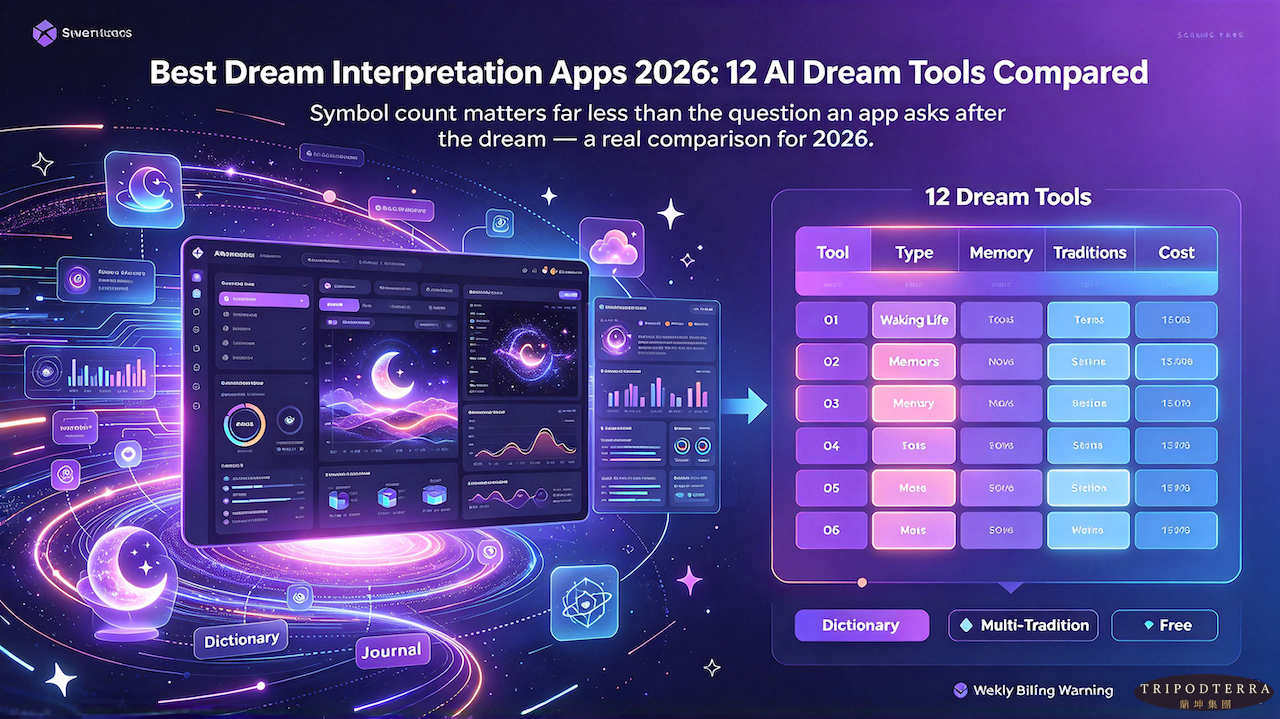
Most dream apps are a dream journal with an AI attached, and the difference between them is what that AI does with a symbol: whether it hands back a dictionary entry and stops, or asks what the image means to the particular dreamer. This comparison covers twelve tools — the dictionary apps with the largest symbol libraries, the journal-first apps, the multi-tradition interpreters, and the genuinely free options — measured against four criteria: whether the app asks about waking life, whether it remembers previous dreams, how many traditions it draws on, and what a year of use actually costs. TripodTerra is our own platform and is labelled as such throughout. Two findings worth stating up front: symbol count matters far less than the question an app asks after the dream, and weekly billing is the worst deal in the category.
18 readsOctober 4, 2026
Contents
🧑
Free BaZi Chart
Enter birth info, get your BaZi chart + Five Elements analysis
Every dream app on the store is a journal with an AI attached. What separates them is what that AI does when you hand it a symbol — and that difference decides whether the app is worth keeping or is a dictionary behind a paywall.
The distinction is easy to state and hard to find in a product listing. A dictionary app returns an entry: snake = transformation, teeth = anxiety. That answer is not wrong, but it is the same answer for everyone, which means it cannot be a reading. An interpretation app asks what that image meant to you before it tells you what the image means in general — because in every serious dream tradition, including 周公解梦, the reading is the symbol applied to a specific person's specific week, not the symbol alone.
Share
Daily Fortune Newsletter
One daily BaZi reading, straight to your inbox. Free, unsubscribe anytime.
This guide compares twelve tools against that distinction and three others, and it names our own platform, so the disclosure is at the top rather than buried: TripodTerra is ours. It is labelled in the table and in its own section, and where a competitor does something we do not, we have written that down too.
1. How we evaluated these apps
1. Does it ask the dreamer anything? The single strongest predictor of whether an interpretation lands. An app that asks about your waking week is doing something categorically different from one that returns a paragraph. Our snake dream article makes the case in full: the same snake, in the same position, reads differently depending on what was happening during the day, and any tool that ignores that is generating horoscope filler with a dream photo attached.
2. Does it remember the previous dream? Recurring imagery is where dreams become legible. A journal that cannot compare this month's dreams to last month's is a notebook, not an interpreting tool. This is the technical feature that most cleanly separates 2026's apps, because long-term memory is genuinely hard to build and easy to skip.
3. Symbol coverage, honestly measured. Several apps advertise enormous dictionaries. Size matters less than it is marketed as — 15,000 entries the app does not contextualise are worth less than 800 it reads against your week — but coverage is still the baseline for looking up a specific image at 3am.
4. What a year costs. Dream-interpretation pricing is unusually fragmented, and the same app often lists several plan names at overlapping prices. Where the store showed multiple figures, we report the range and the tier structure rather than picking one number.
A note on ratings. Store ratings for this category are unstable and sources disagree sharply — one tracker showed an app at 4.6 from 3,863 ratings while another showed 3.98 from 12,510 for what is effectively the same listing. Where figures conflict we say so. Treat every number below as a signal about the shape of the feedback (billing complaints, crashes, paywalls) rather than a precise score.
We build this one, so read it with that in mind. TripodTerra offers an AI dream interpretation that works one dream at a time. You bring the dream — the scene, the symbol, the colour, what the dream did, and what was happening in the waking week — and it reads that dream against both the traditional 周公解梦 layer and a modern psychological angle, then offers something actionable.
Where it is genuinely different: it is built around the association step rather than around dictionary lookup. The reading is generated against your details, not selected from a list, which is the same reason our snake dream guide spends its length on variants and colours rather than on a single fixed meaning. It is also the only tool here that sits inside a wider system — the same platform produces a BaZi chart, and if recurring imagery has become a standing question rather than a one-off, that is often the more useful instrument for a pattern as opposed to a single night. Our dream service page describes what the reading covers.
Where a competitor beats us: on symbol lookup speed, plainly. If you want to type "teeth" and get an entry in four seconds, Dream Moods is free, faster, and not trying to interpret you. We are also web-first with a mobile app alongside, and some of the dedicated iOS journals have a smoother nightly-entry flow.
Free tier: a real interpretation, no card required.
Price: free tier plus subscription for extended use.
3.2. 2. DreamApp
The largest install base in the category — over a million installs — and reliably one of the first results a store search returns. It combines a large dream dictionary, a journal, AI chat, and a "dream into a movie" feature. Last updated mid-2026, development is clearly active.
Price: fragmented enough to be worth spelling out. Weekly plans run about $3.99–$7.99 (including a three-day-trial weekly at $7.99), monthly about $9.99–$19.99, annual about $59.99–$79.99, and a $29.99 lifetime option appears on some listings. Prices vary by region and the app runs frequent 33–87% discounts, so the store page is the only reliable source.
The catch, and it is a real one: reviews are split sharply between people who find the interpretations detailed and people who report being charged after believing they were on a free trial, difficulty cancelling, and paywalls in front of core features. One tracker showed a 4.6 from 3,863 ratings; another showed 3.98 from 12,510 with a recent-rating average around 2.4. That divergence — strong historic scores, weak recent ones — is the signature of an app that has tightened its monetisation over time.
Verdict: powerful, popular, and the one to read the subscription terms on most carefully.
3.3. 3. Dream Moods
The category's honest outlier: a very large free A–Z dream dictionary with no meaningful paywall, available on the web and as an app. It does not interpret. It defines.
Why a dictionary still belongs near the top of this list: because symbol lookup is a genuinely useful, genuinely different job, and because it is free. The discipline is in knowing what a dictionary cannot do. Our teeth-falling-out article makes the point well — teeth dreams are one of the most common dream images in existence and their traditional reading splits along lines a dictionary entry cannot capture, because what matters is which teeth, whether there was pain, and what was happening that week.
Use it for: the 3am lookup. Then bring the dream somewhere that asks a question.
4. The journal-first apps
4.1. 4. Dream Journal – Mirror
One of the more thoughtful apps in the category, and the one with the clearest interpretation-first design. It advertises voice recording with transcription, AI interpretation across more than ten named approaches (symbolic, psychoanalytic, spiritual, emotional, personal growth, relationships, life connections), over 500 interpretation prompts, and a dictionary of 1,000+ symbols.
What it gets right: the prompt library is the real feature. Prompts are what turn a journal into an interpreting tool, because they force the association step that a dictionary skips. The multi-lens approach also acknowledges something true — the same dream reads differently in a Jungian frame and a spiritual one, and pretending otherwise flattens the reading.
Price: free with in-app purchases; premium tiers advertised at $7.99 and $39.99 with a ~$28.90 yearly option.
Weakness: iOS only, and the interpretation depth varies by which lens you pick.
4.2. 5. Dreemlo
An all-in-one aimed at the privacy-conscious: AI interpretation, statistics and trends, recurring-dream tracking, cloud sync, and offline access. It advertises bank-level encryption and secure local storage, and one listing states the developer collects no data. Version 3.0.0 arrived in June 2026.
Price: free tier gives three interpretations per month, with monthly and lifetime subscriptions above that. Three a month is a real free tier rather than a trial — enough to test properly, not enough to be a habit.
Strength: recurring-dream tracking is the feature that matters most in this whole category, and Dreemlo treats it as a first-class function rather than a statistics afterthought.
Weakness: the three-per-month cap is tight if you journal nightly, which is precisely the habit the app encourages.
4.3. 6. Somniar
The most tradition-diverse of the 2026 entrants, and the one closest in spirit to how dream lore actually works across cultures. It highlights symbols in your own dream text, and tapping one shows its meaning across six traditions — Miller, Freudian, Jungian, Islamic, Spiritual, and Hindu/Vedic — across 15,000+ symbol entries. A deep-analysis mode asks four waking-life questions and classifies the dream type.
Why the six-tradition design matters: our snake guide walks through exactly this — the same serpent is wealth and protection in Chinese lore, coiled potential in Hindu iconography, and a rival or a concealed enemy in classical Islamic interpretation. An app that shows you all four at once is being more honest about the material than one that shows a single meaning and implies it is the meaning.
Price: free tier covers an unlimited journal, voice input, the Miller dictionary, and one AI symbol analysis a day. Premium unlocks the other dictionaries, deep psychological analysis, unlimited AI analysis, and weekly insights.
Weakness: one AI analysis a day is a low ceiling, and the breadth of six traditions can be overwhelming if you have not thought about which one you are actually using.
4.4. 7. Dream Interpreter AI
The best value in the paid tier: roughly $4.99/month, explicitly positioned as cheaper than the $9.99/month competitors. It uses Jungian and Freudian frameworks over a database of 10,000+ symbols (with a free dictionary of roughly 9,000–10,000 A–Z entries), plus journaling, pattern tracking, AI visualisations, a "Dreamer Map" community, 17-language support, and cross-platform sync.
Free tier: roughly three to five interpretations total — the tightest of the genuinely-free options, closer to a demo than a tier.
Rating: reported around 4.5–4.6 on iOS, among the more consistent figures in this category.
Verdict: the one to pick if you have decided to pay monthly and want the lowest price for real functionality.
4.5. 8. Oniri
The strongest journaling experience on mobile, with a genuinely different second act: lucid-dreaming tools. It covers voice recording with transcription, emotion/person/place tracking, AI-generated dream images, password lock, exports to PDF/TXT/CSV/video, calendar, stats and search — plus reality-check reminders, night audio cues, WILD/MILD/SSILD guidance, dream goals, and binaural beats.
Price: free to download with a freemium subscription; listings show monthly ($0.99) and yearly ($5.99) options alongside premium tiers from $6.99 up to $24.99–$59.99 depending on region, and a $49.99 "full version."
The honest assessment: an independent Jungian review published in 2026 placed Oniri in a second tier — strong on building the journaling habit, weaker on interpretive depth, with readings described as more Freudian and generic than Jungian. Its cross-dream memory is limited. Google Play ratings sit around 3.1 from ~390 ratings while marketing data showed 4.56 on iOS in the US; treat that gap as a warning about how differently the two platforms are received.
Best for: someone whose actual priority is remembering their dreams at all. That is a legitimate and often overlooked goal — the app that makes you write the dream down may matter more than the app that interprets it badly.
4.6. 9. Dream Decoder
A chat-style interpreter whose defining feature is memory: it keeps previous dreams and uses them to identify long-term patterns. Free with in-app purchases.
Why that matters: it is the direct answer to the objection that a single dream cannot be interpreted alone. If the same figure keeps appearing over months, the pattern is the message — our snake guide calls recurring dreams the point where the image becomes a message your own mind is repeating because it has not been received.
Weakness: chat-interface tools vary in depth depending on how much you put in, and there is little independent review volume to go on.
4.7. 10. Chitta
A multi-framework tool that returns a paragraph each of Freudian, Jungian, and spiritual readings side by side, with a conversation mode and partial cross-dream memory.
The honest verdict from independent testing: placed in a middle tier by a 2026 Jungian review — "reasonable for breadth, thin for depth." The same review noted that Chitta's own comparison content has dismissed AI Jungian interpretation as "AI improvising," which is a fair criticism of the category that applies to Chitta too.
Best for: someone who wants to see three readings of one dream and decide which register fits, rather than committing to one frame.
4.8. 11. Dreamly
The most explicitly spiritual option: recurring themes, symbols and emotions tracked across a journal, with chakra, energy, and manifestation framing throughout, and conversational interaction.
The caveat worth stating plainly: a 2026 Jungian review placed Dreamly in the generic/dictionary tier and made a specific, fair point — spiritual and depth-psychological readings of the same symbol will systematically disagree, so an app that blends them produces something that is neither. That is not a reason to avoid it. It is a reason to know which register you are in. If the spiritual frame suits you, this is a polished implementation of it.
4.9. 12. Yume / DreamyBot
The free end of the market, and worth naming precisely because it is genuinely free. Yume is a minimalist iPhone journal with Face ID and password security and a calendar view; DreamyBot is a fully free AI interpreter that requires no account at all.
The trade-off: no long-term memory, no depth, no pattern tracking. What you get is a clean nightly habit and a zero-cost trial of whether dream journaling is something you will actually sustain. For a large share of people that is the correct first purchase: none.
5. Comparison by what the app actually does with a symbol
Read the middle column first. Every app that scores well on "remembers past dreams" and "asks about your waking life" is doing the thing this article argues for; every app that scores low on both is a dictionary with a nicer font.
6. Which app for which problem
"I want to look up one symbol right now." Dream Moods. Free, fast, no account, no interpretation. Do not pay a subscription for lookup.
"I want a serious reading of one specific dream." An app that asks you questions and holds the traditional and psychological readings together. Ours is built for exactly this and is free to try — bring the colour, the setting, what the dream did, and what was happening that week.
"I want to understand why I keep having the same dream." Somniar, Dream Decoder, or Dreemlo, in that order of preference if budget allows — all three track recurrence. Read our snake dream guide alongside it for what to record: what stays the same and what changes across dreams, since the change is the useful data.
"I want to remember my dreams at all." Oniri or Yume. A dream you did not write down cannot be interpreted by anything, and this is the most common failure point in the entire habit. If you are starting from zero, our snake dream guide sets out the five-line nightly structure that costs nothing and works better than most paid journals — image, feeling, the waking week, one guessed link, one small follow-up.
"I want the cheapest paid option." Dream Interpreter AI at about $4.99/month with a 10,000-symbol dictionary. Avoid weekly billing across the whole category — a $7.99/week plan is roughly $104 a year for an app you open when you remember to.
"I don't want to pay or sign up." Yume plus Dream Moods, both free. Add the daily almanac as a place to note the day alongside the dream, which is the traditional habit and costs nothing.
7. Frequently asked questions
Do dream interpretation apps actually work?
They work as a structured prompt for reflection, and they fail when treated as an oracle. The honest test is whether the output gives you a better question tomorrow morning. If an app tells you a snake means money and stops, it has not interpreted anything — a point our snake dream article develops across a dozen scenarios.
Is there a free dream interpretation app?
Yes, and they are genuinely free rather than trial-based: Dream Moods for dictionary lookup, Yume for journaling, DreamyBot for account-free AI interpretation. The caveat is depth — none of them carries long-term memory, which is where interpretation actually gets interesting.
Which app has the biggest dream dictionary?
Somniar advertises 15,000+ entries across six traditions; Dream Interpreter AI advertises 10,000+ symbols; Dream Journal – Mirror advertises 1,000+. Size is a weaker signal than it looks — an entry you cannot contextualise is a definition, not a reading.
Why do dream apps charge weekly?
Because weekly pricing converts better and costs more over a year. A $7.99/week plan is around $104 annually. If you journal in bursts — intensively for three weeks, then not for two months — a subscription you forget to cancel is the worst possible deal; pay-as-you-go options exist in this category and are worth looking for.
Can an app interpret a recurring dream?
Only if it remembers the previous ones. Check for explicit recurring-dream tracking or cross-dream memory before paying. Several apps on this list claim it; the ones that build a dedicated tracking view are more likely to have actually implemented it.
Should I use a Chinese dream dictionary app or a Western one?
They are not alternatives so much as different libraries, and the honest answer is that both are incomplete alone. The 周公解梦 tradition reads a snake as wealth and protection while the Freudian tradition reads it as instinct — see our snake guide for the full comparison. An app that shows you multiple traditions is being more truthful about the material than one that presents a single meaning as the meaning.
Do these apps give medical or psychological advice?
No, and none of them should be used that way. Dream interpretation is a cultural and reflective tradition with no diagnostic value. If a dream is causing real distress, or recurring nightmares are disturbing your sleep, the right person to speak to is a qualified professional, not an app. Nothing here is medical, psychological, legal, or financial advice.
8. The verdict
Most of this category is the same product with different price tags, and the price tag correlates badly with quality. Ranked by what we would actually recommend:
Best free combination: Dream Moods for lookup plus Yume for journaling. Costs nothing, covers the two jobs a dictionary and a notebook are genuinely good at.
Best for a serious single-dream reading: a tool that asks you questions and holds multiple traditions at once. That is what ours is built to do, which is a conflicted opinion, and the reason we have shown the criteria above it.
Best for pattern work: Somniar for breadth of traditions, Dreemlo or Dream Decoder for recurrence tracking.
Best value paid: Dream Interpreter AI at ~$4.99/month, if you have already decided a subscription is justified.
Worst value: any weekly plan.
If you want to test the serious option with nothing at stake, bring one dream to a free AI interpretation — include the symbol, the colour, what happened, and what your week looked like. That last detail is the one a dictionary can never use, and it is the one that changes the reading.
And if the same dream keeps returning, stop treating it as a nightly question and treat it as an annual one. A single night is a fragment; the year it fell in is the background, and the traditional instrument for reading background rather than fragment is the birth chart — start with our BaZi basics walkthrough, then look at the period you are actually in. Note the dream's date on the daily almanac as you go, so the pattern has something to attach to.
Best Dream Interpretation Apps 2026: AI Dream Guide — TripodTerra
 TRIPODTERRA