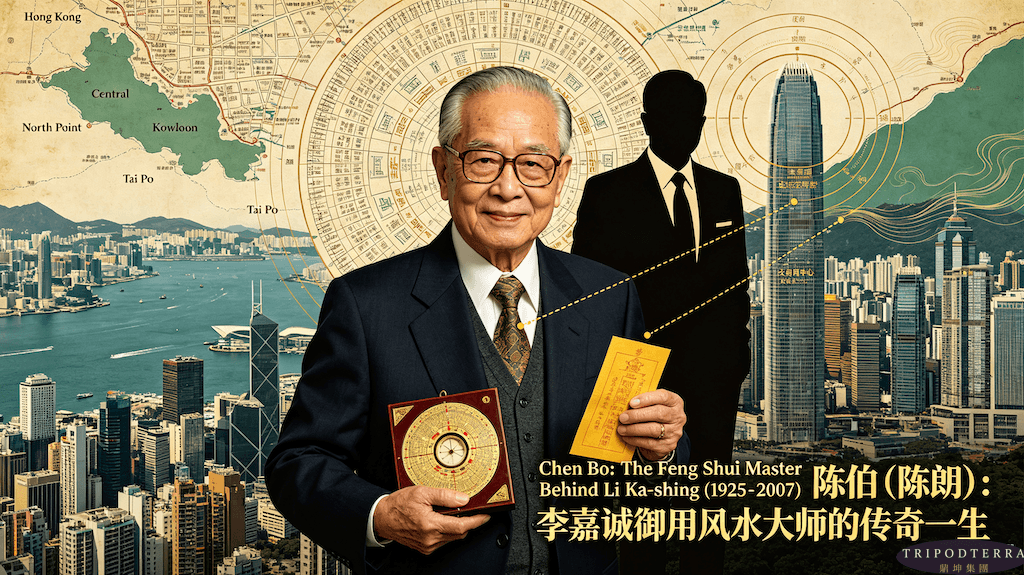
In the folklore of Hong Kong business, no name comes up more often than Chen Bo's (陈伯) when talk turns to how the city's great fortunes were built. A quiet, unassuming feng shui master, he was said to be the consultant behind Asia's richest man — the person Li Ka-shing reportedly asked before almost every major decision, and the man to whom the site selection, the proportions, and the entrance of the Cheung Kong Center in Central were attributed. In Chinese-language coverage he is still called 御用风水师 — literally an "imperial-conscripted feng shui master," a title borrowed from the astronomers and diviners who served the emperors' courts, applied here to a tycoon's personal, all-access advisor.
Like most legends, this one resists verification. Chen Bo left no writings, gave few interviews, and the stories about him were retold, polished, and exaggerated by the very people who profited from his reputation. This article retells the tradition as tradition: the facts that circulated consistently for decades, the cases that made his name, and the classical methods — Xuan Kong Flying Stars (玄空飞星), BaZi (八字), and the trigram lore of the I Ching (易经) — that he is said to have mastered. Whether or not every detail is literally true, his career tells a genuine story about how Chinese metaphysics traveled from village practice into the boardrooms of one of the twentieth century's fastest-growing economies — and why that tradition still fascinates people today, from property developers to founders of startups who have never set foot in Hong Kong.
Who was Chen Bo?
Chen Bo was the professional name of Chen Lang (陈朗, 1925–2007), a native of the Chaoshan region of eastern Guangdong. Retellings of his early life do not always agree in every detail, but the version that circulated in Hong Kong for decades is consistent: he was a boy who steeped himself in the classics from childhood, studying Xuan Kong Flying Stars, BaZi destiny analysis, and the eight trigrams of the I Ching under local masters. By his youth he was already reading faces and casting fortunes for ordinary people across the Chaoshan towns, and the predictions were said to keep coming true — the kind of accuracy that builds a name even in a region famous for its own folk traditions.
In the years after 1949 he moved to Hong Kong, joining one of the great post-war migrations into the territory. He arrived with a reputation already made; what set him apart was that it survived contact with a harder, more skeptical city. Hong Kong's upper society of the 1950s and 1960s was a small world, and word of a reader whose judgments held up spread quickly from the banquet tables of the wealthy to their boardrooms. His eventual client list, as it is usually told, reads like a roll call of Hong Kong's business establishment: Li Ka-shing, Lee Shau Kee (李兆基), Cheng Yu-tung (郑裕彤), and Walter Kwok (郭炳湘) — the family names that came to dominate Hong Kong property, retail, and finance, and that Chinese media still refer to collectively as the "four great families." Chen Bo was by temperament low-profile. He did not advertise, he did not publish, and he was reported to turn away far more seekers than he received. Scarcity, as any marketer will tell you, only raised his price — and his mystique.
The man Li Ka-shing consulted
The relationship that made Chen Bo famous was with Li Ka-shing, and the most repeated version of their first meeting places it at a business dinner in the late 1950s, when Li was still a young factory owner building a plastics business in a city that did not yet believe in him. Chen Bo is said to have studied the young man's face and asked how wealthy he hoped to become; in the most common telling, Li answered that three thousand wan — roughly thirty million Hong Kong dollars — would satisfy him, and Chen Bo reportedly replied that his destiny held far more than that, that his "treasure vault" would overflow such a modest goal, and that he was meant to become the wealthiest man in Hong Kong. Whether or not the exchange happened exactly this way, it became one of the territory's favorite anecdotes, because the punchline arrived on schedule: Li Ka-shing did become the wealthiest man in Hong Kong, then in Asia.
What followed, according to the decades of coverage, was an arrangement closer to a court relationship than a commercial one. Li reportedly consulted Chen Bo before every significant decision — acquisitions, capital moves, new headquarters, and even the arrangement of furniture in his own office, item by item. In return, Chen Bo gained the only form of advertising he ever needed: the visible, consistent trust of the richest man in Asia. Every subsequent client who climbed Chen Bo's stairs knew the value of the endorsement. It is worth pausing on what this means for how we read the story. Even if some of the detail has been embroidered over time, the structure of the relationship is not in dispute: one of the most methodical businessmen of the twentieth century considered the timing-and-place judgments of a feng shui master important enough to build into his decision routine for decades. That is a cultural fact about Hong Kong's business elite, and it is the real subject of this article.
Chen Bo died in 2007 at the age of eighty-two, and the stories about him have only grown since. But his working method can still be reconstructed from the cases that made his name — beginning with the most famous one.
The Cheung Kong Center: a headquarters chosen like a chart
The building that anchors the story is the Cheung Kong Center (长江集团中心), the headquarters tower of the CK Group in the heart of Hong Kong's Central district, in the neighborhood of the HSBC headquarters and the Bank of China Tower. In the 1990s, Li Ka-shing planned a new headquarters, and the account handed down in Hong Kong media gives Chen Bo a starring role in its birth. He personally surveyed the site, selected the land in Central — the "golden site" of the story — and settled the details that most people never think to ask about a building: its height, its orientation, and the direction its main entrance faces.
The governing principle, by this account, was 藏风聚气 — "harbor the wind and gather the qi." The phrase comes from the classical tradition of the Book of Burial (《葬书》), where qi is said to disperse where wind is strong and to gather where water embraces the land. Translated into skyscraper terms, Chen Bo's reported instructions have a practical ring: the tower should not rise so aggressively that it "invites the wind" — a tower that is too tall or too exposed scatters the qi that should accumulate around the enterprise — and the main entrance should not sit in a straight, open line with the street or the lobby, because an entrance that faces directly outward lets wealth "leak" straight out again. In the telling, the completed building and the company's fortunes were one continuous story: the headquarters rose, and Cheung Kong's business went from strength to strength.
A modern reader should be clear-eyed about this. Skyscrapers are built by architects, structural engineers, and quantity surveyors, and no feng shui report overrides a zoning code. What the account almost certainly preserves faithfully is the culture: a boardroom in which the feng shui master's written opinion sat on the same table as the surveyor's estimate, and where a senior executive could be expected to defend a decision about door alignment or floor height with a straight face. Whether the master shaped the building or merely blessed decisions already made is unknowable — and, in cultural terms, beside the point. The point is that in the last decades of the twentieth century, in the most expensive real estate market on earth, the most expensive decisions in that market were routinely expected to pass through a metaphysical review.
Chen Bo's toolbox
Chen Bo was not a one-trick reader. The disciplines credited to him span most of the classical curriculum of Chinese metaphysics, and each one answered a different kind of question from his clients:
| Discipline | What it works with | Where tradition places his use | |---|---|---| | Xuan Kong Flying Stars (玄空飞星) | The nine stars of the Lo Shu square mapped onto a building, its rooms, and its era | Site selection and layout of headquarters and offices, including the Cheung Kong Center | | BaZi (八字命理) | The four pillars of birth data — year, month, day, hour | Personal destiny readings, timing of major decisions, wealth questions | | I Ching (易经八卦) | The eight trigrams and their transformations | Judgments about change, opportunity, and the direction of events | | Feng shui survey (风水堪舆) | Landforms, water, doors, and the flow of qi through space | Placement of desks, doors, and wealth corners in his clients' offices | | Face and palm reading (看相) | The reading of a person's features and bearing | His early career in Chaoshan, and his first meeting with Li Ka-shing |
Of these, the technique most associated with his name in Hong Kong is Xuan Kong Flying Stars. It belongs to the San Yuan tradition of feng shui, and its central idea is that a building has a "time fate" as well as a spatial one. The practitioner maps the Lo Shu square — the magic grid of numbers that legend says emerged from the Yellow River — onto the building, assigns the stars of the current 20-year period (运) to its sectors, and reads how the period's energies interact with the mountain (back) side and the water (front) side of the structure. Because the underlying chart changes every twenty years, a building that was excellent in one period can decline in the next, and the remedy is often a matter of doors, water features, and the uses assigned to rooms. This is why, in the lore of Hong Kong feng shui, the entrance direction of a tower and the placement of a fountain are treated as serious, time-sensitive engineering — not decoration.
Xuan Kong's obsession with period luck also explains why it suited Hong Kong. A city that rebuilt its skyline every decade was a city where "the times" were visibly changing, and a method built around the changing times resonated with executives whose fortunes rose and fell with property cycles. The flying stars gave them a vocabulary for something every tycoon already believed: that timing was part of success. Which is exactly the subject of Chen Bo's other great discipline.
BaZi the way Chen Bo read it
BaZi — literally "eight characters," the four pairs of Heavenly Stem and Earthly Branch that encode a person's birth — was Chen Bo's method for reading people, and his approach to it was more technical than the popular image of a fortune teller. In the tradition he belonged to, every reading begins with the Day Master (日主): the Heavenly Stem of the day pillar, which represents the person himself in the chart. Chen Bo reportedly placed unusual weight on two questions: whether the Day Master is strong or weak (日主强弱), and which elements the chart needs to bring it into balance — the selection of the "useful god" (用神). The first question decides how much pressure the person can carry; the second decides what kinds of years, environments, and partners will support them and what will drain them. Both are matters of elemental logic rather than mysticism, which is why a proper BaZi reading is closer to a diagnostic than to a prophecy.
This is the part of his craft that a modern reader can actually inspect, because the underlying mechanics are available to anyone. The four pillars are computed from birth data, and if you know your exact birth date and time, your Day Master and the balance of the five elements in your chart can be derived in seconds. Where Chen Bo was said to excel was in the details — in noticing, within a chart, the small configurations that other readers glossed over, and in connecting them to the client's actual situation rather than to generic pronouncements. The Chinese text of this article's source material preserves a saying attributed to him that captures the whole philosophy: 「看八字不是看吉凶,是看时机。同一件事,时机对了大吉,时机不对大凶。」 — "Reading a BaZi chart is not about seeing good or bad fortune; it is about seeing timing. The same act, at the right time, is great fortune; at the wrong time, it is disaster."
In that one sentence, Chen Bo reframed the entire enterprise of destiny reading. A chart, in his view, was not a verdict on whether you would succeed — it was a timetable of when conditions favored pushing and when they favored waiting. That is a strikingly modern attitude, closer to a trader reading market cycles than to a soothsayer announcing fate. It also explains why his advice to businessmen so often sounded like advice about calendars: the same acquisition, the same launch, the same relocation could be fortunate or ruinous depending on where the client stood in the cycles of the chart.
"First destiny, second luck, third feng shui, fourth good deeds, fifth study"
The proverb Chen Bo was most associated with is a ranking of everything that shapes a life, and he repeated it so often that it became his signature: 「一命二运三风水,四积阴德五读书」 — "First destiny, second luck, third feng shui, fourth accumulated virtue, fifth study."
| Factor | Chinese | What it refers to in the tradition | What it says about agency | |---|---|---|---| | 1. Destiny | 命 | The natal blueprint fixed at birth — the BaZi chart itself | You do not choose your starting conditions | | 2. Luck | 运 | The fortune cycles of a lifetime — the ten-year periods of luck (大运) and the yearly flows (流年) | Timing is external but legible; you can learn to read it | | 3. Feng shui | 风水 | The environments you inhabit — buildings, homes, graves, cities | Environment can be adjusted, and adjustment is the master's craft | | 4. Virtue | 阴德 | Unseen good deeds; moral capital accumulated quietly | Character and conduct shift what the chart portends | | 5. Study | 读书 | Education, cultivation, and deliberate learning | Effort and knowledge override many defaults |
The ordering matters. Chen Bo, by every account, believed that destiny contains fixed elements (定数) — but the proverb he preached puts feng shui only third, behind two things no practitioner can change or sell. And it places virtue and study above the master's own trade. The implicit message, which his reported advice repeated in various forms, is that a good environment helps a person who is already moving in the right direction, and that no layout rescues a person who refuses to learn or to deal fairly. This is a useful corrective to the popular image of feng shui as a magic switch. In the tradition Chen Bo represented, feng shui is one layer of a many-layered system — real, influential, and adjustable, but ranked below the moral and intellectual work that a person does on himself. When modern readers ask whether "believing in feng shui" is rational, the tradition's own answer is more sophisticated than either a believer or a skeptic might expect.
The bankrupt toy maker: the turnaround case
The case most often cited as proof of Chen Bo's method is not a tycoon's tower but a small factory owner's office. In 1998, in the wake of the Asian financial crisis, a toy manufacturer in Hong Kong was on the edge of bankruptcy. Orders had collapsed, debts were compounding, and the owner came to Chen Bo as a last resort — the classic posture of a client who has exhausted every ordinary remedy.
According to the story as it is told, Chen Bo did not read the man's chart and pronounce doom. He walked the office, and he changed it. The owner's desk stood in what the Eight Mansions school of feng shui (八宅) calls the 绝命位 — the "severed-life" direction, traditionally the most harmful of the eight directional positions. Chen Bo reportedly had the desk moved to the 生气位, the "generating-qi" direction associated with growth and new beginnings. A crystal ball was placed at the office's wealth position (财位) — the corner where, in the tradition, accumulating qi should be anchored and activated. The main door's orientation was adjusted so the space would not shed its energy into the corridor. Small moves, all of them: furniture, ornament, a door. No prayers, no amulets, no promises carved in stone.
The ending, as the anecdote is told, arrived in about three years. The manufacturer cleared his debts, and — the detail that makes the story credible to a business audience — he did not merely survive in toys. He pivoted into electronics manufacturing, and the company's annual revenue reportedly crossed the hundred-million-yuan mark. The numbers can no longer be checked, and the story should be read as the moral fable it has become. Its logic, though, is worth taking seriously: the remedy was not passive. The owner was told to change his environment in ways that changed how he worked every day — where he sat, what faced him, how the space signaled authority and attention. Whatever one believes about qi, reorienting a person's working space so that it faces opportunity rather than a wall is a form of behavioral intervention, and behavioral interventions sometimes work. Chen Bo's genius, in this telling, was not supernatural. It was that he treated the office itself as part of the business plan.
The golden age of tycoons and their masters
Chen Bo belonged to a generation of practitioners who became fixtures of Hong Kong and Taiwanese business culture in the 1980s and 1990s, an era when the region's tycoons consulted their masters the way Western executives consulted strategy consultants. The most documented of his contemporaries is the entertainment and finance tycoon Albert Yeung (杨受成), whose relationship with Chen Bo began — according to Yeung's own memoir 《争气》, published years later — with a warning delivered at the Peninsula Hotel in 1983, when Chen Bo told the successful young businessman that a catastrophe was approaching that year. Yeung dismissed him. Months later, the story goes, Hong Kong's financial turmoil caught up with him: he owed hundreds of millions to the bank that seized his assets, and he returned to ask what to do. Chen Bo reportedly told him to expand westward — to go to Kuwait and trade currencies and gold. Yeung did, the Hong Kong property market recovered, and within a few years he had paid off the debt and rebuilt. Yeung credits Chen Bo as the first person on the list of benefactors in his memoir, and the story is as well sourced as anything in this genre gets.
The same era produced a whole constellation of figures who operated at the intersection of metaphysics and money. Across the border in Thailand, the White Dragon King served a similar crowd of Hong Kong stars and businessmen — a different tradition, but the same social role, and his story is worth reading alongside Chen Bo's. Later popularizers such as Li Juming (李居明) brought Xuan Kong feng shui and BaZi to mass audiences through books, television, and columns, turning what had been a discreet service for the rich into a subject anyone could study. Even thinkers far outside the feng shui trade — the scholar Nan Huai-chin, the management lecturer Zeng Shiqiang — spent years explaining the I Ching to business audiences in plain language, evidence of how hungry the Chinese-speaking business world was for a structured vocabulary about change, timing, and character.
Chen Bo's place in this pantheon is distinctive for two reasons. First, he never popularized: he remained the private consultant, the specialist the other specialists referred their most difficult clients to. Second, and more important, his clients included the men who built the physical city — and their offices, headquarters, and projects became his lasting portfolio. When a master's client is a property developer, his work gets poured in concrete and glass, and it stays visible for a hundred years.
Commercial feng shui: the tradition he helped create
The legacy that outlives Chen Bo's own clients is a discipline that Chinese media sometimes call 商业风水 — "commercial feng shui." By the standard account, Chen Bo did more than practice feng shui for businessmen; he fused traditional metaphysics with modern business thinking so thoroughly that he helped create a distinct school of practice, one that treats the enterprise — its headquarters, its offices, its expansion timing — as a legitimate subject of destiny analysis alongside the individual.
The school's conventions are by now familiar across Asia. Property developers engage feng shui masters before breaking ground and sell the master's endorsement as part of the brochure. Corporate offices are laid out with attention to who sits where, what the chairman's office faces, and where the water feature goes. Companies schedule launches, openings, and relocations around the almanac's auspicious days. In mainland China, Hong Kong, Taiwan, and Singapore, this is ordinary business practice, not eccentricity — as normal as a Western company hiring an external consultant for a market entry. Whatever an outsider thinks of the metaphysics, the social fact is undeniable: commercial feng shui is one of the most successful consulting business models in the world, and Chen Bo is the name most often credited with founding its modern, corporate form.
For the rest of us, the interesting question is what survives when the tycoons are gone and the tradition has been industrialized. Chen Bo's own reported philosophy points to an answer. If BaZi is about timing rather than fate, and if feng shui ranks below study and virtue in the order of influence, then the practical content of the tradition is not prediction at all. It is a discipline of attention: attention to where you are, to what season of your life you are in, and to whether your environment is helping you do the work you have chosen. That discipline does not require a belief in qi to be useful. It only requires the willingness to ask the questions the tradition asks. And on the question of whether any of this is worth taking seriously at all, the recorded view attributed to Chen Bo himself is the most level-headed position on offer: destiny study, he reportedly insisted, is not superstition but a system of wisdom about the relations between time, space, and people — a claim this article has tried to test fairly on its own terms.
What a modern reader can take from Chen Bo
None of this is advice to abandon critical thinking at the office door, and the tradition itself would not ask you to. Phrased as traditional views rather than guarantees, here are the lessons of the Chen Bo stories that survive contact with a skeptical modern reader:
- Timing is a real variable. Every tradition Chen Bo practiced — Xuan Kong's twenty-year periods, BaZi's ten-year luck cycles (大运), the yearly almanac — is a way of saying that the same action succeeds or fails partly because of when it happens. Modern readers can translate this into calendar discipline: review major decisions against where you are in your own cycles, rather than acting on impulse.
- Environment shapes behavior. The toy maker's story works whether or not you believe the desk had qi. Where you sit, what you face, and how your workspace is arranged changes how you think and work. A periodic, deliberate rearrangement of your environment is a reasonable habit by any standard.
- The useful question is "what supports me now," not "am I lucky." The 用神 concept — finding the elements a chart needs to balance — is a model of targeted self-knowledge. The modern equivalent is honest diagnosis: which conditions, people, and seasons of the year bring out your best work, and which drain you?
- Character outranks technique. In the proverb Chen Bo preached, feng shui comes third, behind nothing a practitioner can change for you — and virtue and study rank above it. A master who tells you your environment matters but your conduct matters more is giving you advice that costs him business, which is exactly why it sounds like the truth.
If you want to explore the tradition's actual content rather than its folklore, the entry point is the same one Chen Bo used with every client: a person's own chart.
Start with the chart Chen Bo would have asked for
And if you want the timing question the tradition is really built on — "is this the season to push, or to wait?" — you can ask it directly in plain language. Start a conversation in the AI metaphysics chat, where the day's almanac, your chart's cycles, and eighteen schools of Chinese divination are a question away, or check the daily almanac to see how the tradition reads an ordinary Tuesday. Curious whether a machine can actually do any of this? AI fortune telling is an honest look at what the models can and cannot read. The master who advised Asia's richest man is gone, but the tools he used were never secret — they were just, until now, expensive. The chart is still free, the timing still matters, and the questions are still worth asking.