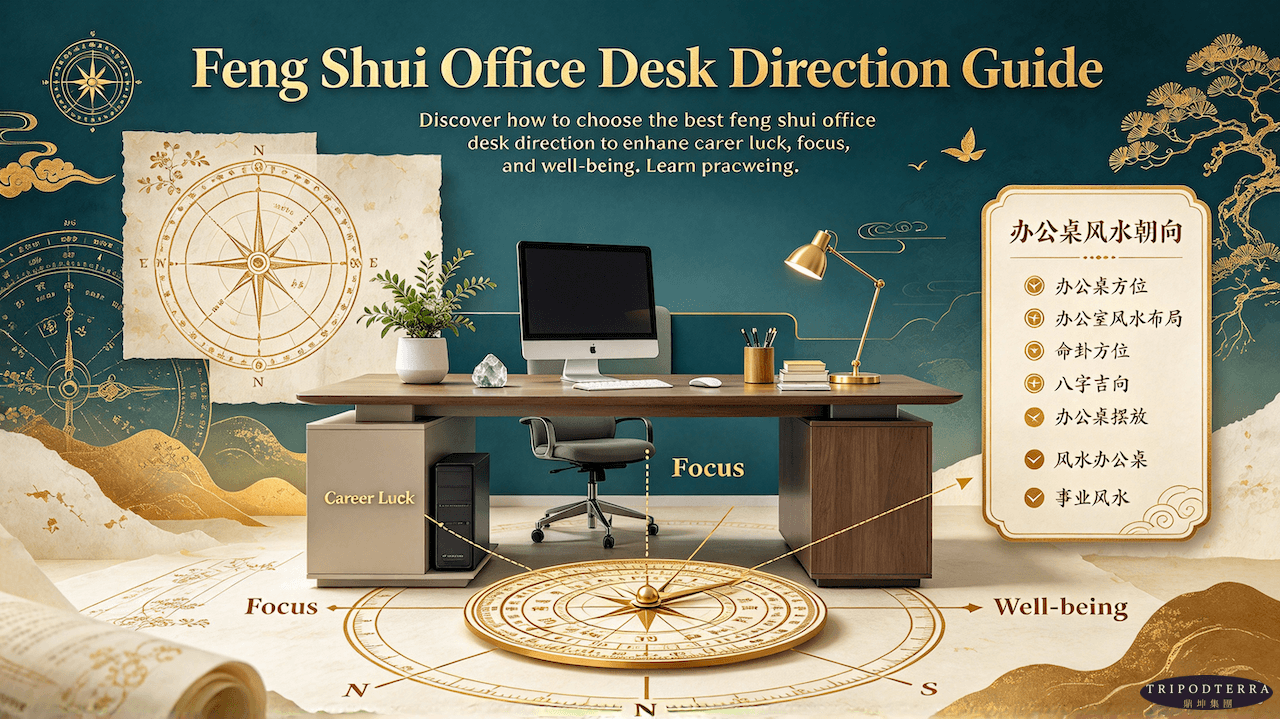
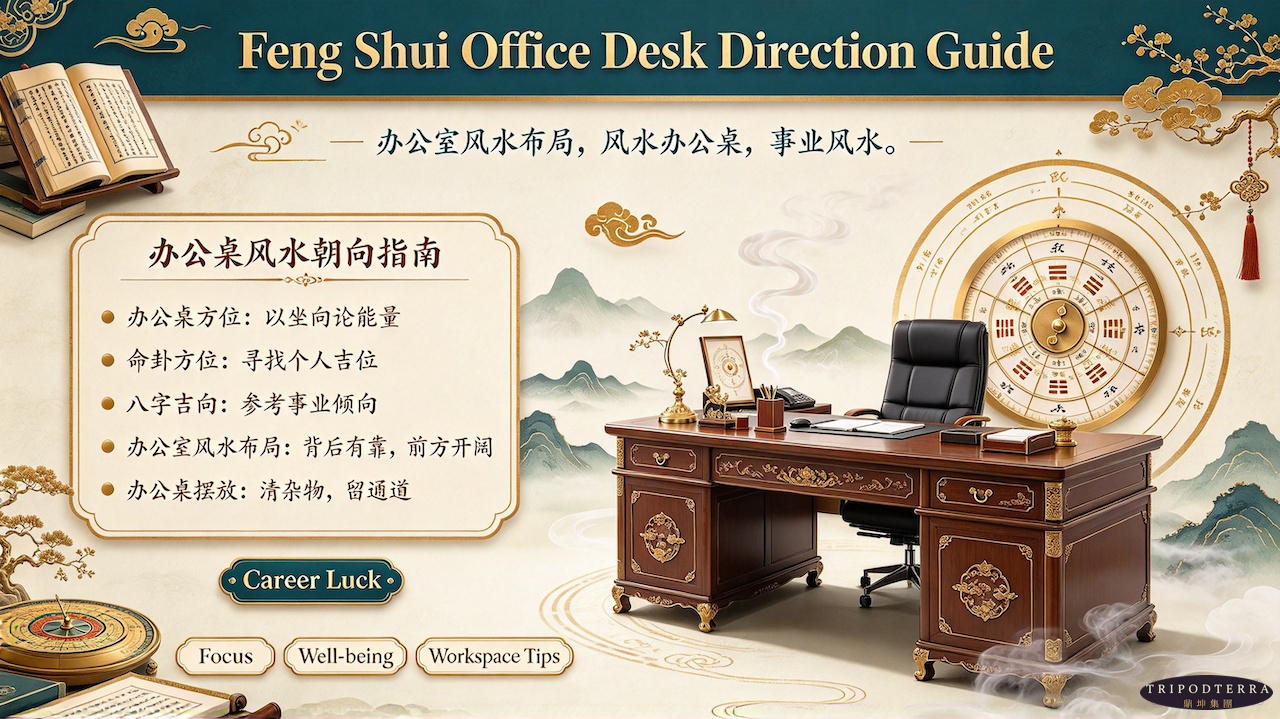
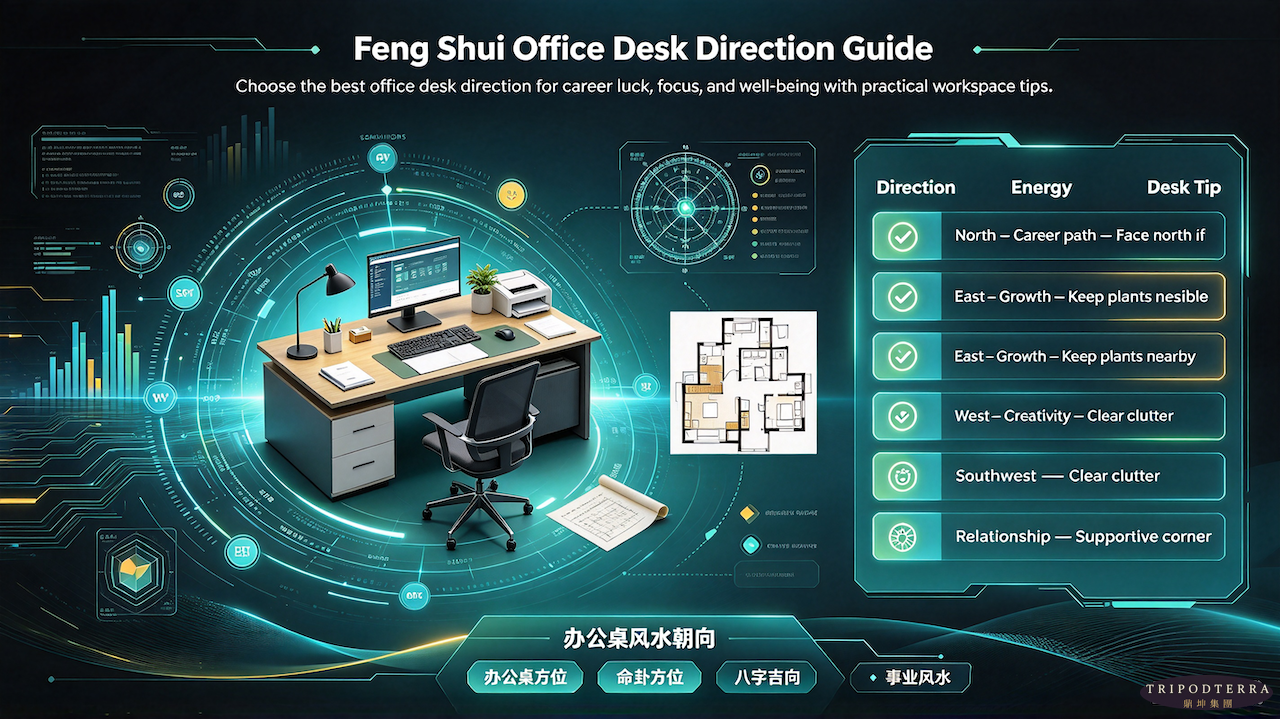
Discover how to choose the best feng shui office desk direction to enhance career luck, focus, and well-being. Learn practical tips for your workspace.
26 readsOctober 21, 2026
Contents
🧑
Free BaZi Chart
Enter birth info, get your BaZi chart + Five Elements analysis
1. Introduction to Feng Shui Office Desk Direction
In traditional Chinese metaphysics, the direction your office desk faces is believed to influence your career, productivity, and overall fortune. Feng shui, the ancient art of harmonizing energy (qi) in your environment, offers guidelines for positioning your desk to attract positive energy and minimize negative influences. While modern workplaces may not always allow ideal arrangements, understanding the principles can help you make the best of your space.
This article explores the key considerations for choosing the optimal feng shui office desk direction. We'll cover the commanding position, personal auspicious directions based on your BaZi (Four Pillars of Destiny), and practical adjustments for common office layouts. Remember, these suggestions are for reference only and should be adapted to your real-world constraints.
2. The Commanding Position: The Golden Rule
The most fundamental feng shui principle for desk placement is the commanding position. This means sitting with a solid wall behind you, a clear view of the door, and not directly in line with the door. This position symbolizes support, control, and the ability to see opportunities and challenges as they approach.
Share
Daily Fortune Newsletter
One daily BaZi reading, straight to your inbox. Free, unsubscribe anytime.
Support: A wall behind you represents backing from mentors, superiors, or stable resources.
Control: Facing the door (but not directly) allows you to see who enters, reducing surprise and anxiety.
Focus: Avoiding a direct line with the door prevents energy from rushing at you, which can cause distraction.
2.2. How to Achieve It in an Office
If your desk cannot be moved, you can simulate the commanding position with a mirror or a small reflective object that shows the door behind you. Alternatively, place a solid partition or a tall plant behind your chair to create a sense of support.
3. Personal Auspicious Directions: BaZi and Kua Number
In addition to the commanding position, feng shui considers your personal energy map. Two common systems are the Kua Number (based on your birth year and gender) and BaZi (Four Pillars of Destiny, based on your birth date and time). These can indicate your best directions for career, wealth, and health.
3.1. Kua Number Basics
Your Kua number reveals four auspicious and four inauspicious directions. For career and work, the Sheng Qi (Life-Generating) and Tian Yi (Heavenly Doctor) directions are often recommended. For example:
Kua 1: Sheng Qi in the southeast, Tian Yi in the east.
Kua 2: Sheng Qi in the northeast, Tian Yi in the west.
Kua 3: Sheng Qi in the south, Tian Yi in the north.
Kua 4: Sheng Qi in the north, Tian Yi in the south.
(Note: Kua number calculations differ for men and women; consult a feng shui professional for accuracy.)
3.2. BaZi: A Deeper Layer
BaZi analyzes your birth chart to identify your favorable elements and directions. For instance, if your chart is weak in wood, facing east (wood direction) may support growth and career advancement. A BaZi consultant can provide personalized recommendations.
Disclaimer: These recommendations are for reference only and should not replace professional advice.
4. Practical Tips for Common Office Layouts
Not everyone can choose their desk direction. Here are solutions for typical scenarios.
4.1. If Your Back Is to the Door
This is considered vulnerable. Place a mirror on your desk facing the door, or hang a small convex mirror on the wall behind you to reflect the entrance. A tall-backed chair can also provide symbolic support.
4.2. If You Face a Wall
A wall directly in front can block opportunities. Hang inspiring artwork or a vision board to stimulate motivation. Ensure the wall is not too close (at least an arm's length away).
4.3. If You Sit in an Open Plan
Use plants, screens, or bookshelves to create a boundary behind you. Position your desk so you can see the main entrance without being directly in line with it.
4.4. If You Share a Desk
Personalize your space with items that reflect your favorable elements. For example, a small water fountain (water element) or a crystal (earth element) can adjust the energy.
5. Directional Associations and Their Meanings
Each cardinal direction carries specific energies in feng shui. Here's a quick guide:
North: Career and path in life; element water. Facing north can enhance career focus.
East: Health and family; element wood. Facing east supports growth and new beginnings.
South: Fame and reputation; element fire. Facing south can boost recognition.
West: Creativity and children; element metal. Facing west aids creative projects.
Northeast: Knowledge and spirituality; element earth. Facing northeast supports learning.
Southeast: Wealth and abundance; element wood. Facing southeast attracts prosperity.
Southwest: Love and relationships; element earth. Facing southwest fosters harmony.
Northwest: Helpful people and travel; element metal. Facing northwest brings mentors.
Choose a direction that aligns with your current goals. For career advancement, north or southeast are popular choices.
6. Enhancing Your Desk with Feng Shui Elements
Beyond direction, the items on your desk and their placement matter.
6.1. The Five Elements
Balance the five elements (wood, fire, earth, metal, water) on your desk:
Wood: Plants, wooden pen holder.
Fire: A small lamp, red accents.
Earth: Crystals, ceramic cup.
Metal: Metal clock, silver frame.
Water: Small fountain, blue mousepad.
Avoid clutter, which stagnates qi. Keep your desk clean and organized.
6.2. Symbolic Items
Laughing Buddha: For joy and abundance.
Dragon Turtle: For support and longevity.
Citrine or Pyrite: For wealth.
Personal mascot: A meaningful item that inspires you.
Place these items in the appropriate direction (e.g., wealth items in the southeast).
7. Common Mistakes to Avoid
Sitting with your back to a window: This lacks support and can cause insecurity.
Facing a sharp corner or edge: Known as "poison arrows," these create tension.
Cluttered desk: Blocks energy flow.
Directly facing the door: Energy rushes at you, causing stress.
Sitting under a beam: Can cause pressure and health issues.
If you cannot avoid these, use feng shui remedies like plants, mirrors, or crystals to mitigate.
8. Conclusion
Choosing the right feng shui office desk direction is a personal and practical endeavor. Start with the commanding position, then incorporate your personal auspicious directions if possible. Adjust with feng shui enhancements to create a workspace that supports your career and well-being. Remember, these are guidelines—your intention and comfort are paramount. For personalized advice, consult a qualified feng shui consultant.
Disclaimer: This article is for informational purposes only and does not constitute professional advice. Feng shui is a traditional practice and results may vary.
Feng Shui Office Desk Direction: Best Facing Guide — TripodTerra