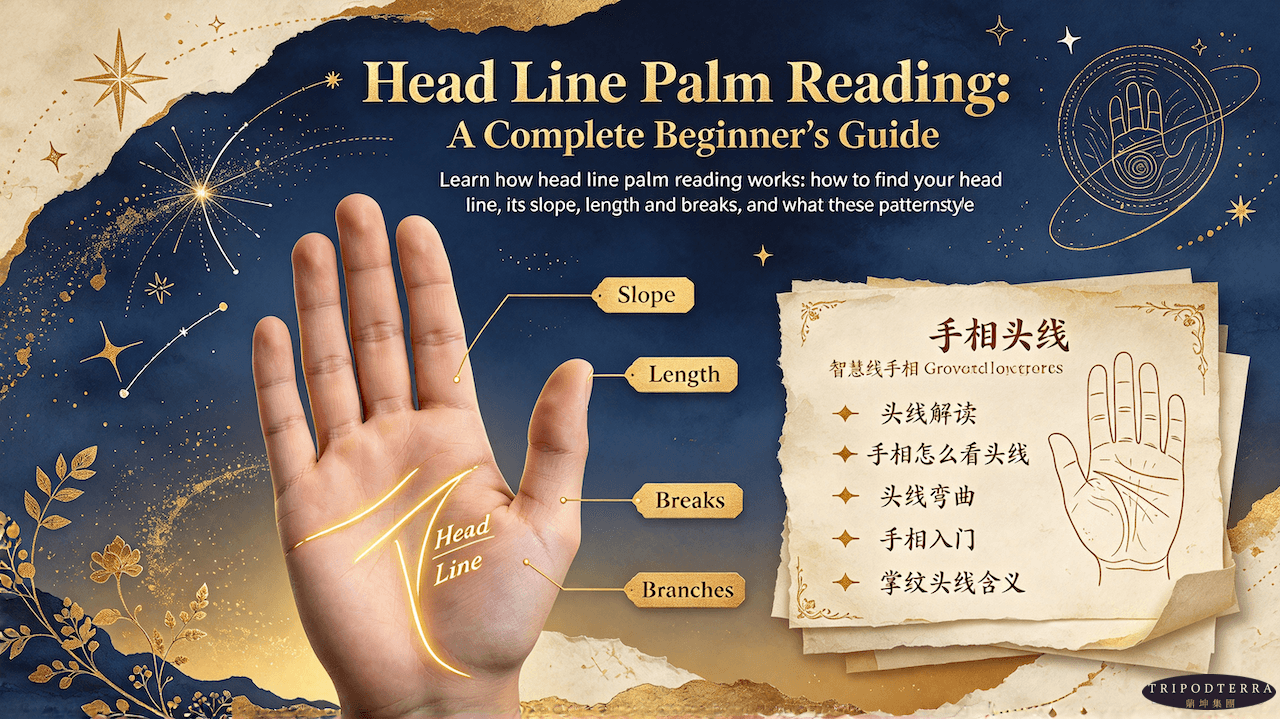
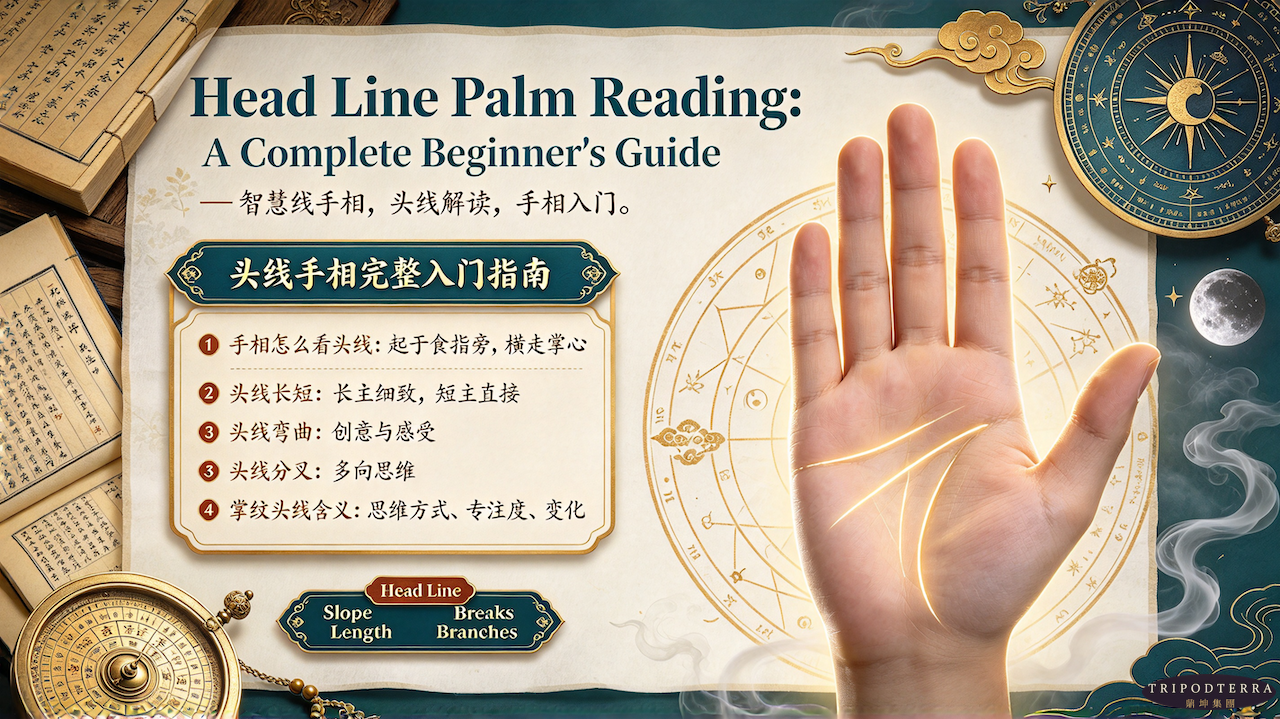
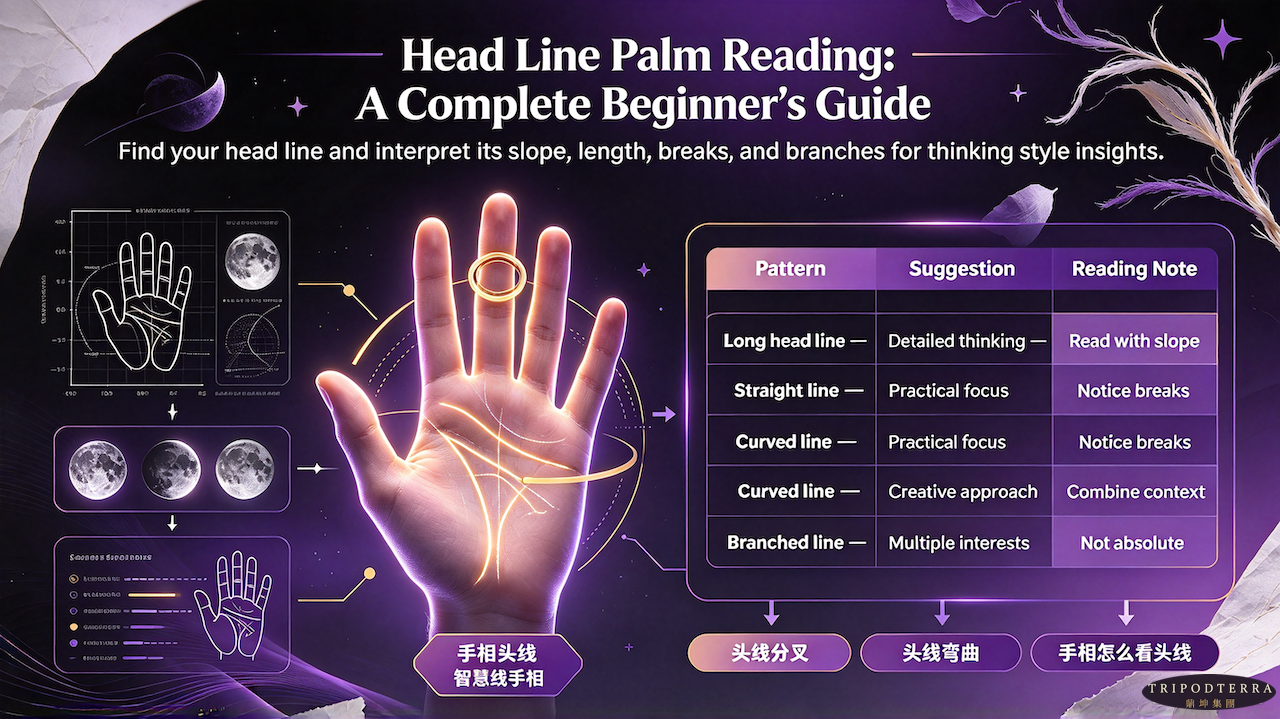
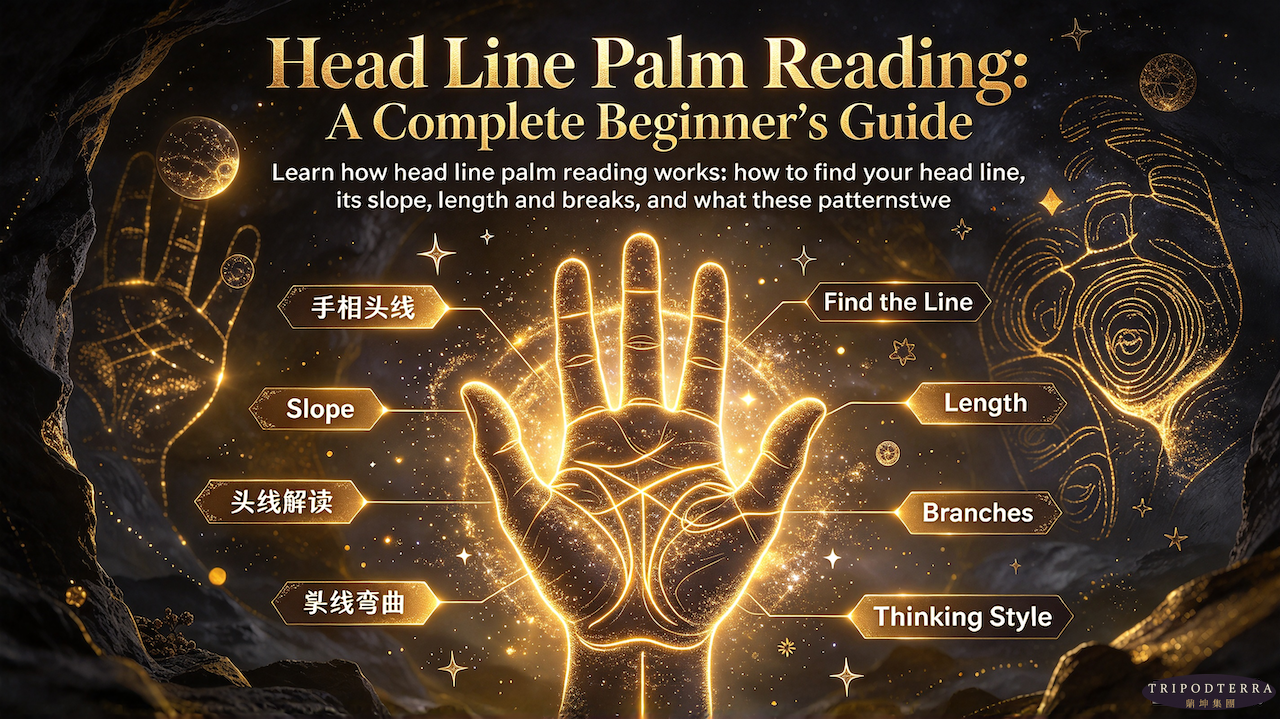
Head Line Palm Reading: A Complete Beginner's Guide
Learn how head line palm reading works: how to find your head line, its slope, length and breaks, and what these patterns suggest about thinking style.
10 readsOctober 26, 2026
Contents
🧑
Free BaZi Chart
Enter birth info, get your BaZi chart + Five Elements analysis
The head line (also called the wisdom line or brain line) is one of the three major lines on the palm, alongside the life line and the heart line. In traditional palmistry it is read as a map of the mind — how a person thinks, focuses, communicates, and makes decisions.
Unlike the life line, which is often associated with vitality and life rhythm, the head line is primarily about mental style. Two people with very different head lines may both be intelligent; the difference lies in how that intelligence is expressed. One may be practical and detail-driven, another imaginative and abstract.
This guide covers how to locate the head line, the main features palmists look at, and how to interpret them responsibly. Palmistry is a traditional symbolic art, not a science — treat everything here as a lens for self-reflection rather than a fixed verdict.
Share
Daily Fortune Newsletter
One daily BaZi reading, straight to your inbox. Free, unsubscribe anytime.
In most palmistry traditions, the non-dominant hand shows inherited tendencies and early conditioning, while the dominant hand (the one you write with) shows what you have developed in life. Read both, but give more weight to the dominant hand for present-day questions.
2.2. Step 2: Locate the three major lines
Life line: curves around the base of the thumb.
Heart line: runs horizontally across the upper palm, below the fingers.
Head line: starts near the gap between the thumb and index finger, then travels across the middle of the palm.
2.3. Step 3: Trace the head line
The head line usually begins joined to, or very close to, the life line, then moves toward the opposite edge of the palm (the percussion edge, under the pinky and ring fingers). Its endpoint and slope are the most-read features.
2.4. Step 4: Check your lighting
Use soft, indirect light and hold your hand relaxed. Lines change appearance with tension — a clenched hand flattens and distorts the palm. Photograph your palm if you want to compare over time.
3. The Main Features Palmists Read
3.1. Length
A common misconception is that a longer head line means higher intelligence. In practice, length is usually read as range of mental interest rather than IQ.
A longer line reaching toward the percussion edge often suggests broad curiosity and sustained focus across many subjects.
A shorter line that stops near the center of the palm is often associated with decisiveness and a preference for concrete, immediate matters.
Neither is better. A short, clear line can indicate someone who cuts through noise quickly.
3.2. Slope and curvature
This is arguably the most expressive feature.
Straight or gently sloping line: practical, logical, linear thinking; comfortable with structure and rules.
Noticeably downward curve: imaginative, associative, sometimes artistic thinking; drawn to metaphor and possibility.
Very steep drop toward the base of the palm: strong creative impulse, though it can also suggest overthinking or moodiness if the line is faint.
3.3. Depth and clarity
A deep, unbroken line is traditionally read as steady concentration and clear mental focus. A faint or fragmented line is not a defect — it often appears in people whose attention is scattered across many interests, or who think in bursts rather than long stretches.
3.4. Starting point
Joined to the life line at the start: often read as caution, family influence, and a slower, more deliberate early path.
Separated from the life line: often associated with independence and early self-reliance.
Starting high, near the index finger: ambition and drive in mental pursuits.
3.5. Branches and forks
A fork at the end of the head line (a "writer's fork") is traditionally linked to versatility and communication skill.
Small upward branches toward the heart line can suggest emotional considerations influencing decisions.
Downward branches are often read as practical grounding — or, if very fine and numerous, as worry.
3.6. Breaks and overlaps
A clean break is usually interpreted as a change in mental focus or a shift in worldview rather than anything ominous. Overlapping segments may suggest a transition period where old and new ways of thinking coexist.
3.7. Islands and chains
Small enclosed shapes (islands) or chain-like segments are traditionally read as periods of mental fatigue or scattered attention. In practice, these often appear during stressful chapters of life and are worth reading alongside lifestyle factors, not in isolation.
4. Reading the Head Line Together With Other Features
4.1. Head line plus life line
When the two begin joined and separate later, palmists often describe a gradual emergence of independence. A wide gap at the start can indicate an early need to rely on oneself.
4.2. Head line plus heart line
The space between them is sometimes called the quadrangle. A wide, clear quadrangle is traditionally associated with balanced judgment — neither purely cold logic nor purely emotional reaction.
4.3. Head line plus the mounts
A head line that ends under the mount of Moon (lower percussion edge) is often linked to imagination; one that ends under Mercury (below the pinky) to analytical or commercial thinking. These are symbolic associations, and they are most useful when they match what you already notice about yourself.
4.4. Cross-referencing with birth chart work
Palmistry and Chinese metaphysics are separate systems, but many readers use them side by side. If you already study your BaZi chart, you may find that the element balance in your chart and the emphasis in your palm lines tell complementary stories. Understanding the Five Elements can add nuance to how you read temperament — for example, a strongly Wood-dominant chart paired with a curving head line often reads as a person who thinks in growth and connections.
5. Common Head Line Patterns at a Glance
Pattern
Traditional reading
Long, gently sloping
Broad curiosity, balanced logic and imagination
Short, straight
Decisive, practical, focused on the concrete
Deep downward curve
Creative, associative, imaginative
Forked ending
Versatile communicator, multiple skill sets
Faint or chained
Scattered attention or mental fatigue periods
Clean break
A shift in focus or worldview
Joined to life line at start
Caution, strong early family influence
6. How to Use a Head Line Reading Well
The most useful way to approach palm reading is as a conversation starter with yourself. If a reading describes scattered focus, ask whether that matches a current season of your life. If it describes strong practical logic, notice where you already rely on that strength.
A few practical guidelines:
Read the whole hand. A single line never tells the whole story. Compare the head line with the heart line, life line, and the shape of the hand.
Track changes over time. Palm lines are not perfectly static; skin condition, hydration, and pressure affect how lines appear. Photograph your palm every few months.
Avoid fatalistic conclusions. No line determines your career, health, or relationships. Palmistry has no predictive guarantee.
Combine with reflection. Journaling, feedback from people who know you, and structured self-assessment will always be more reliable than any single feature.
If palmistry interests you, you may also enjoy exploring the life line for a complementary view of vitality and rhythm, or face reading for another traditional physiognomy perspective.
7. Frequently Asked Questions
7.1. Is a long head line better than a short one?
No. Length is traditionally read as range of interest, not intelligence. Short lines are often associated with decisiveness.
7.2. Can the head line predict career success?
Palmistry is a symbolic tradition, not a forecasting tool. Career outcomes depend on skills, choices, and circumstances. Use readings for reflection only.
7.3. Which hand should I read?
Read both. The non-dominant hand is often read as inherited tendencies; the dominant hand as developed traits.
7.4. Does a broken head line mean something bad?
In most traditions, a break indicates a change in mental focus or perspective, not misfortune.
7.5. Can I learn palm reading on my own?
Yes. Start with the three major lines, practice on friends who consent, and compare readings with what they actually experience.
8. A Final Note
Head line palm reading is a traditional symbolic practice. It can be a pleasant and thought-provoking way to reflect on how you think and decide, but it is not a diagnostic or predictive science. Content on this page is for reference and entertainment only and should not replace professional advice on health, career, or finances.
If you want to go deeper into Chinese metaphysical systems, consider a structured BaZi consultation or a Zi Wei Dou Shu reading — both offer frameworks that pair naturally with palmistry for self-understanding.
Head Line Palm Reading: Meaning, Slope & Forks — TripodTerra