 TRIPODTERRA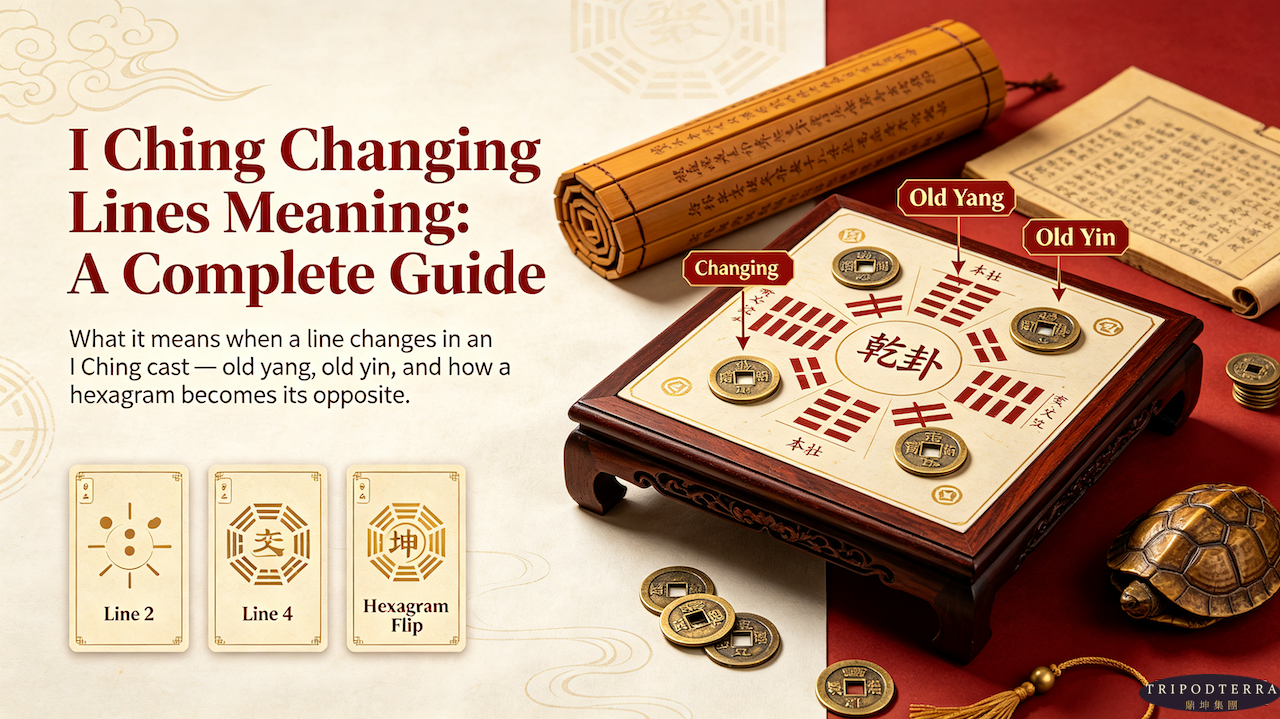
Cast an I Ching reading with coins or yarrow stalks and most lines stay still — but a few "change." Those changing lines are the heart of the oracle: they are the answer moving, not just sitting there. Here's what they mean and how to read them.
What a changing line is
Each of the six lines of a hexagram is either yin (broken) or yang (solid). But every line also has a degree:
- Young yang (7) — solid, stable. Stays solid.
- Young yin (8) — broken, stable. Stays broken.
- Old yang (9) — solid, but at its extreme. It is so yang it tips over into yin.
- Old yin (6) — broken, but at its extreme. It tips over into yang.
Only the "old" lines change. When a reading produces one, that line flips to its opposite and you get a second hexagram — the changed hexagram (之卦). The first hexagram is the present situation; the changed hexagram is where the situation is moving.
Why "old" lines change
The I Ching's cosmology treats extremes as inherently unstable. The noon sun begins its descent; the full moon begins to wane. A line that has reached its maximum — old yang, old yin — cannot stay; it must transform. A changing line is therefore the book pointing at exactly where the situation has peaked, and where it will tip.
How to read a cast with changing lines
The traditional rules, in order of specificity:
- No changing lines — read the hexagram's overall judgment (the 卦辞). The situation is stable; nothing is about to tip.
- One changing line — read that line's text (爻辞). It's the whole answer; the rest of the hexagram is context.
- Two changing lines — read the upper of the two (the higher-position line carries the emphasis).
- Three changing lines — read both hexagrams' judgments; the situation is genuinely mid-transition.
- Four or five changing lines — read the changed hexagram's judgment, with special attention to its unchanged line(s).
- Six changing lines — everything transforms: read the changed hexagram. (The two exceptions, Hexagram 1 and 2, have special "all-moving" texts — 用九 and 用六.)
In modern practice, one or two changing lines are the common case — which is why the line texts (爻辞) are what most readers spend most of their time with.
An example: the first line of Hexagram 1
Take Hexagram 1, 乾 (The Creative), all yang. If the first line — "The hidden dragon. Do not act." — comes up changing, it flips to yin, and the hexagram becomes Hexagram 44, 姤 (Coming to Meet). The reading: you are in a position of untested potential (hidden dragon), and the situation is turning toward an encounter with something outside your control. The changed hexagram names the destination; the changing line names the decision.
Why changed hexagrams matter in practice
The changed hexagram is what turns the I Ching from a fortune-telling device into a planning tool. The first hexagram tells you the weather; the changed hexagram tells you the forecast. Ask a question about a job, a move, a relationship — the changing lines mark the pivot points where your decision actually lives. Read those lines twice: once for the present, once for what you're becoming.
To cast your own reading and get the interpretation in plain language, ask the TripodTerra I Ching consultant — describe your question and it will walk through the hexagram, the changing lines, and the changed hexagram step by step.