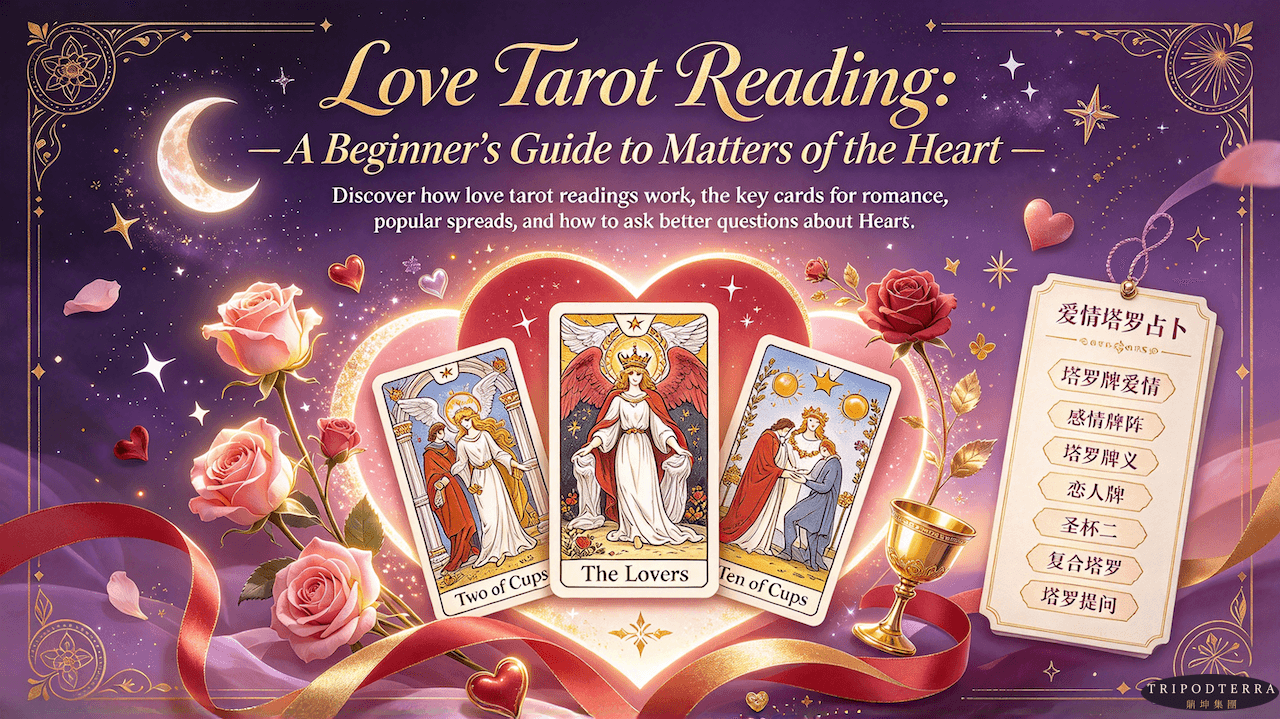
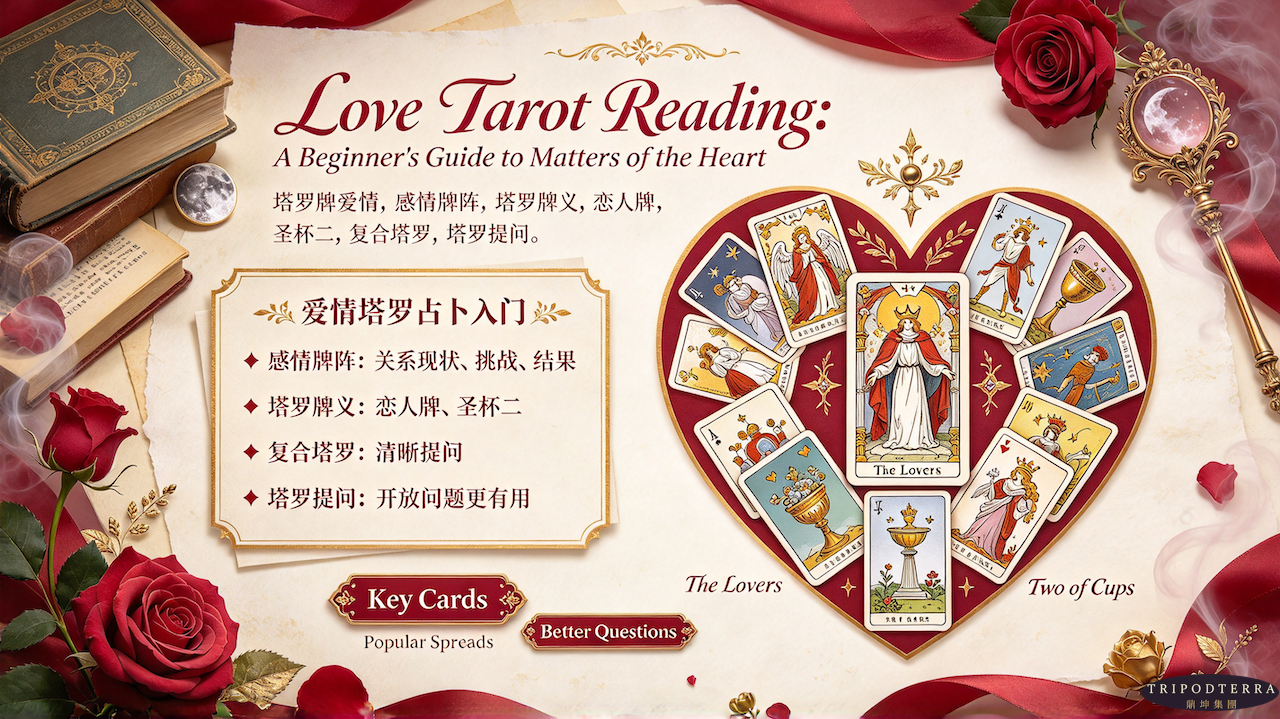
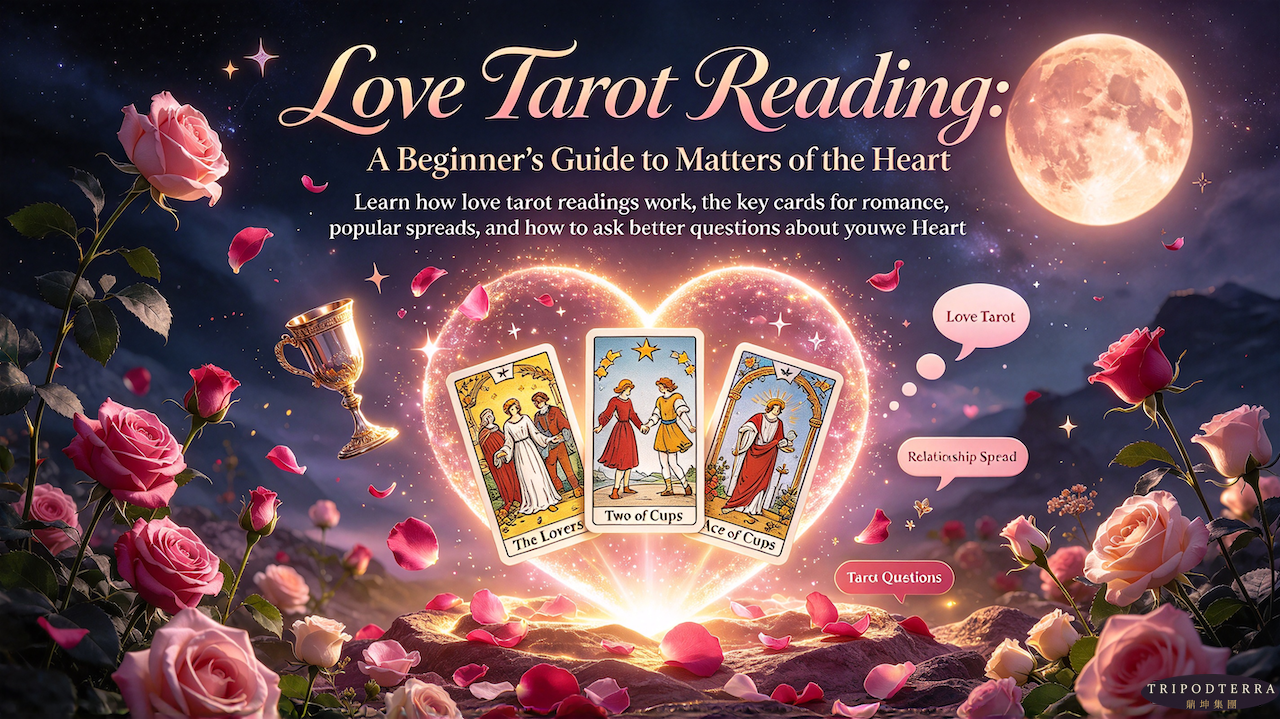
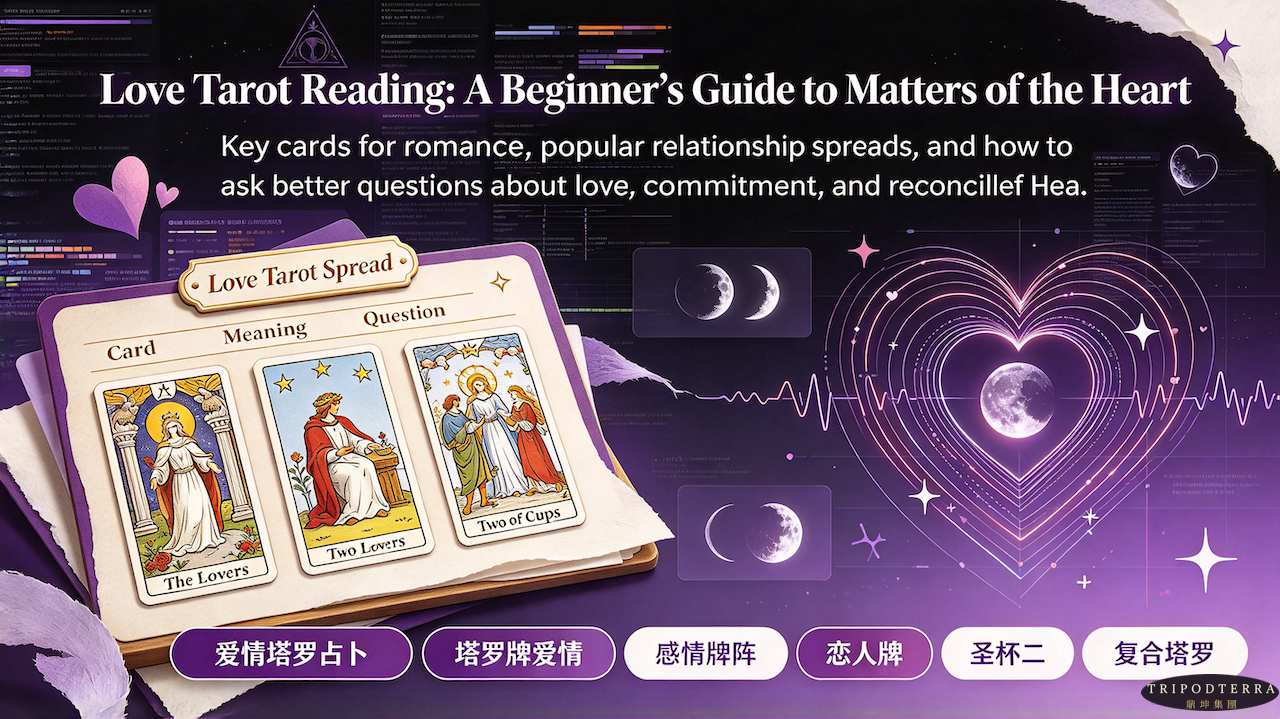
A love tarot reading is a structured way of using tarot cards to reflect on romantic questions: a new crush, a long-term partnership, a breakup, or your own readiness for love. It is not a magic switch that changes another person's feelings. Instead, it is a symbolic language that helps you name what you already sense, notice patterns, and consider choices you may have been avoiding.
Most readers approach love readings as a mirror rather than a verdict. The cards do not decide your future; they offer images and archetypes you interpret in context. That context includes your question, the spread you choose, the position of each card, and your honest situation.
Tarot is a tool for reflection, not a guarantee of outcomes. For reference and self-awareness only.
2. How a Love Tarot Reading Works
2.1. Setting an Intention
Before shuffling, decide what you actually want to explore. Vague intentions produce vague readings. "Will he text me?" is narrow and passive. "What do I need to understand about my connection with this person?" invites useful reflection.
2.2. Shuffling and Drawing
There is no single correct method. Some readers shuffle while repeating a question silently; others draw cards face-down and turn them one at a time. Consistency matters more than ritual perfection: choose a method that helps you focus.
Share
Daily Fortune Newsletter
One daily BaZi reading, straight to your inbox. Free, unsubscribe anytime.
In a spread, each position has a meaning — "you," "them," "the dynamic," "the challenge," "the advice." A card that looks difficult in the "challenge" position may be constructive in the "advice" position. Always read the card through its position.
2.4. Reversals and Nuance
Many readers use reversed (upside-down) cards to indicate blocked, internalized, or delayed energy. Others read only upright. Neither approach is wrong. What matters is that you decide your convention before you begin and stay consistent within a reading.
3. Key Tarot Cards for Love
3.1. The Lovers (VI)
The Lovers speaks to choice, alignment, and genuine connection — but also to values. In love readings it often asks: are you choosing from authenticity, or from fear of being alone? It can signal a meaningful bond, yet it rarely means "happily ever after" without effort.
3.2. The Two of Cups
A classic card of mutual attraction, partnership, and balanced exchange. It suggests two people meeting as equals. In a "future" position it can point toward reconciliation or a new connection; in a "you" position it may ask whether you are open to receiving as well as giving.
3.3. The Empress and The Emperor
The Empress represents nurturing, sensuality, and abundance; the Emperor represents structure, protection, and commitment. Together they raise a practical question: does this relationship have both warmth and stability?
3.4. The Three of Swords
The Three of Swords is often feared, but it usually describes honest pain — heartbreak, disappointment, or a truth that hurts. It is rarely a prediction of doom; more often it validates grief that needs acknowledgment before healing.
3.5. The Ten of Cups
The Ten of Cups is the card of emotional fulfillment, family, and shared joy. It is a lovely card to see, but remember: fulfillment in tarot is often a direction, not a deadline.
3.6. Court Cards in Love Readings
Pages suggest messages and beginnings; Knights suggest movement and pursuit; Queens suggest emotional maturity and self-worth; Kings suggest mastery and long-term commitment. A court card may represent you, your partner, or the energy the situation needs.
4. Popular Love Spreads
4.1. The One-Card Pull
Best for a daily check-in. Ask, "What do I most need to know about my love life today?" One card, one honest sentence.
4.2. The Three-Card Spread
A flexible classic: past, present, future — or you, them, the relationship. Simple, fast, and surprisingly revealing when read carefully.
4.3. The Five-Card Relationship Spread
A common layout:
You in the relationship
Your partner (or the other person)
The current dynamic
The challenge or lesson
The likely direction if nothing changes
The final card is not fate; it is a snapshot of the current trajectory.
4.4. The Celtic Cross for Love
A ten-card spread that examines the situation, obstacles, hopes, external influences, and likely outcome. It is best saved for complex, long-standing questions rather than casual crushes.
5. How to Ask Better Love Questions
5.1. Avoid Yes/No Framing
"Does he love me?" gives the cards almost nothing to work with. Try instead: "What is the true nature of our connection?" or "What do I need to understand about his behavior?"
5.2. Focus on What You Can Influence
Questions about your own choices, boundaries, and readiness tend to produce more actionable readings than questions about controlling someone else's feelings.
5.3. One Question, One Reading
Repeatedly drawing cards on the same question within a short period usually produces confusion, not clarity. Sit with the first reading before asking again.
6. Common Mistakes in Love Readings
Reading for a third party without consent. Tarot cannot reliably report another person's private feelings. Focus on the dynamic and your role in it.
Treating a card as a command. The Tower is not an instruction to end a relationship; it describes disruption and sudden clarity.
Ignoring the boring cards. A calm Six of Cups or a steady Four of Wands can carry as much information as dramatic ones.
Reading while emotionally flooded. Strong anxiety or desperation tends to bend every card toward fear.
7. Ethical and Practical Notes
A responsible love reading respects free will — yours and everyone else's. It does not promise a specific person, a timeline, or a guaranteed reunion. If a reading touches on mental health, finances, or legal matters, treat it as a reflective prompt and consult a qualified professional.
Content is for reference and entertainment only and is not a substitute for professional advice.
8. Getting Started Today
Choose a deck you enjoy looking at, pick a three-card spread, and ask one sincere question. Write down the cards and your first impressions before you look up meanings. Over time, your own notes become the most valuable tarot book you own.
Love tarot reading works best not as a crystal ball, but as a quiet conversation with yourself — one that helps you see your relationships, and your own heart, a little more clearly.