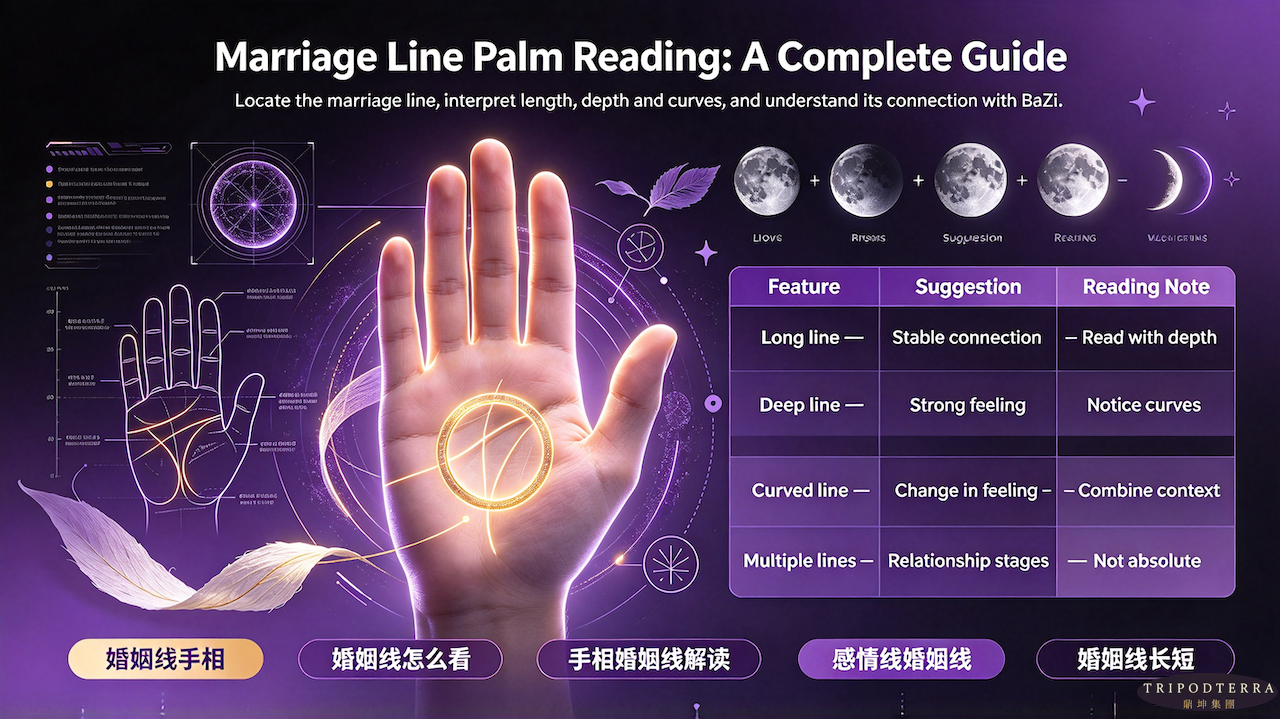
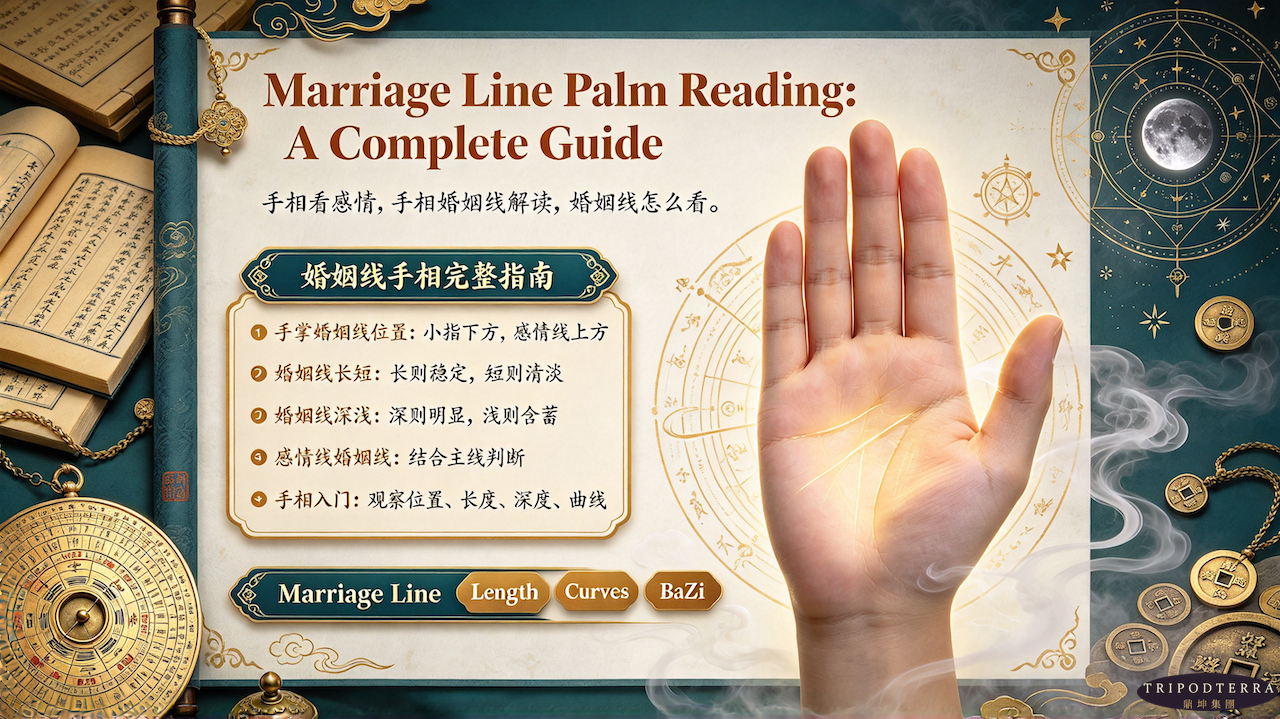
In palmistry, the marriage line (also called the affection line or relationship line) is one of the small horizontal creases found on the outer edge of the palm, just beneath the little finger and above the heart line. It sits on the mount of Mercury, the fleshy area at the base of the pinky.
Unlike the life line or heart line, the marriage line is short and often faint, which is exactly why so many people misread it. This guide walks through where to find it, how traditional palmistry interprets its shape, and how to hold those interpretations lightly.
A quick note before we begin: palmistry is a traditional symbolic art, not a science. Nothing in this article is a prediction of your actual marital future. Treat it as cultural learning and self-reflection — for reference only.
2. How to Locate Your Marriage Line
2.1. Step-by-step placement
Hold your dominant hand palm-up under good light.
Find the heart line — the long crease running across the upper palm, below the fingers.
Share
Daily Fortune Newsletter
One daily BaZi reading, straight to your inbox. Free, unsubscribe anytime.
Look at the outer edge of the palm, between the base of the little finger and the heart line.
The short horizontal lines in that narrow band are the marriage lines. Most people have one to three.
2.2. Which hand to read?
Many schools of palmistry read the dominant hand as the present and future, and the non-dominant hand as inherited tendencies or early life. Others compare both hands to see what has shifted. If you already follow Chinese metaphysics, this mirrors the idea of a natal chart versus lived experience — the map and the journey.
2.3. Common mistakes
Confusing the marriage line with the health line or the edge of the heart line.
Reading a single faint crease as definitive. Lines change over months and years.
Ignoring the rest of the hand. In palmistry, no single line stands alone.
3. Reading the Marriage Line: Traditional Interpretations
3.1. Length
A longer marriage line is traditionally associated with a long, steady partnership or with placing a lot of importance on relationships. A short line is not "bad" — it may simply suggest a relationship that is intense but bounded, or someone who values independence.
3.2. Depth and clarity
Deep and clear: often read as emotional steadiness and clear intentions in love.
Faint or broken: traditionally linked to uncertainty, changing feelings, or a relationship that needs conscious effort.
Chained or feathered: may suggest emotional complexity or many small ups and downs.
3.3. Curves and direction
Upward curve toward the little finger: often interpreted as optimism in love and a tendency to grow through partnership.
Downward curve toward the heart line: sometimes read as emotional sensitivity or a tendency to give more than you receive.
Straight and level: associated with pragmatism and reliability.
3.4. Multiple lines
Having two or three marriage lines is common and does not mean multiple marriages. Traditional readings vary: some see the strongest line as the significant bond, others see each line as a major relationship chapter. In modern practice, most readers treat multiple lines as a sign of a rich relational life rather than a count of weddings.
3.5. Forked ends and islands
A fork at the end of the line is often read as a partnership that develops in stages, or as two people with different rhythms learning to align. Small oval "islands" on the line are traditionally linked to periods of strain or misunderstanding — again, a symbolic marker, not a verdict.
3.6. Timing conventions
Some palmists estimate the timing of a relationship by dividing the marriage line into segments. These methods differ widely between teachers and are best treated as storytelling devices rather than forecasts. If you want a more structured timing framework, Chinese astrology offers its own systems — see our BaZi introduction for how birth charts handle relationship timing.
4. What the Marriage Line Does Not Tell You
It is worth being direct: the marriage line cannot tell you whether you will marry, when, or to whom. It cannot describe your partner's appearance, income, or character. Any reader who claims certainty on these points is overstepping.
What palmistry can do is offer a vocabulary for thinking about how you approach closeness — whether you tend to rush, withdraw, over-give, or stay steady. That reflective use is where the practice has real value.
5. Marriage Line vs. Other Relationship Markers
5.1. The heart line
The heart line describes your general emotional style — how you love, express affection, and process feeling. The marriage line is narrower: it speaks to specific bonds. Read them together. A deep heart line with a faint marriage line tells a different story than the reverse.
5.2. The mount of Venus
The fleshy base of the thumb, the mount of Venus, is traditionally associated with warmth, sensuality, and family feeling. A well-developed mount paired with a clear marriage line is often read as strong relational capacity.
5.3. The life line
If you are new to palmistry, start with the life line guide before layering in relationship lines. Understanding the major lines first makes the smaller ones easier to place.
6. Combining Palmistry with Chinese Metaphysics
Many readers on our platform use palmistry as a visual, intuitive layer alongside chart-based systems. The two traditions developed independently, but they ask similar questions.
6.1. BaZi and relationship patterns
In BaZi (Four Pillars), relationship themes are read through the Day Master, the spouse palace (the day branch), and the interaction of the five elements. Where palmistry looks at a single crease, BaZi looks at the whole configuration of your birth moment. If you want to explore that, our five elements overview is a good starting point, and you can also book a BaZi consultation.
6.2. Zi Wei Dou Shu
Zi Wei Dou Shu maps relationship dynamics through palaces and stars, offering a more narrative, situation-based reading than palmistry's static lines. See our Zi Wei service page if you would like a structured chart reading.
6.3. Accuracy and birth time
One practical note: chart-based systems depend heavily on accurate birth time. If you were born near a time-zone boundary or during daylight saving, check our guide to true solar time before drawing conclusions.
7. Practical Tips for Self-Reading
Photograph your palm in natural light and compare over months. Lines do shift subtly.
Read both hands and note differences rather than treating one as authoritative.
Keep a journal of what you notice, and separate observation from interpretation.
Avoid reading for anxiety. If a line worries you, that is a sign to step back, not to look closer.
Do not use palmistry for medical or financial decisions. For anything health-related, consult a qualified professional.
8. Frequently Asked Questions
8.1. Can the marriage line predict divorce?
No. Traditional readings sometimes associate broken or islanded lines with difficulty, but this is symbolic language, not prediction. Real relationships are shaped by communication, circumstances, and choice.
8.2. Why do I have no visible marriage line?
Faint lines are common and often simply reflect skin texture, lighting, or the way your hand is held. Many people find a line only under angled light.
8.3. Does the left hand or right hand matter more?
Practice varies. A common approach is to read the non-dominant hand as underlying tendency and the dominant hand as current expression. Compare both and see which reading feels more useful to you.
8.4. Is palmistry compatible with Chinese astrology?
They are separate traditions with different logic. Many readers use palmistry for immediate, visual impressions and charts for structural analysis. Neither replaces the other, and neither should be treated as certainty.
9. A Closing Thought
The marriage line is a small crease with a large reputation. Read it with curiosity, not fear. If you enjoy this kind of symbolic reflection, you may also like our guides to face reading and love tarot readings — different tools, same underlying question about how we connect.
All content on this page is for cultural interest and self-reflection only. It is not a prediction, diagnosis, or professional advice. 内容仅供参考。
Marriage Line Palm Reading: Meaning and How to Read — TripodTerra