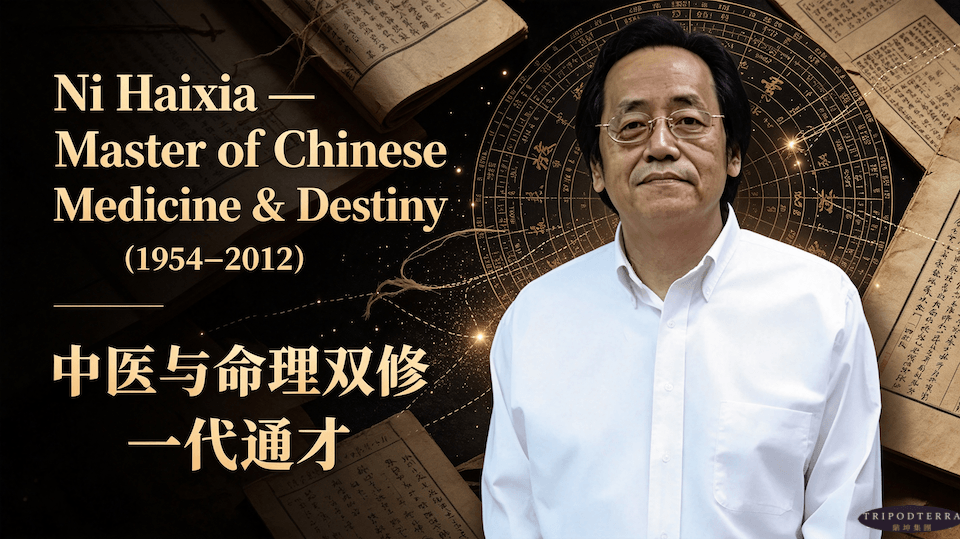
Ni Haixia — Master of Chinese Medicine & Destiny (1954–2012)
Ni Haixia (1954–2012) was a Taiwanese-born doctor of Chinese medicine who practiced in the United States and taught classical herbal formulas, BaZi and Zi Wei Dou Shu to students worldwide. His guiding idea — that medicine and destiny study walk one path — still shapes how people learn both arts today.
722 readsSeptember 10, 2026
Contents
🧑
Free BaZi Chart
Enter birth info, get your BaZi chart + Five Elements analysis
If you have spent any time in Chinese-speaking communities online, you have probably met his name attached to lecture videos: a stocky man in a polo shirt, writing Chinese characters on a whiteboard, telling a room of students that a doctor who cannot read a birth chart is missing half of medicine. That man was Ni Haixia (倪海厦), known simply as "Teacher Ni" (倪师) to the students and patients who followed him across two decades. He died in early 2012, at his home in Taipei, at just 58 years old — and his recorded lectures kept spreading anyway, passed from hard drive to hard drive until they reached an audience far larger than the classrooms he taught in.
Ni Haixia is a genuinely unusual figure in modern Chinese metaphysics. He was a working clinician — a doctor of Traditional Chinese Medicine (TCM) who ran a busy practice in Florida — and simultaneously a teacher of destiny study who lectured on BaZi (八字), Zi Wei Dou Shu (紫微斗数), the I Ching and the feng shui of dwellings. In his own words, widely repeated by his students, the two fields were not hobbies that happened to share a weekend: they were one discipline. Chinese medicine and Chinese metaphysics grow from the same root — yin and yang, the five elements, the observation of how time and climate shape a human being — and Ni Haixia spent his career arguing that each art makes sense only when you can see the other one behind it.
Share
Daily Fortune Newsletter
One daily BaZi reading, straight to your inbox. Free, unsubscribe anytime.
This article tells his story, sketches the core ideas he taught, and shows what a modern student of BaZi can still take from him. A note on framing before we begin: everything below about destiny and medicine is presented the way traditional Chinese learning presents it — as a coherent traditional framework for reflection, not as established fact, and certainly not as medical advice. If you are curious about the systems Ni Haixia taught, this is an introduction; if you need healthcare, please see a licensed professional.
1. Who Ni Haixia was
A student before he was a teacher. Ni Haixia was born in 1954 in Taiwan, into a family from Ruian in Zhejiang province that had moved to the island after the war. By his own account, medicine found him before he found it. As a teenager he was more interested in rock guitar than in anything classical — and then his older sister fell ill. With no physician in the family to turn to, the young Ni picked up a copy of the Qing dynasty classic Yi Zong Jin Jian (《医宗金鉴》), the Golden Mirror of the Medical Tradition, and studied it until he could work out a formula himself. The story his students tell is that the formula worked, and that the experience decided his path: from then on, the classics were his real curriculum.
He kept studying in two directions at once. At university he enrolled in political science, but spent his free hours on the subjects that fascinated him — he taught himself Zi Wei Dou Shu, feng shui, face reading and I Ching divination, and he found teachers for medicine: the acupuncturists Zhou Zuoyu (周左宇) and Xu Jimin (徐济民), and later the classical-formula master Jiang Zuojing (姜佐景), from whom he absorbed the "jingfang" (经方) school — the tradition that treats illness with the compact, powerful formulas recorded in Shang Han Lun (《伤寒论》) and Jin Gui Yao Lue (《金匮要略》). After military service in the Matsu islands, where his acupuncture skill earned him the local nickname "Matsu's miracle doctor," he returned to Taipei and — by his own later account — supported himself for a time as a fortune-teller under an assumed name, practicing the very arts of reading people he would later teach openly. A physician who had also lived as a reader of charts: it is hard to imagine a better preparation for the "medicine and destiny" synthesis he became known for.
The Florida years. In 1980 Ni Haixia emigrated with his family to the United States and settled in Florida. There he earned a doctoral degree in Chinese medicine, became a licensed acupuncturist and physician of Chinese medicine, and opened a clinic he named "Han Tang" (汉唐) — the name evoking the Han and Tang dynasties, the classical golden ages whose texts he taught. In 1995 he founded the American Han Tang Institute of Chinese Medicine, one of the better-known Chinese medical teaching schools in the United States at the time, and he served for years as its dean. He treated a large and demanding patient population, many of them seriously ill people who had been told Western medicine had no more to offer; more than one memorial account records that his patients called him "the last hope."
His standing went beyond his own clinic. From 2000 to 2003 he was appointed by the governor of Florida to the state's Acupuncture Advisory Council, where he served as a member and vice-chairman. And all through the 1990s and 2000s he taught constantly — small classes in his clinic, intensive seminars, and above all the recorded lecture series that became his real monument.
Year
Milestone
1954
Born in Taiwan; ancestral family roots in Ruian, Zhejiang
Late 1970s
Military service in Matsu; studies jingfang medicine under Jiang Zuojing
1980
Emigrates to the United States, settles in Florida
1991
Registered as a Florida acupuncturist
Late 1980s–1995
Opens the Han Tang clinic; founds the American Han Tang Institute of Chinese Medicine (1995)
2000–2003
Appointed to the Florida Acupuncture Advisory Council (member, later vice-chairman)
2004–2005
Begins the Ren Ji medical lecture series in Taipei, later released as books and DVDs
2007
Starts the Di Ji ("Earth Records") field project — unfinished at his death
2010–2011
Returns to Asia; opens Han Tang jingfang clinics in Taipei (2010) and Shenzhen (2011)
2012
Dies in Taipei on January 31
2. Two codes: Tian Ji and Ren Ji
Ni Haixia organized his teaching into two great recorded series, and the pair of them is the clearest evidence of how seriously he took the unity of medicine and destiny.
Tian Ji (天纪), the "Heavenly Records" — his destiny-studies curriculum, taught in Taipei from the late 1980s and published from 1994. It ranged across the I Ching, BaZi, Zi Wei Dou Shu and the feng shui of dwellings (阳宅). The name is deliberate: these are the arts of reading the "heavenly" patterns of time — the cycles of years, months and hours under which a person is born.
Ren Ji (人纪), the "Human Records" — his medical curriculum, taught in Taipei from 2004 onward and released as books and DVDs. It walked students through the five pillars of the classical medical library: acupuncture (keyed to Zhen Jiu Da Cheng), the Huangdi Neijing (Yellow Emperor's Inner Canon), the Shennong Bencao Jing (herbal classic), Shang Han Lun and Jin Gui Yao Lue — the texts of the jingfang tradition, plus recorded clinical internships where he treated real patients in front of his students.
Di Ji (地纪), the "Earth Records" — the series he planned but never finished: a field project to document medicinal herbs and folk remedies across the world. He started it in 2007 and talked about it often in his later lectures; after 2012 it remained, like so many of his plans, a promise to his students that no one else could keep.
The logic of the three names is itself a statement of his worldview: Heaven (天) is the timing you were born into, Earth (地) is the world your body lives in, and Humanity (人) is the art of keeping that body aligned with both. A reader of charts studies the first; a physician works in the third; Ni Haixia's point was that none of the three can be understood in isolation.
3. "Medicine and destiny walk one path"
The idea Ni Haixia is most remembered for is usually compressed into four characters: 医命同道 — "medicine and destiny share one way." It sounds like a slogan, but in his teaching it was a working method, and it rests on a genuinely old Chinese premise.
In the classical view, the same grammar organizes the sky and the body. The five elements (五行) that structure a BaZi chart — Wood, Fire, Earth, Metal, Water — are the same elements that structure the organs in Chinese medical theory. The seasons that make a day master strong or weak are the seasons that govern how the body's qi rises and falls. Classical physicians did not treat this as a metaphor. The Neijing tradition maps the elements onto organs, seasons, emotions, climates and tastes in one continuous table:
Element
Organs (zang/fu)
Season
Classical association
Wood (木)
Liver (肝) / Gallbladder (胆)
Spring
growth, decisiveness, anger
Fire (火)
Heart (心) / Small Intestine (小肠)
Summer
warmth, joy, visibility
Earth (土)
Spleen (脾) / Stomach (胃)
Late summer
nourishment, worry, stability
Metal (金)
Lungs (肺) / Large Intestine (大肠)
Autumn
boundary, grief, refinement
Water (水)
Kidneys (肾) / Bladder (膀胱)
Winter
storage, fear, depth
In this framework, a person born in a Wood-heavy spring chart carries a different constitutional weather from a person born in a dry autumn — and a physician who knows which one he is treating, Ni Haixia argued, understands why two patients respond differently to the same illness and the same formula. He also taught the classical doctrine of 五运六气 (the five movements and six qi), in which each year's stem-and-branch pair describes a climatic pattern that shapes that year's epidemics and illness tendencies. To the traditional physician this is not superstition but applied observation: the annual cycle is written in the calendar, and the body lives in the calendar. Ni Haixia pushed the same logic one step further, down to the level of the individual: the calendar your body was born into, he insisted, is part of your medical history. That is why he wanted his doctors to read birth charts — not to tell fortunes, but to see the patient's baseline more clearly.
It is worth being precise about what this does not mean. Reading a birth chart has never been a diagnostic tool in any verifiable sense, and no responsible modern practitioner treats "your element is weak" as a finding equivalent to a lab result. What the traditional framework offers is something else: a language for thinking about constitution, seasonality and temperament that some people genuinely find useful for self-reflection. Ni Haixia's distinctive contribution was to insist, loudly and repeatedly, that the two languages — the physician's and the chart reader's — were one language, and that mastering only half of it made you half a practitioner of either art.
4. What he taught about BaZi
Ni Haixia was not primarily known as a BaZi theorist — his destiny-studies reputation rested on Zi Wei Dou Shu and the I Ching — but the BaZi principles he taught were the classical ones, delivered with his characteristic bluntness. The core rule he drilled into students is the one preserved in his teaching and repeated by his students ever since: 以日为主,以月为纲 — "take the Day as the lead; take the Month as the guideline." If you are new to BaZi, this single sentence is worth unpacking, because it contains most of the system's practical method:
The Day is the lead. In every chart, the heavenly stem of the day pillar is the Day Master (日主) — the character that stands for "you." Everything else in the chart — the other seven characters, the luck cycles, the passing years — is read in relation to this one stem. If you do not know which of the ten stems you were born under, you do not yet have a chart to read; finding it is the first step of the whole tradition. A free TripodTerra chart will show you yours in seconds, and this plain-language guide to the Day Master explains what each of the ten stems tends to mean.
The Month is the guideline. The month pillar — specifically the "month command" (月令) — is the most powerful character in the chart after the Day Master itself, because it carries the season's qi. Classical theory holds that the month decides whether your Day Master is "in season" (得令) or not, and therefore whether you are structurally strong or weak. Wood born in spring, when Wood is in command, starts strong; Wood born in autumn, when the season's Metal is cutting Wood, starts under pressure. The same logic runs through all five elements:
Day Master
Born in season — 得令 (in command)
Born off season — 失令 (out of command)
Wood (甲/乙)
Spring — wood thrives
Autumn — metal cuts wood
Fire (丙/丁)
Summer — fire blazes
Winter — water douses fire
Earth (戊/己)
Late summer — earth is at full strength
Spring — wood drains earth
Metal (庚/辛)
Autumn — metal sharpens
Summer — fire melts metal
Water (壬/癸)
Winter — water deepens
Late summer — earth dams water
Whether you are strong or weak by this test determines the whole strategy of a reading: a strong day master can carry the wealth, officer, and other resources that a weak one would be crushed by, so the same ten characters can describe two very different lives depending on which month they sit in. From strength and season, the classical reader then derives the chart's "favorable elements" (用神) — the elements the person most needs more of — and watches them arrive and depart in ten-year luck cycles (大运) that unfold from the month pillar.
Note how closely this mirrors the medical logic of the previous section. The month is the season; the season is the climate the day master was born into; "is this character in season?" is the same question as "what constitutional weather did this body start in?" That is 医命同道 showing up inside the mechanics of a chart — which is precisely why Ni Haixia taught BaZi the way he did, as a physician's subject rather than a fortune-teller's parlor trick. If you want to see the principle at work on your own chart, generate it free and look at which season your month pillar belongs to; then compare it with the yearly fortune calendar to feel how the same seasonal logic repeats at every scale of time.
He gave his students a second destiny system as well: Zi Wei Dou Shu (紫微斗数), the "Purple Star" system of 12 palaces that maps a life into sectors such as the self, wealth, career and relationships. In his Tian Ji lectures the two systems appear side by side — BaZi reading the elemental weather of time, Zi Wei reading the structure of a life's twelve rooms — and he taught both as practical skills: how to read a person's temperament, how to time a decision, and how to arrange a dwelling (阳宅风水) so its doors, beds and stoves support rather than fight the occupant. His style throughout was anti-mystery: he insisted that a chart is a map of tendencies, not a script of events, and that the point of reading it is to make better decisions with the time you have.
5. The teacher people still argue about
Why does a man who died in 2012 still fill YouTube recommendation feeds, Bilibili playlists and Chinese-language study groups in 2026? Partly because his lectures are genuinely good teaching — energetic, concrete, full of cases, allergic to hand-waving. He taught from the original texts rather than from secondary summaries, he could reproduce formulas and pulse patterns from memory, and he had the rare gift of making an ancient text feel like something happening in the room. The Ren Ji series in particular became a gateway drug into classical medicine for a whole generation of Chinese-speaking students overseas, many of whom had no other access to a teacher of that caliber.
But his legacy is contested, and a fair portrait has to say so plainly. Ni Haixia was a polemicist. He attacked modern institutional TCM for drifting away from the classics, and he attacked Western medicine in terms that went far beyond professional disagreement — dismissing whole branches of it, making dramatic claims about causes of disease, and encouraging patients to refuse treatments that their own doctors recommended. Some of his specific claims (for example, about coffee, vaccines and cancer) alarmed medical professionals and have not survived contact with evidence; his followers sometimes treated him as infallible in ways he himself never claimed. He also ran his Taiwan teaching and clinics in a legal gray area that drew criticism from local practitioners. The honest summary is this: he was a brilliant traditional teacher whose medical certainties outran the evidence in places, and whose sharpest critics and warmest students were both reacting to the same man. Anyone who studies his lectures should hold two thoughts at once — that his reading of the classical tradition is rich and often illuminating, and that his authority was human, not divine. Nothing in this article should be read as medical advice, and no online lecture, however charismatic, is a substitute for a licensed clinician.
6. What a modern BaZi student can take from Ni Haixia
Strip away the polemics, and three practical lessons survive intact — and they happen to be excellent advice for anyone starting out with BaZi today.
First, start from the texts. Ni Haixia's students read the classics directly — not just summaries of the classics — because he believed the framework only makes sense in the original builders' hands. For BaZi that means starting with the sub-Ziping tradition: the system of the Day Master, ten gods and month command that Xu Ziping systematized a thousand years ago is still the skeleton of every modern reading, including ours.
Second, anchor every abstraction to an actual chart. Ni Haixia was allergic to students who could recite theory but could not read a real person's eight characters. The equivalent move today is to stop memorizing and start looking: pull up your own free chart — with the true solar time correction that matters more than most people expect — and spend time with its five basic facts: your Day Master, your season, your strength, your favorable elements, and the luck cycle you are in right now. The BaZi basics section of TripodTerra walks you through exactly this order, and the intro to BaZi article gives you the map before you dive into details.
Third, treat the chart as a mirror, not a verdict. For all his confidence, Ni Haixia's actual teaching repeated one refrain that newcomers often miss: a chart shows tendencies, and the point of knowing your tendencies is to work with them — not to surrender to them. That is also the view of the wiser teachers of the tradition, from Nan Huai-chin, who insisted knowing fate is for bettering yourself, to Zeng Shiqiang's "three parts heaven, seven parts effort". A chart that tells you your autumn Wood is under pressure is not a sentence; it is a weather report, and weather reports exist so you can dress accordingly.
If you are curious whether the "medicine and destiny" lens fits you personally, there is a gentler way to test it than enrolling in a medical school: look at your own chart's season and elements, then read the classical profile of your constitution and see whether it rings true as self-description. Try an AI conversation about your chart — ask what your element profile suggests about how you recharge, what rhythms suit you, and when you are most in season. BaZi will not diagnose anything, and it will not decide anything for you; what it can do is give you a sharp, coherent language for thinking about yourself — which, in the end, is exactly the language Ni Haixia spent his life insisting that doctors and diviners shared.
Whatever you make of his claims, the man himself was a remarkable demonstration of one traditional belief: that a single framework — yin and yang, the five elements, the turning of the seasons — can organize both a medical practice and a reading of a human life. Whether you arrive at it through the clinic door of BaZi, the almanac page of daily fortune, or the charts of the masters like Li Juming and Chen Bo, that framework is still alive, still coherent, and still waiting to be tested against your own experience. Ni Haixia's chart-reading teacher days began with a teenage boy and a medical classic; yours can begin with eight characters and an open mind — cast your own free chart and see what the season has to say about you.