 TRIPODTERRA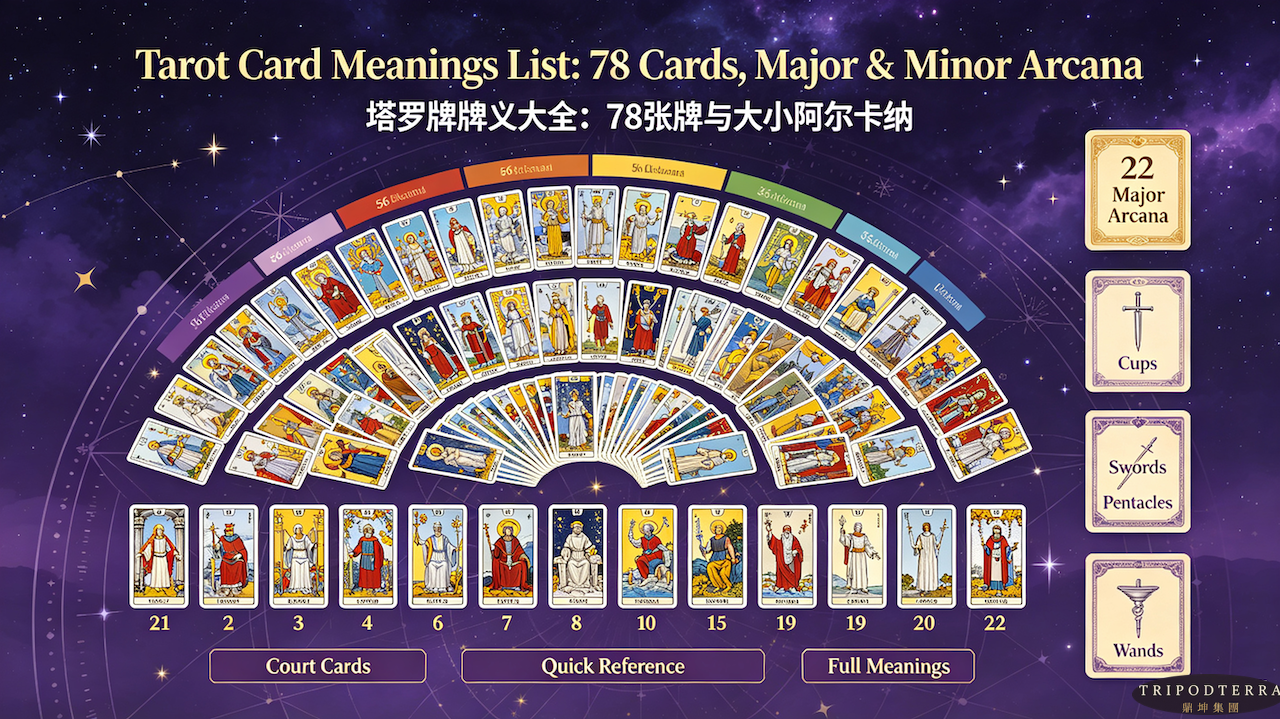
A tarot deck has 78 cards, and every one of them carries several layers of meaning at once. That is exactly why a meanings list is useful — and exactly why a meanings list on its own is never enough.
This page is a tarot card meanings list in the fullest sense: all 22 Major Arcana with upright and reversed readings, all four suits of the Minor Arcana with their themes, all sixteen court cards, and the visual cues in the Rider-Waite-Smith tradition that let you read a card you have never seen before. Treat everything below as traditional tendency and a mirror for self-reflection rather than a prediction about your life. Nothing here is medical, legal, or financial advice.
How to use a tarot card meanings list
Beginners usually open a tarot card meanings list and start memorising all 78 entries. That is the slowest possible route, and it tends to collapse the moment a real reading begins, because no card in a spread ever appears alone.
A better approach: learn the structure first, then the keywords.
| Layer | What it gives you | Why it matters |
|---|---|---|
| Major Arcana vs Minor Arcana | Life themes vs daily events | Tells you how big the card is |
| Suit (Wands/Cups/Swords/Pentacles) | The domain of life | Tells you what the card is about |
| Number or rank | The stage of a process | Tells you where in the story you are |
| Orientation (upright/reversed) | Whether the energy flows or is blocked | Tells you how it is going |
| Position in the spread | What question the card answers | Tells you who or what it speaks to |
Once you hold that frame, a card you have never studied becomes readable. The Queen of Wands is a court card (a person or a mode of being) in the Wands suit (energy, drive, creativity) with a Queen's temperament (inward mastery expressed outwardly). You already know roughly what that means before you look anything up.
Upright versus reversed
A reversed card — one that appears upside down in the spread — is the single most over-mystified idea in tarot. In the Rider-Waite-Smith tradition as taught by most modern readers, reversal is not "the bad version" of a card. It usually indicates one of four things:
- Blocked or delayed — the card's energy is present but cannot move. The Chariot reversed often suggests stalled momentum rather than failure.
- Internalised — the same quality, turned inward. The Hermit upright is a search for wisdom; reversed, it can read as isolation.
- Excess — too much of a good thing. The Sun reversed is not darkness, it is glare.
- Resisted or denied — the thing the card names is being avoided. Justice reversed often points to a decision someone is declining to make.
Some readers never use reversals and read every card upright, letting the surrounding cards carry the tension. That is a legitimate tradition, not a shortcut — the important thing is consistency within a single reading. If you want a deeper look at how a card or a question lands, the AI tarot reading is built for exactly this kind of one-question-at-a-time conversation.
The 22 Major Arcana
The Major Arcana are the 22 cards numbered 0 through XXI, plus no suit. They speak to the larger arcs of a life — identity, choice, loss, growth — rather than to Tuesday's meeting. When several appear in one spread, the tradition reads it as a period of unusual significance.
The sequence is often called the Fool's Journey: card 0 begins it, card XXI completes it.
0 — The Fool. Beginning, innocence, a leap taken before the ground is visible. Upright: a fresh start and the willingness to look foolish while learning. Reversed: recklessness, or the opposite — hesitating at the edge and never jumping.
I — The Magician. Skill, will, resourcefulness. Upright: you already have every tool you need, and this card is about using them deliberately. Reversed: scattered effort, or talent used manipulatively.
II — The High Priestess. Intuition, the inner voice, what has not yet been spoken. Upright: answers that arrive through stillness rather than analysis. Reversed: ignoring your own instinct, or secrets held too tightly.
III — The Empress. Abundance, nurture, creative fertility. Upright: growth that is being fed properly, often in a domestic or creative sense. Reversed: neglect of self-care, or creativity smothered by over-management.
IV — The Emperor. Structure, authority, boundaries. Upright: discipline and clear rules that make things stable. Reversed: rigidity, control, or the absence of any structure at all.
V — The Hierophant. Tradition, teaching, shared belief. Upright: guidance from a system, a mentor, or a community with a long memory. Reversed: questioning inherited rules, or following them without conviction.
VI — The Lovers. Choice, union, alignment of values. Upright: a meaningful relationship or a decision that defines you. Reversed: misalignment, avoidance of a choice, or values that no longer match.
VII — The Chariot. Willpower, direction, momentum. Upright: winning through focus and keeping opposing forces pointed the same way. Reversed: drifting, or pushing hard in conflicting directions.
VIII — Strength. Patience, courage, gentle mastery. Upright: influence through steadiness rather than force. Reversed: self-doubt, or the exhausting habit of forcing everything.
IX — The Hermit. Solitude, reflection, inner search. Upright: a deliberate withdrawal to find your own answer. Reversed: loneliness, or withdrawal that has stopped being useful.
X — Wheel of Fortune. Cycles, timing, turning points. Upright: a change in circumstance, often arriving on its own schedule. Reversed: resistance to an inevitable turn, or a stretch of bad timing.
XI — Justice. Fairness, cause and effect, accountability. Upright: decisions weighed honestly, and consequences that follow from actions. Reversed: imbalance, bias, or refusing to take responsibility.
XII — The Hanged Man. Pause, surrender, a shift in perspective. Upright: value found in waiting rather than pushing. Reversed: stalling, or sacrifice that has stopped meaning anything.
XIII — Death. Endings, transition, transformation. Upright: something concluding so that something else can begin — rarely literal. Reversed: clinging to what is already finished.
XIV — Temperance. Balance, patience, blending. Upright: slow, measured combination of opposites. Reversed: excess, impatience, or a mix that has gone out of proportion.
XV — The Devil. Attachment, compulsion, self-imposed limits. Upright: a pattern you keep choosing, often with visible chains that are not locked. Reversed: breaking free, or the first honest look at the pattern.
XVI — The Tower. Upheaval, revelation, sudden change. Upright: a structure built on a false foundation giving way. Reversed: a crisis delayed, or change fought off at growing cost.
XVII — The Star. Hope, renewal, quiet faith. Upright: calm recovery after difficulty and a reason to keep going. Reversed: doubt, discouragement, or hope withheld from yourself.
XVIII — The Moon. Illusion, dreams, the unconscious. Upright: unclear ground, where instinct matters more than information. Reversed: confusion beginning to clear, or a fear finally named.
XIX — The Sun. Joy, clarity, vitality. Upright: visibility, warmth, and a genuine yes. Reversed: weariness, or brightness that has become pressure.
XX — Judgement. Awakening, reckoning, a call answered. Upright: a moment of honest self-assessment and a decision to rise to it. Reversed: self-judgement that paralyses, or a calling repeatedly declined.
XXI — The World. Completion, wholeness, a cycle closed. Upright: an accomplishment fully realised, and readiness for the next beginning. Reversed: a last loose end, or completion that never quite feels finished.
Major Arcana quick reference
| # | Card | Upright keywords | Reversed tendency |
|---|---|---|---|
| 0 | The Fool | New start, innocence, leap of faith | Recklessness, hesitation |
| I | The Magician | Skill, will, resourcefulness | Scattered effort, manipulation |
| II | The High Priestess | Intuition, inner knowing, silence | Ignored instinct, secrets |
| III | The Empress | Abundance, nurture, creation | Neglect, smothering |
| IV | The Emperor | Structure, authority, stability | Rigidity, control |
| V | The Hierophant | Tradition, teaching, guidance | Convention questioned, dogma |
| VI | The Lovers | Union, choice, alignment | Misalignment, avoidance |
| VII | The Chariot | Willpower, direction, victory | Drift, conflicting pulls |
| VIII | Strength | Patience, courage, quiet mastery | Self-doubt, force |
| IX | The Hermit | Solitude, reflection, searching | Isolation, withdrawal |
| X | Wheel of Fortune | Cycles, timing, turning point | Resistance, bad timing |
| XI | Justice | Fairness, truth, accountability | Imbalance, bias |
| XII | The Hanged Man | Pause, surrender, new angle | Stalling, empty sacrifice |
| XIII | Death | Endings, transition, renewal | Clinging to the finished |
| XIV | Temperance | Balance, patience, blending | Excess, impatience |
| XV | The Devil | Attachment, compulsion, limits | Release, honest seeing |
| XVI | The Tower | Upheaval, revelation, collapse | Delayed crisis, resistance |
| XVII | The Star | Hope, renewal, faith | Doubt, discouragement |
| XVIII | The Moon | Illusion, dreams, instinct |
The Minor Arcana: four suits
The 56 Minor Arcana cards are divided into four suits of fourteen: Ace through Ten, plus four court cards. Where the Major Arcana describe the chapter, the Minor Arcana describe the paragraph — the everyday events, moods, and people that fill it.
The four suits map onto four domains of ordinary life, and the mapping is stable across nearly every modern deck, even when the artwork changes completely.
| Suit | Element | Domain | Typical themes |
|---|---|---|---|
| Wands | Fire | Action, will, creativity | Drive, ambition, projects, momentum, spark |
| Cups | Water | Emotion, relationships, intuition | Feelings, love, dreams, connection, mood |
| Swords | Air | Thought, communication, conflict | Ideas, truth, decisions, words, mental strain |
| Pentacles | Earth | Material life, work, body, money | Career, resources, health habits, security, craft |
A quick way to keep them apart: Wands do, Cups feel, Swords think, Pentacles build. Most everyday questions land in one of those four.
Wands (Fire) — the suit of action
Wands are about energy moving outward: starting things, pursuing them, and keeping the momentum alive. The Ace is a spark of inspiration; the Ten is the weight of having taken on everything.
Cups (Water) — the suit of feeling
Cups are about the emotional and relational layer: what you feel, what you want, who you love. The suit runs from the Ace's overflowing cup to the Ten's shared rainbow.
Swords (Air) — the suit of mind
Swords are the most misunderstood suit. They are not "the bad cards." They are the cards of thinking, speaking, deciding — and, at their harder end, of the strain that thinking too much produces.
Pentacles (Earth) — the suit of matter
Pentacles cover the tangible: work, money, home, health routines, and the slow accumulation of skill. They are the least dramatic suit and often the most consequential.
The court cards
Sixteen cards — a Page, Knight, Queen, and King in each suit — and the ones beginners find hardest, because a court card can be a person, a role, or a mode of behaviour, and you have to decide which.
The usual approach: read it as a person when it answers a "who" question, as a role you are playing when it describes your situation, and as a quality to adopt when it describes what the reading asks of you.
| Page | Knight | Queen | King | |
|---|---|---|---|---|
| Wands | Enthusiastic beginner, curious messenger | Bold, restless, action-first | Warm, magnetic, confidently creative | Visionary leader, owns the direction |
| Cups | Sensitive, romantic, emotionally open | Idealistic, following the heart | Empathetic, intuitively perceptive | Emotionally mature, calmly supportive |
| Swords | Alert, curious, quick-minded | Direct, blunt, fast-moving | Clear-eyed, honest, perceptive | Rational authority, principled judgement |
| Pentacles | Studious, practical, learning the trade | Diligent, methodical, reliable | Resourceful, grounded, caring provider | Established, prosperous, dependable |
A general pattern worth remembering: Pages learn the element, Knights charge with it, Queens hold it inwardly, Kings direct it outwardly. So the Queen of Swords is honest perception held as an inner standard, while the King of Swords is that same clarity exercised as judgement over a situation.
Rider-Waite visual cues worth knowing
The Rider-Waite-Smith deck, illustrated by Pamela Colman Smith in 1909, is the ancestor of most decks in use today. Its great innovation was putting a full scene on every single card — including the numbered Minor Arcana, which older decks left as abstract pip arrangements. That shift is why the deck is still the best one to learn on: the meaning is drawn, not just written.
A few recurring visual conventions repay the attention:
- Facing direction. A figure facing right tends to indicate movement forward and into the future; facing left suggests looking back, reviewing, or hesitating.
- The lemniscate (∞). Appears above the Magician, Strength, and the Two of Pentacles — a mark of balance, continuity, and infinite resource.
- Water and land. Water is the emotional field; solid ground is the material, practical field. Which one a figure stands on tells you what layer of life the card is speaking about.
- Colour as code. Yellow is illumination and intellect; red is passion and action; blue is intuition and depth; white is purity and beginning; grey is uncertainty.
- The number zero. The Fool is the only Major Arcana card numbered 0, unnumbered potential — everything and nothing yet.
- Chains that are loose. The Devil's two figures wear chains with slack in them. The traditional reading is unambiguous: the binding is chosen.
A handful of specific images recur often enough in discussions that they are worth naming directly. The High Priestess sits between a black pillar and a white one, holding a scroll partly concealed — knowledge that is available but not yet revealed. The Hanged Man hangs by one ankle with a serene expression and a halo, which is why the card reads as willing suspension rather than punishment. Death rides a white horse carrying a white rose banner — the rose is the clue that this is transformation, not termination. The Tower is struck by lightning that knocks a crown from its top, and two figures fall from a building whose foundation was never sound. The Star's figure kneels by a pool pouring water onto both land and water, one foot in each. The Moon shows a path between two towers with a dog and a wolf howling and a crayfish emerging from the water — the road between the known and the unknown, travelled by instinct.
How to read cards together
A single card is a sentence. A spread is an argument. The following combination habits are what most readers actually use, and they are far more useful than memorising more keywords.
Count the elements. A spread dominated by Cups speaks about feeling; one dominated by Swords speaks about thinking. If the same suit appears five times out of seven cards, that domain of life is where the weight of the reading sits.
Watch for clusters of numbers. Several low numbers suggest something beginning; several high numbers suggest something nearing its end. Repeated court cards often point to other people being involved, or to the querent's own behaviour being the subject.
Weight the Major Arcana. In a standard spread, roughly a third of the cards will be Majors. If more than half are, the tradition reads it as a period where larger forces are at work and the querent has less day-to-day control. If none appear at all, the reading tends to be about ordinary, self-managed matters.
Read the pairs, not just the positions. Two adjacent cards are usually read as a combination before either is read alone. The Tower next to the Star is a very different message from the Tower next to the Devil — collapse followed by recovery, versus collapse caused by attachment.
Let the reversed cards speak last, not loudest. A reversal modifies a card; it does not replace it. Read the upright meaning first, then apply the reversal as a condition on it.
Ask what the card is asking for. Every card has a direction of action hidden in it. The Four of Swords asks for rest. The Eight of Pentacles asks for practice. The Eight of Cups asks you to leave. A reading you cannot act on is a reading you have not finished interpreting.
Know when to stop. A tarot reading is a structured way to reflect on a situation you already partly understand. It is at its best when it gives you language for something you sensed and had not named — and at its worst when it is asked to make a decision that belongs to you, your doctor, or your financial advisor.
How tarot sits alongside BaZi
For related reading, the yes-or-no tarot guide covers single-question spreads, the tarot reading service walks through how a full session is structured, and the I Ching offers a third divination tradition for comparison. If the intersection of these systems interests you, the Chinese naming guide is a good example of how a different classical framework handles a single practical question.
Quick reference: reading any card in under a minute
| Ask yourself | Then look at | To land on |
|---|---|---|
| Major or Minor? | Card numbering | Life theme, or daily event |
| Which suit? | Wands/Cups/Swords/Pentacles | The domain: action, feeling, mind, matter |
| Which number? | Ace–Ten | The stage of the process |
| Which rank? | Page/Knight/Queen/King | A person, a role, or a quality |
| Upright or reversed? | Orientation | Flowing, blocked, internalised, or excessive |
| What image stands out? | The illustration | The detail the reading is pointing at |
| What is it asking for? | Your own reaction | The action the card implies |
That grid is the whole method. The 78 meanings above are the vocabulary; this is the grammar, and grammar is what lets you read a card you have never seen before.
Start with one card
A list of tarot card meanings is a reference, not a reading. Pick one question you have been circling, draw a single card, and read it against the structure above — suit first, number second, orientation third, and only then the keywords. You will be surprised how much a single card can hold.
If you would rather have a conversation than consult a table, our AI tarot reading takes one question at a time, explains which card came up and why it points where it points, and helps you turn the answer into something you can actually act on. For the wider context, generate your free BaZi chart and read the two side by side.