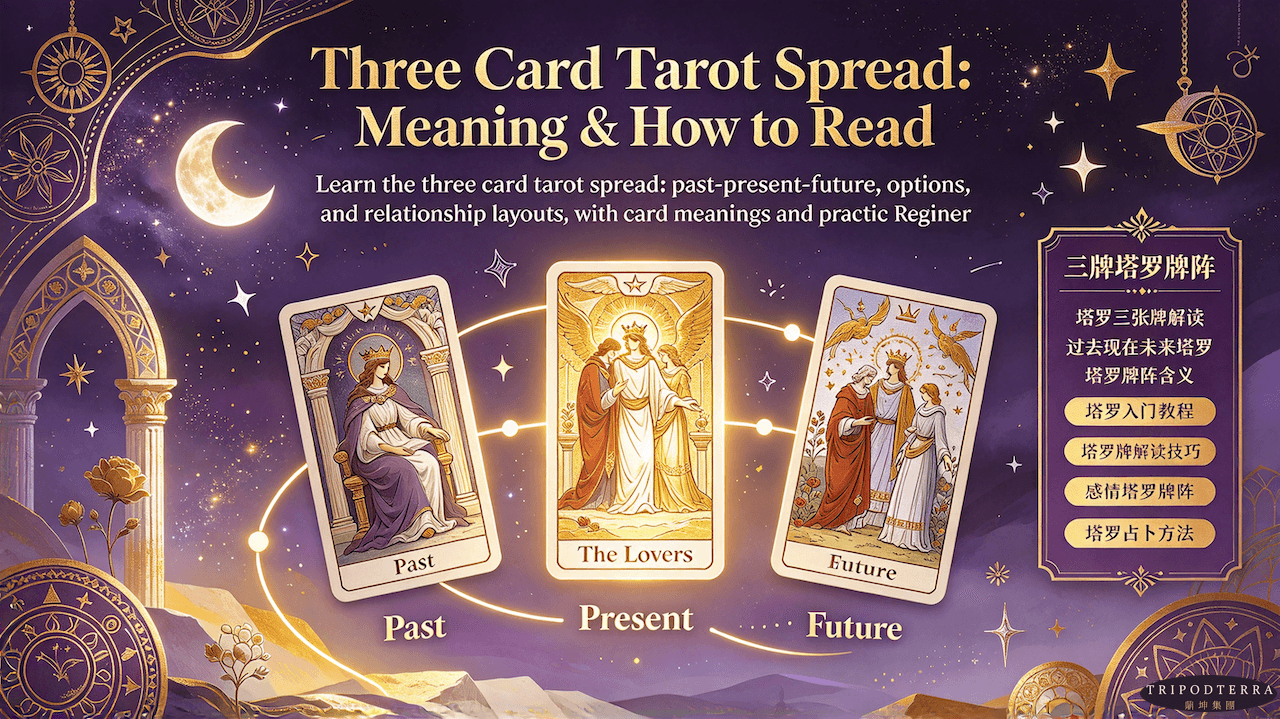
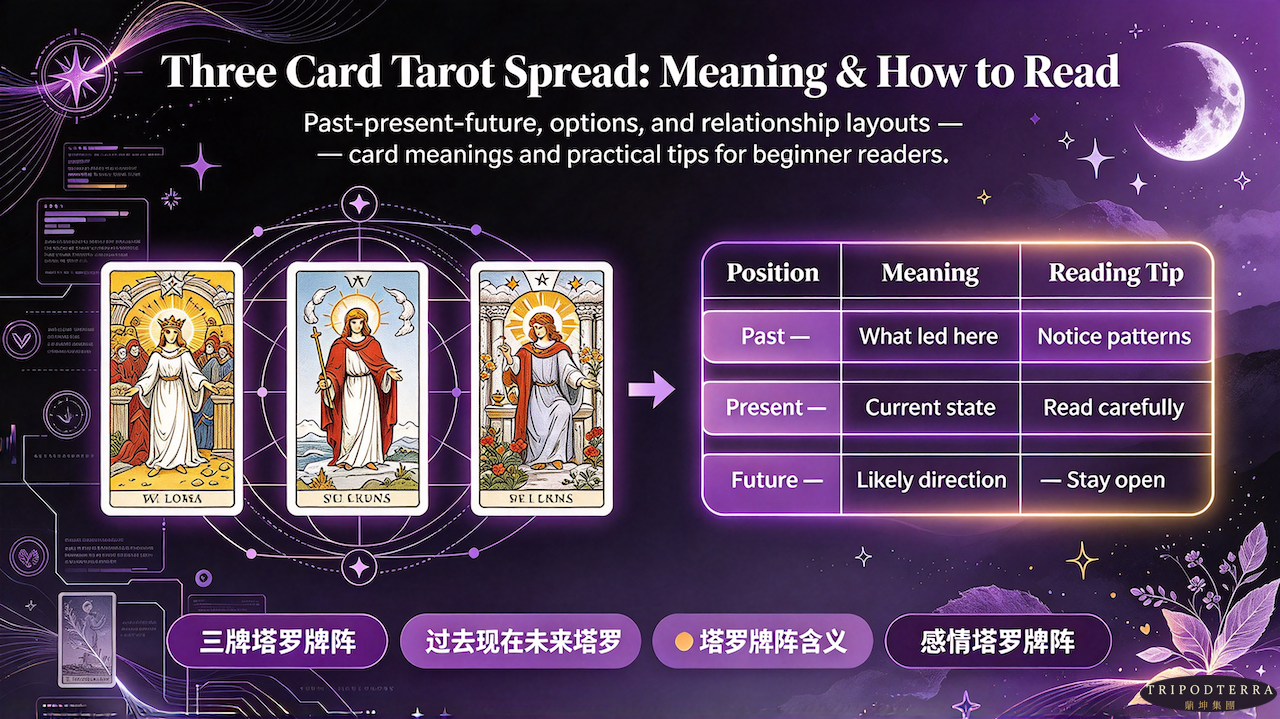
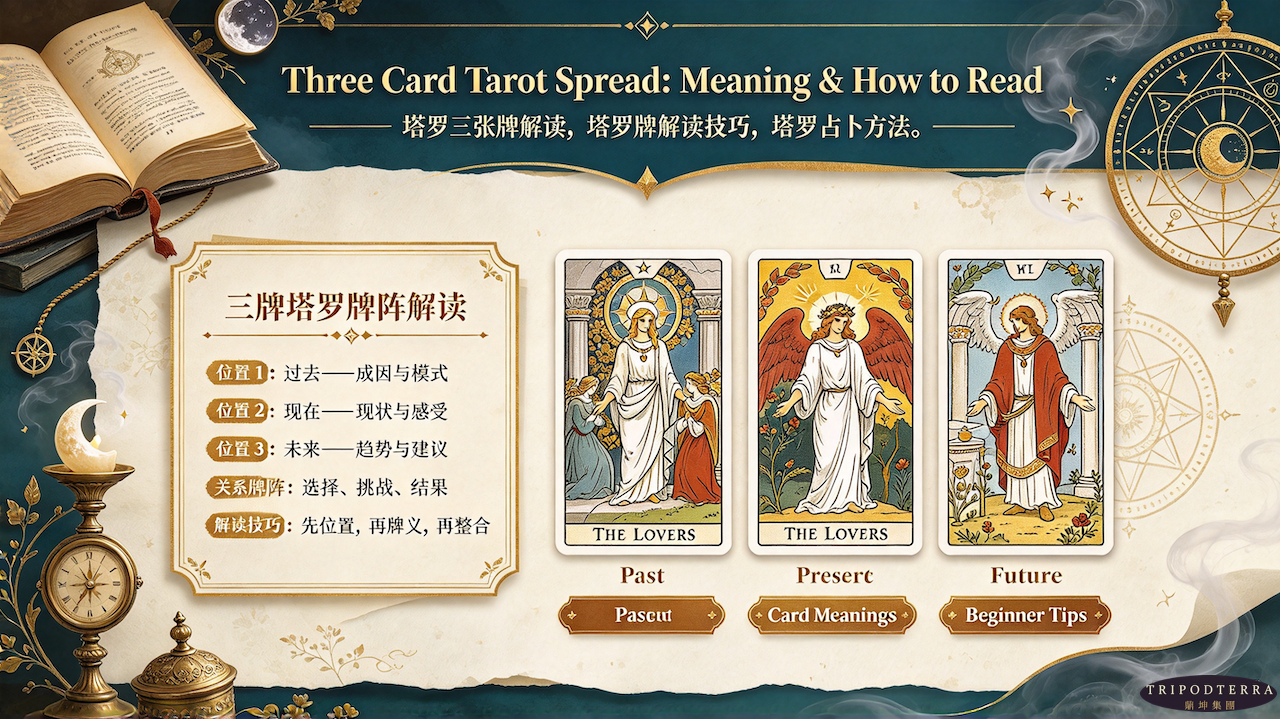
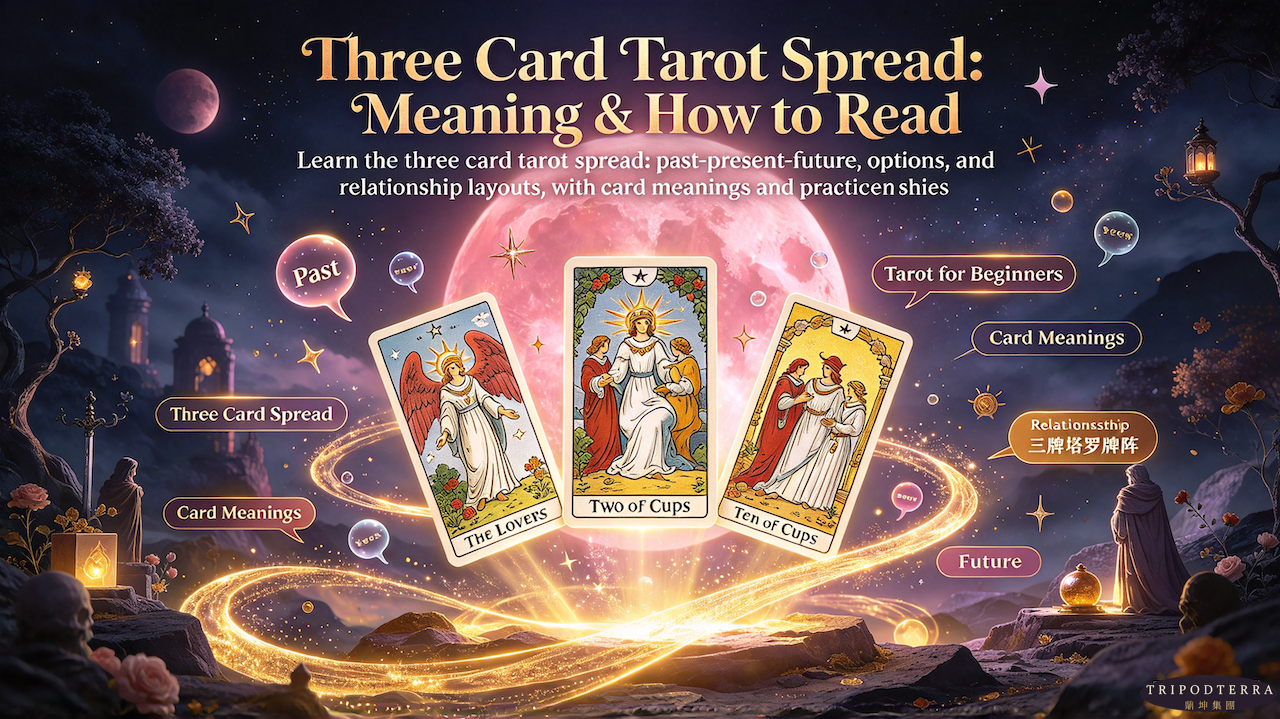
Learn the three card tarot spread: past-present-future, options, and relationship layouts, with card meanings and practical reading tips for beginners.
15 readsOctober 24, 2026
Contents
🧑
Free BaZi Chart
Enter birth info, get your BaZi chart + Five Elements analysis
The three card tarot spread is the most widely used layout in modern tarot practice. As the name suggests, it uses only three cards, drawn from a shuffled deck and placed in a row. Its simplicity makes it the ideal starting point for beginners, while its flexibility keeps it useful for experienced readers who want a quick, focused answer.
Unlike larger spreads such as the Celtic Cross, the three card spread does not overwhelm the querent with detail. Instead, it narrows attention to three key points: a situation's origin, its present state, and its likely direction. In Chinese metaphysics circles, this mirrors the classical idea of 天、地、人 (heaven, earth, human) — three positions that together form a complete picture.
Three is the smallest number that allows a narrative. Two cards give only a comparison; three cards allow a beginning, a middle, and an end. This is why the three card spread feels complete without being complicated.
Share
Daily Fortune Newsletter
One daily BaZi reading, straight to your inbox. Free, unsubscribe anytime.
A beginner can memorize the past-present-future positions in minutes. But the same layout can be read at a much deeper level by considering:
Elemental balance — how many cards are Wands, Cups, Swords, or Pentacles
Major vs. Minor Arcana — whether the situation is driven by fate or by daily choices
Card interaction — whether the cards support, oppose, or modify each other
3. The Classic Past-Present-Future Spread
This is the standard three card layout. Shuffle the deck while holding a clear question in mind, then lay three cards face up from left to right.
3.1. Position 1: The Past
This card shows the root of the situation — events, attitudes, or decisions that led to the present moment. It is not always a distant past; sometimes it refers to something from last week.
How to read it: Ask what foundation was laid here. A difficult card in this position does not mean the past was bad; it may simply show a lesson that is still relevant.
3.2. Position 2: The Present
This is the heart of the reading. It describes the current energy, the querent's state of mind, and the actual conditions surrounding the question.
How to read it: This card often reveals what the querent already senses but has not fully admitted. Pay attention to whether it feels accurate — that is the sign the reading is on track.
3.3. Position 3: The Future
This card shows the likely direction if current trends continue. It is a trajectory, not a fixed destiny.
How to read it: Treat this as advice as much as prediction. If the card is unfavorable, it usually points to what needs to change now.
4. Alternative Three Card Layouts
4.1. Option A / Option B / Outcome
Use this when facing a decision. Place two cards side by side for the two choices, then a third card above or below them for the likely result of the better path.
4.2. Situation / Action / Result
A practical layout for problem-solving. The first card describes the issue, the second suggests the best course of action, and the third shows what follows.
4.3. You / Them / The Relationship
A relationship spread. The first card represents the querent, the second the other person, and the third the dynamic between them.
4.4. Mind / Body / Spirit
A wellness-oriented layout. It is often used for reflection rather than prediction. Remember that tarot is not a substitute for professional medical care.
4.5. Stop / Start / Continue
A coaching spread. The first card shows what to release, the second what to begin, and the third what to maintain.
5. How to Interpret the Three Cards Together
5.1. Read the Story, Not the Cards
The most common beginner mistake is reading each card in isolation. A three card spread is a sentence, not three separate words. Ask yourself: what is the relationship between these images?
5.2. Look for Repeating Suits and Numbers
If two or three cards share a suit, that element dominates the reading. Three Swords suggest mental conflict; three Cups suggest emotional matters; three Pentacles suggest practical or financial concerns; three Wands suggest action and ambition.
If the same number appears twice, that number's theme is amplified. For example, two Fives often point to instability or change.
5.3. Note Major Arcana Density
0 Major Arcana: the situation is largely in the querent's hands
1 Major Arcana: one significant outside force is at work
2 Major Arcana: the matter is strongly fated or karmic
3 Major Arcana: a major life transition is underway
5.4. Consider Reversed Cards
Not every reader uses reversals. If you do, a reversed card usually softens, blocks, or internalizes the upright meaning. In a three card spread, a reversed card in the future position often suggests the outcome is still open.
6. Step-by-Step Reading Process
Set a clear question. Vague questions produce vague readings. "What do I need to know about my career?" works better than "Will I be rich?"
Shuffle and focus. Some readers shuffle until a card falls out; others cut the deck three times.
Lay the cards left to right. Keep the layout consistent so your interpretations stay consistent.
Look at the whole picture first. Note the mood, colors, and figures before assigning positions.
Read position by position.
Synthesize. State the overall message in one or two sentences.
Write it down. A tarot journal is the fastest way to improve.
7. Common Mistakes to Avoid
Asking the same question repeatedly. If you do not like the answer, drawing again will only confuse you.
Treating the future card as fixed. It is a snapshot of a trend, not a verdict.
Ignoring the question. Every card should be read in light of what was asked.
Over-reading. Three cards carry enough meaning. Resist the urge to draw a fourth "clarifier" too often.
8. Three Card Spread vs. Other Layouts
Spread
Cards
Best For
Three Card
3
Quick, focused questions
Celtic Cross
10
Complex situations
Horseshoe
7
Detailed timelines
One Card
1
Daily guidance
The three card spread sits in the sweet spot between a single-card daily draw and a full ten-card analysis.
9. Final Thoughts
The three card tarot spread is popular for a reason: it is simple enough to learn today and rich enough to study for years. Whether you use past-present-future, option comparison, or a relationship layout, the goal is the same — to turn a vague concern into a clear, actionable insight.
Treat the cards as a mirror for reflection, not a source of absolute truth. Used with an open mind, three cards are often more than enough.
内容仅供参考,请理性看待占卜结果。
Three Card Tarot Spread: Meanings & Reading Guide — TripodTerra