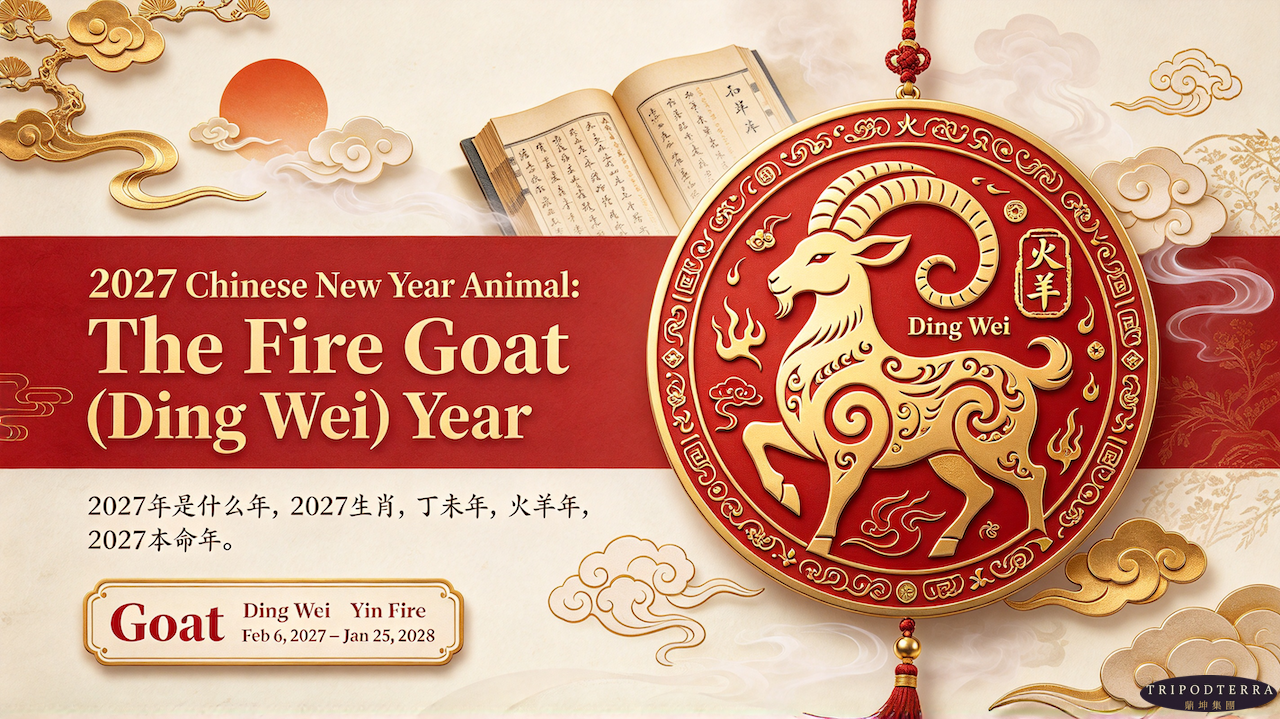
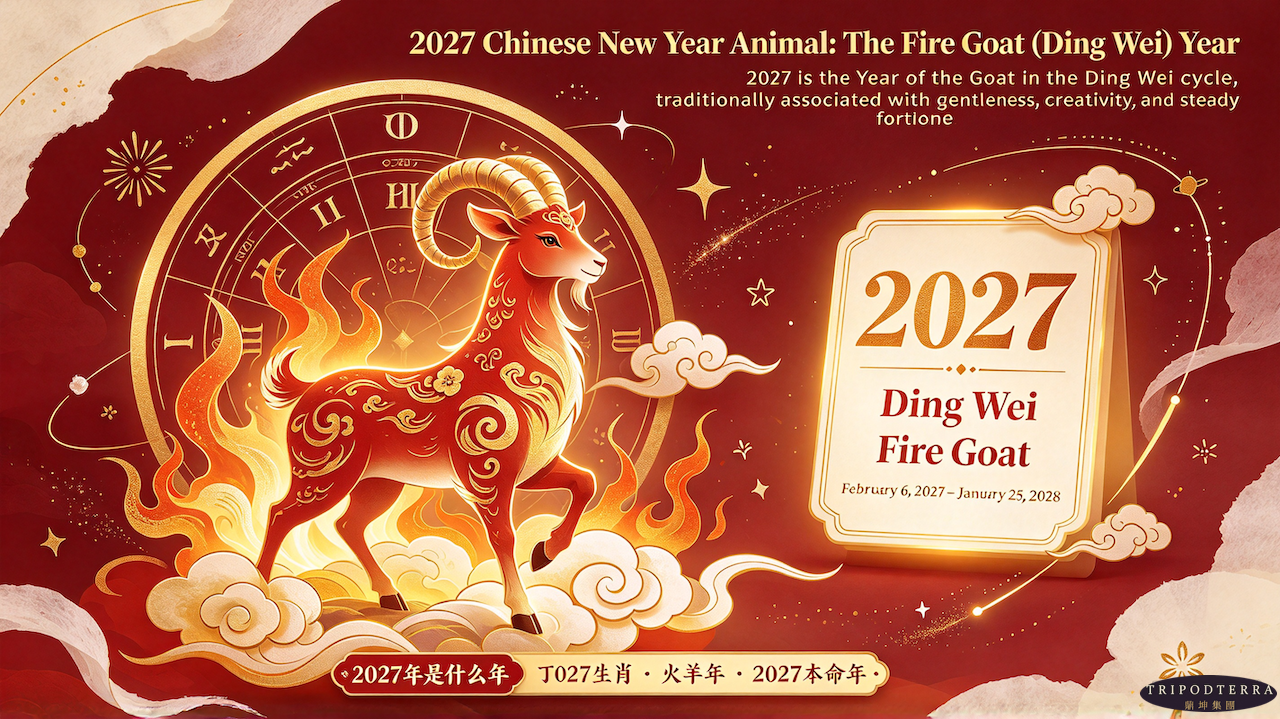
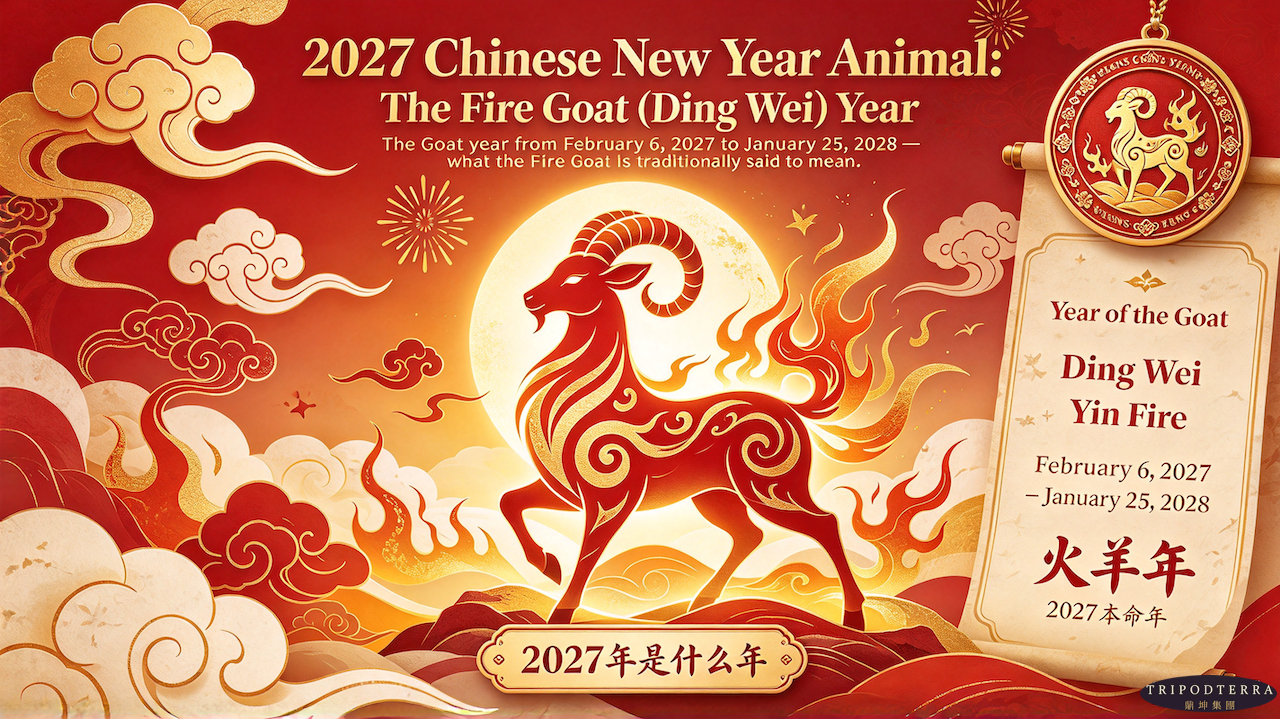
2027 Chinese New Year Animal: The Fire Goat (Ding Wei) Year
The 2027 Chinese New Year animal is the Goat, in a Ding Wei (Yin Fire) year running from February 6, 2027 to January 25, 2028. Here is what the Goat year is traditionally said to mean.
7 readsOctober 7, 2026
Contents
🧑
Free BaZi Chart
Enter birth info, get your BaZi chart + Five Elements analysis
The 2027 Chinese New Year animal is the Goat — 羊 (yáng), the eighth of the twelve zodiac animals — and the year it names is 丁未 (Ding Wei): a Yin Fire Goat year. Chinese New Year 2027 falls on February 6, 2027, and the Goat year runs until January 25, 2028, when the year of the Monkey begins.
That answers the question in two lines. Everything else is what those two lines carry: why the year holds two elements rather than one, what a Fire-on-Earth combination has traditionally been understood to suggest, what the animal's own year means for the people born under it, how the year is said to meet each of the other eleven signs, and how much of this you should actually take seriously.
Share
Daily Fortune Newsletter
One daily BaZi reading, straight to your inbox. Free, unsubscribe anytime.
One note before we start, because it saves confusion. This article is about the year itself — what 2027 is. If your actual question is "what animal am I in 2027?", that is a different question with its own answer, and our companion guide to finding your zodiac sign in 2027 walks through the full table and the birth-date edge cases. Read this piece for the year's character; read that one for your own.
1. The 2027 year at a glance
Marker
Date
What it is
立春 (Start of Spring)
around February 4, 2027
the BaZi year boundary — the stem-branch year turns here
Chinese New Year (正月初一)
February 6, 2027
day one of the Goat year on the lunar calendar
Spring Festival period
February 6 – February 20, 2027
the traditional fifteen days of celebration
Lantern Festival (正月十五)
February 20, 2027
the festival's closing night
Goat year ends
January 25, 2028
the last day before the Monkey year
Monkey year begins
January 26, 2028
Chinese New Year 2028
Notice the top row. Chinese New Year and the start of the metaphysical year are not quite the same instant. The lunar calendar flips on February 6, 2027, but the stem-branch year used in BaZi readings flips at 立春, which lands around February 4, 2027. For a couple of days each year, the two calendars disagree. That gap matters for exactly one group of people — babies born in it — and we come back to it below.
2. Why the animal is the Goat and not the Sheep
In Chinese, the animal is simply 羊 (yáng). The language does not force a choice between goat and sheep; 羊 is the umbrella term, and Chinese speakers routinely render it as goat, sheep, or ram depending on the translation convention they grew up with. English has to pick.
The consequence is that "Year of the Goat," "Year of the Sheep," and "Year of the Ram" all describe 2027. They are not three different years. Goat is the most widely used rendering in English-language coverage today, Sheep is common in older and more agricultural translations, and Ram appears mostly in contexts where the animal's horns are being emphasised. Whichever you came here searching for, you're in the right place.
What is not flexible is the branch itself: 未 (wèi), the eighth of the twelve Earthly Branches. 未 is the branch, 羊 is the animal attached to it, and 2027 is a 未 year. When the year's character is analysed in the tradition, it is 未 that gets analysed, not the farmyard picture.
3. Ding Wei: how 2027 gets its name
Chinese years are named by pairing two independent cycles. The ten Heavenly Stems (天干) carry an element and a polarity; the twelve Earthly Branches (地支) carry the animals. Pair them in order and you get sixty unique years — the 六十甲子, or sexagenary cycle — before the sequence repeats. No combination recurs inside a single human lifetime's worth of ordinary reckoning, which is why the same animal returns every twelve years but the same stem plus animal pair returns only every sixty.
For 2027 the pairing is:
Year
Stem-branch
Animal
Stem element
Polarity
2026
丙午 Bing Wu
Horse
Fire
Yang
2027
丁未 Ding Wei
Goat
Fire
Yin
2028
戊申 Wu Shen
Monkey
Earth
Yang
Laid out like that, the reason the Goat year feels different from the last two Fire-adjacent years becomes visible. 2026 was 丙午 — Yang Fire sitting on the Horse, the loudest and fastest configuration in the cycle, a year of full sun and open movement. 2027 is 丁未 — Yin Fire sitting on the Goat, the same element in its small, contained form, resting on Earth instead of more Fire. Then 2028 steps out of Fire entirely into Earth. Read as a sequence, the tradition describes 2026 as a year of motion, 2027 as a year of settling, and 2028 as a year of building on what settled.
4. The element combination: Yin Fire on Earth
Here is where the year's real character lives. A stem-branch pair is not two independent labels; it is a relationship, and 丁未's relationship has several distinct layers.
Layer
Chinese
Element
Polarity
What it traditionally contributes
Year stem (天干)
丁 Ding
Fire
Yin
focused, warm, refined Fire — a candle or lamp rather than the sun
Year branch (地支)
未 Wei
Earth
Yin
receptive, nurturing Earth — soil rather than mountain
Branch main qi (本气)
己 Ji
Earth
Yin
the branch's dominant note: patience, care, practical provision
Branch middle qi (中气)
丁 Ding
Fire
Yin
a hidden ember inside the soil — the stem has a root here
Branch residual qi (余气)
乙 Yi
Wood
Yin
a trace of Wood — flexibility, growth that survives quietly
Na Yin (纳音)
天河水
Water
—
"Heaven River Water," the pair's poetic element name
Three observations follow from that table, and each one shapes how the year is read.
Fire gives, Earth receives. In the five-element cycle, Fire generates Earth (火生土). The year stem is therefore feeding the year branch rather than fighting it: the year's drive is spent producing something solid. Traditional readings describe this configuration as energy that goes into the ground rather than out into the air — output that accumulates instead of dispersing. Practically, the tradition frames such years as favourable for anything that rewards patience and compounding: skill-building, long projects, relationships that deepen slowly, work whose value is measured over years rather than weeks.
The Fire is small but rooted. 丁 is the yin form of Fire — not the sun, but the lamp, the hearth, the candle. It illuminates a room rather than a landscape, and its strength is precision rather than reach. Importantly, 未 is not merely soil: its hidden stems include 丁 itself, so the year's Fire sits on its own root. Classical texts would say the stem is not "propped up" or hollow. The image the tradition reaches for is a lamp burning steadily inside a warm room — contained, purposeful, and hard to blow out.
The soil is dry, and it stores Wood. The four Earth branches are not identical. 辰 and 丑 are damp; 未 and 戌 are dry, warm earth. Within that framework, 未 carries a particular reputation: it is one of the four "storehouses" (库), and specifically the storehouse of Wood (木库). The traditional reading of a storehouse is exactly what the word suggests — a granary rather than a field. Things are gathered and kept, not consumed immediately. For a Goat year this is often summarised as: what starts in 2027 may not look dramatic in 2027, because the year's habit is to put things away for later.
There is also a poetic layer worth knowing because it is genuinely part of the tradition rather than a modern invention. Each stem-branch pair has a Na Yin (纳音) name — a fifth-element label independent of the visible stems and branches. For 丁未, the Na Yin is 天河水, "Heaven River Water." A Fire-on-Earth year whose hidden label is Water is a pleasing contradiction, and classical commentators liked exactly this kind of tension: a year outwardly warm and dry, inwardly carrying the image of rain. It is a reminder that the system describes tendencies in layers, not verdicts, and that any single label pulled out of context will mislead.
5. A note on the older folklore
If you go looking for 丁未 in historical Chinese writing, you will eventually meet the phrase 赤马红羊劫 (chì mǎ hóng yáng jié) — "the calamity of the red horse and red goat," a Song-dynasty shorthand for the 丙午 and 丁未 years as periods of upheaval. It is genuinely old, genuinely part of the tradition's literature, and genuinely a product of a specific political moment rather than a general law.
Treat it as what it is: a cultural artefact showing how pre-modern writers mapped historical anxiety onto the calendar. It is not a forecast, and no serious modern practitioner uses it to predict events. Its value here is educational — it explains why 丁未 sometimes carries a heavier reputation in older texts than its element profile alone would justify.
6. What a Goat year traditionally suggests
Strip away the machinery and what does the tradition actually claim about the year's mood?
The Goat occupies an unusual position in the twelve-animal sequence. It is a herd animal, not a predator, and the classical associations gathered around it are correspondingly social and aesthetic rather than martial: gentleness, courtesy, craftsmanship, food, family, music, and the careful maintenance of relationships. The Goat is the sign of the maker and the host rather than the hunter or the general.
That gives the year a distinct flavour in folk reading. Years of the Goat are traditionally described as favourable for anything involving craft, taste, and care — artistic work, design, cooking, teaching, healing professions, small businesses built on loyal customers rather than volume. They are described as less favourable for blunt competition, aggressive expansion, and confrontational strategies, not because those things fail in a Goat year but because the year's grain runs against them.
There is a New Year motif that captures the positive reading perfectly: 三羊开泰 ("three goats open the way to peace"), a play on the classical phrase 三阳开泰, where 羊 substitutes happily for 阳 because they sound alike. It comes from the I Ching hexagram 泰 (Peace), whose first three lines are all yang. The image is of a cold season ending and a new cycle opening well — which is a fair summary of how the tradition would like you to greet a Goat year.
The tradition also carries a less flattering stereotype: the Goat as hesitant, easily worried, and inclined to over-think. Classical writings on the sign lean into this more than modern readers expect. It is worth naming so you can hold it at arm's length. A whole year does not have a personality disorder, and the people born in Goat years are exactly as varied as the people born in any other year — something worth keeping in mind as we get to the twelve-sign section below.
7. What the year is said to favour, by area of life
The tradition's own logic is that a year's stem-branch sets a tone, and different areas of life respond to that tone differently. Below is how that reading is conventionally applied, with the usual caveat: these are traditional tendencies and cultural patterns, not predictions, and definitely not instructions.
7.1. Career and work
A Yin Fire year on Earth is read as a year that rewards depth over visibility. The conventional advice is to expect that quiet, unglamorous competence gets more credit in a Goat year than self-promotion does — the person who has been steadily good at something for three years tends to be noticed, while the loudest new initiative may not land.
Fire is also the element of expression and display, so fields where that quality lives — writing, design, performance, teaching, anything where the work is shown to an audience — are traditionally considered well-supported. Earth underneath adds the note of durability: the year is said to favour work that can be sustained rather than spiked. If you are weighing a choice between a fast, high-variance move and a slow, compounding one, the tradition's preference for 2027 is unambiguous, and it is the second.
7.2. Money and money-adjacent decisions
Traditional readings associate Earth years with accumulation and Fire with consumption, and 丁未 is Fire actively feeding Earth — which folk commentary summarises as "earned and kept." The recurring theme is the storehouse again: money and resources gathered rather than spent on display.
Please read this as cultural description rather than advice. Nothing in the Chinese calendar tells you what any asset will do, when to buy, or how to allocate anything, and this article does not either. If you want the tradition's language for the year, it is preservation and patience. If you want guidance on your actual finances, the tradition is not a financial adviser, and neither are we.
7.3. Relationships, family, and marriage
This is where the Goat year's reputation is warmest. The Goat is the sign of the household, and Goat years are traditionally described as good years for family matters: mending a strained relationship with a relative, growing a household, formalising something that has quietly been working for a long time.
The role of 未 in the compatibility system matters here too. 未 forms a Six Harmony (六合) with the Horse and joins the Wood frame (亥卯未) with the Rabbit and the Pig — two of the friendliest structural relations in the system. What that means for a wedding date, a business partnership, or simply a year in which to make a commitment is covered in far more detail in our Chinese zodiac compatibility chart, and couples planning a 2027 ceremony should also look at auspicious wedding dates for 2027, which works through the year's specific clash days — the Ox-branch dates in particular come up often in a Goat year.
7.4. Health, energy, and pace
The tradition's vocabulary here is about pace, not illness. Yin Fire and Yin Earth together read as a low-burn, steady year rather than a sprint — the kind of year people describe afterwards as productive but not exciting. Folk writing tends to advise rest, warmth, and not running on adrenaline for twelve months straight.
That is the extent of it. Chinese metaphysics is not medicine, this year's element combination has no bearing on anyone's diagnosis or treatment, and if you are unwell the useful thing to do is see a clinician. Enjoy the cultural framing; do not substitute it for care.
8. 本命年: what the Goat year means for Goat people
In Chinese, your 本命年 (běn mìng nián) is the year whose animal matches your birth-year animal. For anyone born in a Goat year, 2027 is that year — the third time in the sixty-four-year span below that the zodiac comes back around to you.
Goat birth years (recent and upcoming)
Age at Chinese New Year 2027
1931
96
1943
84
1955
72
1967
60
1979
48
1991
36
2003
24
2015
12
2027
born this year
2039
next Goat year
The traditional reasoning behind 本命年 is that in your own animal's year you are sitting directly beneath 太岁 — the year's presiding power — a position described as 值太岁 ("facing the year god"). The folk proverb attached to it is 太岁当头坐,无喜恐有祸: "when the year god sits overhead, without joy there may be trouble." The saying is not a prediction; it is an instruction to be deliberate.
What people actually do about it, in practice:
Wear red. The single most widespread custom. Red underwear, socks, a belt, or a wrist cord, ideally given by an elder rather than bought for yourself. Red is the colour of Fire and vitality; the practice is a folk counterweight to the year's extra attention.
Receive a 太岁符. A small paper charm or tablet from a temple, kept for the year and then returned or burned. Common in Chinese, Taiwanese, and Southeast Asian communities.
拜太岁 at the start of the year. A temple visit, typically around the eighth or fifteenth day of the first lunar month, to formally acknowledge the year. In 2027 that window is mid-to-late February.
躲春. A quieter custom: staying home and avoiding conflict during the hour of 立春, in 2027 around February 4. Personal, optional, and often practised only by those who take the calendar seriously.
冲喜. A traditional idea that a joyful event — a wedding, a birth, a major celebration — can "offset" the year by giving it something to mark. This is part of why some families in a Goat year actively choose to hold weddings rather than postpone them.
One clarification that surprises people: 本命年 is not the only thing the tradition watches in a given year. A sign can be in tension with the year's branch through several different mechanisms, and being the year's own animal is only one of them. The next section lays them out for all twelve signs.
9. How the 2027 Goat year is said to meet each sign
The Chinese zodiac is not just a list of twelve animals; it is a network of relationships between the twelve branches. Six of them are harmonious, six clash, and a few carry specialised tensions with names of their own. A year's branch activates whichever of these apply to your sign.
Sign
Relation to 未 (Goat)
Classical name
Conventional reading of 2027
Horse 午
Six Harmony (六合)
合太岁
the closest structural ally of the year; traditionally described as a cooperative year
Rabbit 卯
Three Harmony (三合, 亥卯未)
合太岁
strong support; a year conventionally read as favourable for alliances and creative work
Pig 亥
Three Harmony (三合, 亥卯未)
合太岁
the same Wood frame as the Rabbit; the tradition reads it as a year of steady returns
Snake 巳
Three Meeting (三会, 巳午未)
会太岁
completes the southern Fire direction with the year's branch; a warm but neutral-to-positive year
Goat 未
Self-position + self-punishment
值太岁 · 刑太岁
the 本命年 sign; traditionally a year for care rather than bold moves
Ox 丑
Clash (冲) + Punishment (刑)
冲太岁 · 刑太岁
the year's most activated sign; tradition advises avoiding major irreversible commitments
Rat 子
Harm (害)
害太岁
a subtle friction; folk reading warns about misunderstandings and paperwork
Dog 戌
Punishment (刑) + Break (破)
刑太岁 · 破太岁
small recurring obstacles rather than a single crisis; tradition counsels patience
Tiger 寅
none
—
neutral; the year's tone is set mostly by your own chart, not the animal
Dragon 辰
none
—
neutral
Monkey 申
none
—
neutral
Rooster 酉
none
—
neutral
Two things are worth pulling out of that table.
The first is that the four "activated" signs — Goat, Ox, Rat, and Dog — are doing four different things. The Ox is in the sharpest position (both clashing and punishing with the year branch), and folk tradition accordingly treats 2027 as the year Ox people are most likely to be told to slow down. The Goat, Rat, and Dog sit at intermediate degrees. The other eight signs are variously supported or untouched.
The second is a structural point about the whole system. If you enjoy the pattern-matching, notice that 2027 gives the Wood-frame signs (Rabbit and Pig) a year in which the year branch matches their own combination — a Wood frame under a Fire stem, i.e. Wood feeding Fire, i.e. energy moving outward. Meanwhile the Horse, whose own branch harmonises with Goat, gets the year's direct partnership. For illustration of how these pairings read in practice, our deeper dives on Rat and Ox compatibility and Rabbit and Dog compatibility show the same relational logic applied between two people instead of between a person and a year.
And a caution that applies to all twelve rows: this table describes the year branch's relationship to your birth-year branch. That is one thin layer of a much thicker stack. Your Day Master, your month pillar, and the ten-year luck cycle you are currently in all carry more weight in a real reading than the year animal does.
10. Common questions about the 2027 Goat year
Is 2027 the Year of the Goat or the Year of the Sheep?
Both. The Chinese word is 羊, which covers goat, sheep, and ram without distinguishing. Goat is the most common English rendering today, Sheep is common in older translations, and both refer to the same 丁未 year.
When exactly does the 2027 Goat year begin and end?
February 6, 2027 (Chinese New Year) through January 25, 2028 (the day before Chinese New Year 2028, which falls on January 26, 2028). Note that the BaZi stem-branch year turns slightly earlier, at 立春 around February 4.
Is a Goat year unlucky?
No, and that framing misreads the tradition. Goat years are generally described in warm terms — family, craft, steadiness. The heavy reputation attached to 丁未 in old texts comes from a specific Song-dynasty historical trope, not from the year's element structure.
What if I was born between February 4 and February 6, 2027?
You are in a genuinely interesting gap. On the lunar calendar you are still in the Horse year; in BaZi you are already in 丁未. Which answer you want depends on which system you are asking — folk zodiac or a proper reading. A chart that computes all four pillars handles this correctly and will show you exactly where the boundary fell.
I was born in a Goat year. Does that mean 2027 is my 本命年?
Yes, if your birth date falls after that year's Chinese New Year. If you were born in January or early February of a Goat year, double-check the date — you may belong to the previous sign, in which case 2027 is an ordinary year for you.
Do I need to worry if 2027 is not my year?
Not according to the tradition's own structure. Unless your sign is one of the four activated ones, the year branch is neutral toward you, and the parts of your chart that actually drive a reading — Day Master, month pillar, luck cycle — are unaffected by which animal the year carries.
Where should I look for something personal rather than general?
The year animal is a twelve-part filter; your chart is a several-hundred-thousand-part one. If you want to know how 2027 is said to interact with your particular pillars, run the chart, then talk the result through. Start with a free BaZi chart, or check the day-level picture in the daily almanac.
11. Traditions, or entertainment?
An honest answer to the implied question behind this whole article: mostly the second, and that is fine.
The 2027 Goat year, its Fire-Earth combination, the storehouse of Wood, the 本命年 customs — these are real cultural artefacts with long histories, real regional variation, and real social functions. They give people a vocabulary for talking about phases of life, a reason to call their parents, a ritual for marking a new beginning. Chinese New Year itself is a genuine and widely shared festival, and knowing why 2027 is the Year of the Goat is straightforwardly useful cultural literacy.
What they are not is a mechanism that determines your year. The tradition's own best practitioners say this: a year is a tone, not a script, and the personal chart matters far more than the year's animal. Two people born in the same year lead completely different lives in it.
So the sensible use of everything above is this. Enjoy the framework. Let it prompt useful reflection — if the year's theme is "store things up rather than spend them," maybe that is worth a thought for your own 2027. Learn the customs, especially the 本命年 ones, because they connect you to a culture that takes them seriously. And then make your decisions the way you always would: on evidence, on your own judgment, and with the people you trust.
12. Where to take this next
If you have read this far, the useful next step is not more about the year — it is about you. The year animal is one of twelve; your chart is specific. Generate your free BaZi chart to see your four pillars, your Day Master, and the luck cycle you are currently in, then ask our AI reader how the 丁未 year is said to sit against your own pillars. If you would rather start with the day in front of you, the daily almanac shows today's 宜 and 忌 in plain language, and if you want the sign-level view of 2027 for your own animal, our guide to the 2027 zodiac year has the full table.
2027 Chinese New Year Animal: The Fire Goat (Ding Wei) — TripodTerra