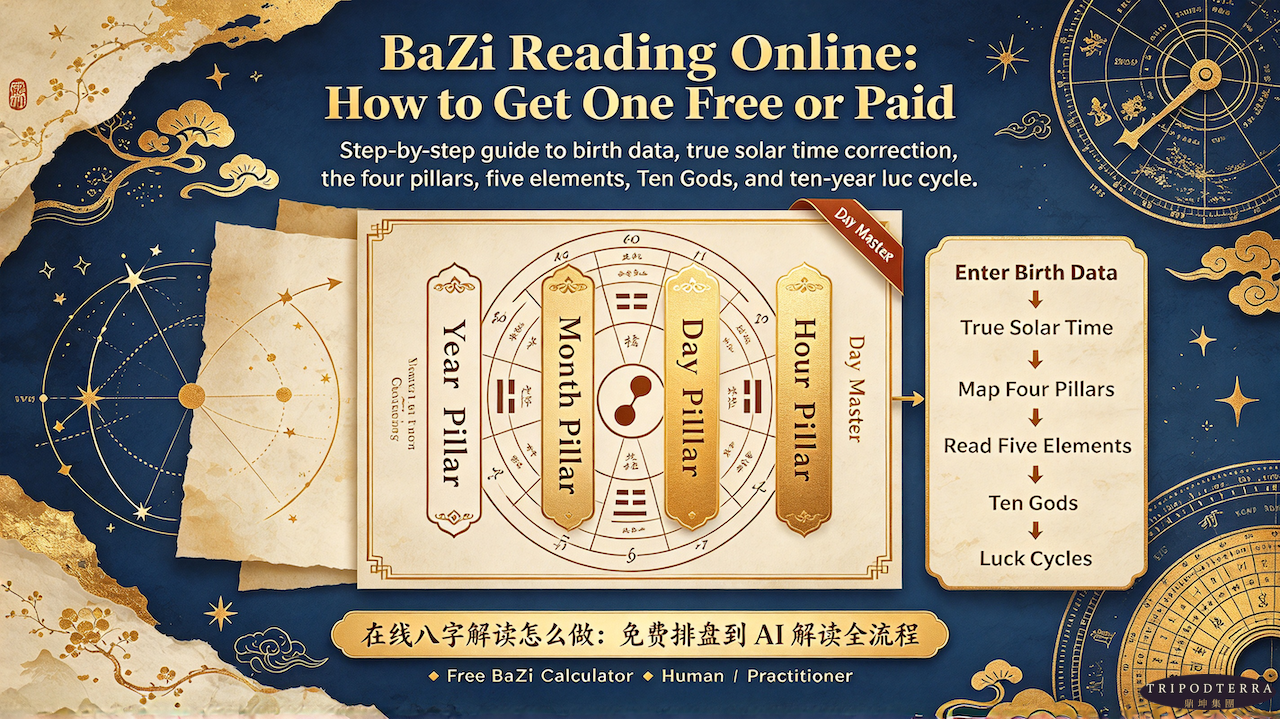
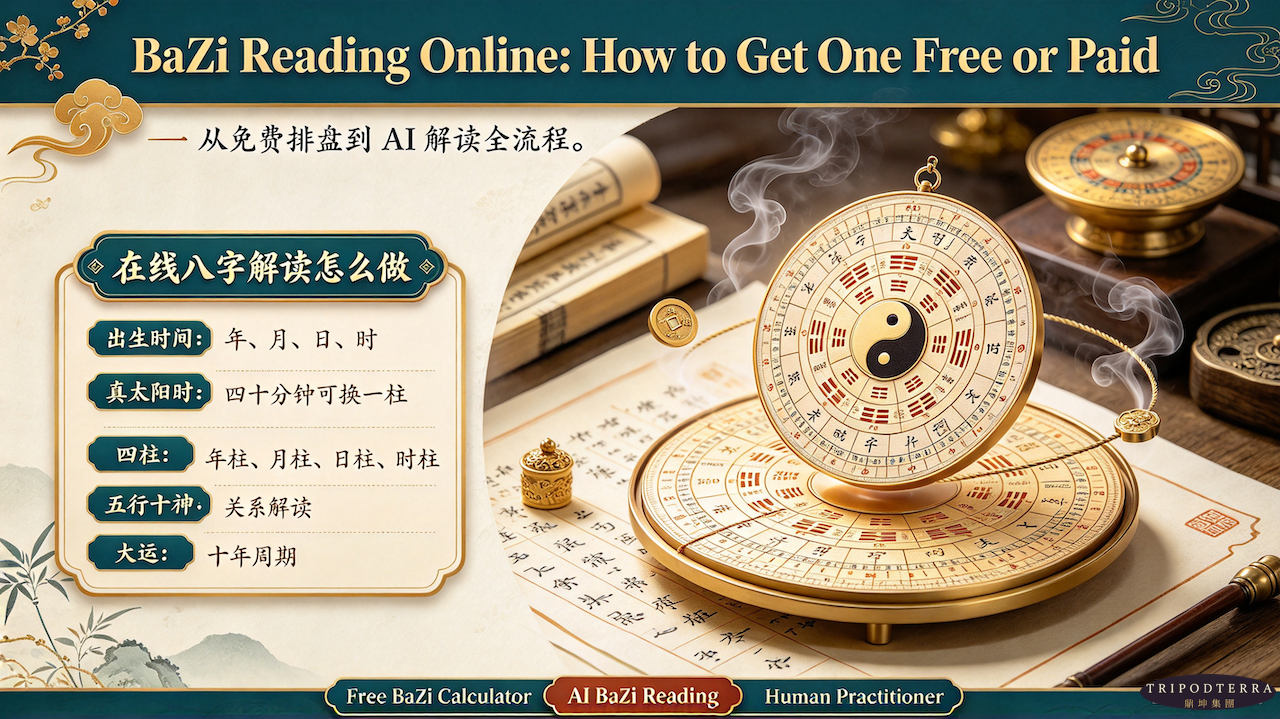
How an online BaZi reading actually works, step by step: what birth data to enter and why your birth hour matters more than beginners expect, how true solar time correction works and how a forty-minute adjustment can replace one of your pillars outright, what each of the four pillars represents, and the order in which the Day Master, the five elements, the Ten Gods and your ten-year luck cycles become legible instead of overwhelming. Also covers what a free BaZi calculator does genuinely well and where every free tool stops, a candid comparison of AI BaZi readings against human practitioners with current market pricing, and answers to the questions beginners actually ask — unknown birth hours, leap months, the Start of Spring year boundary, and whether your birth data is safe.
15 readsOctober 8, 2026
Contents
🧑
Free BaZi Chart
Enter birth info, get your BaZi chart + Five Elements analysis
You type your birth date into a box, press a button, and eight Chinese characters appear. Three minutes later you have a chart, a pile of unfamiliar terms — 十神, 大运, 日主, 藏干 — and no idea whether what you are looking at is meaningful or whether you have just been handed a very elaborate wall.
That gap between casting a chart and reading one is where almost everyone gets stuck, and it is the gap this guide is built to close. Here is the whole process of a BaZi reading online: what to enter, what gets produced, what each layer of the chart actually tells you, the difference between free tools and paid readings, and how AI interpretation compares with a human practitioner.
One framing note first, because it shapes everything below. BaZi (八字, "eight characters") is a traditional Chinese system for reading temperament and timing. It is a cultural and reflective framework. It is not a medical, financial or legal instrument, and nothing in a reading should be treated as a prediction of a fixed outcome.
1. Step 1: Get your birth data right
Everything downstream depends on this step, and it is where most wrong readings originate. You need four things:
Share
Daily Fortune Newsletter
One daily BaZi reading, straight to your inbox. Free, unsubscribe anytime.
1. Date of birth. The calendar date on your birth certificate — Gregorian is fine, and any decent tool converts to the Chinese lunisolar calendar internally.
2. Time of birth. This is the one people get wrong most often, and it matters more than beginners expect. Day-of-birth precision is not enough, because the hour determines one of your four pillars outright. A birth at 10:55 and a birth at 11:05 fall into different two-hour periods (时辰) and can produce a genuinely different chart. If your birth certificate lists a time, use it. If your family remembers only "early morning," record that as early morning — see the unknown-hour note below rather than inventing a number.
3. Place of birth. This is not decoration. It feeds the true solar time correction, which adjusts clock time to actual solar position at your birth location.
4. Sex (or gender as recorded at birth). Traditional BaZi uses this to determine the direction your ten-year luck cycles run — forward or reverse through the sixty-year cycle. It is a technical input to the classical method, not a statement about you.
2. Step 2: The true solar time question
Most beginners have never heard of this and it is the single most common reason two calculators give two different charts for the same person.
Clocks are political. China runs on a single time zone — Beijing time — stretched across a landmass that geographically spans five. Someone born in far-western China is on a clock that can be more than two hours out of step with the sun above their head. Historically, many countries have shifted their standard time by an hour for daylight saving, sometimes permanently.
True solar time (真太陽時) corrects for this: it takes your clock time, adjusts for your longitude relative to your time zone's standard meridian, and applies the equation of time — the up-to-sixteen-minute drift caused by Earth's elliptical orbit and axial tilt.
Why it matters in practice: the correction is often twenty to forty minutes, and a forty-minute correction near a 时辰 boundary flips your hour pillar entirely. Your chart does not get slightly wrong. It gets a different fourth pillar, which changes the Ten Gods, the element balance, and everything read from them.
The practical rule: use a tool that applies the correction, or at minimum tells you the correction it applied. We cover the arithmetic in full in our guide to true solar time in BaZi.
3. Step 3: What the chart actually contains
Once your data is in, the tool produces the four pillars — year, month, day and hour — each written as a heavenly stem (天干) over an earthly branch (地支). That is eight characters. Here is what sits on top of them.
3.1. The Day Master — the centre of the reading
The stem of your day pillar is called the Day Master (日主 or 日元). It is the single most important element of the chart, because it represents you — everything else is read as a relationship to it.
The Day Master is one of ten possible stems, each a specific element in a specific polarity: Yang Wood, Yin Wood, Yang Fire, Yin Fire, Yang Earth, Yin Earth, Yang Metal, Yin Metal, Yang Water, Yin Water. If someone asks "what is my element in BaZi?", this is the answer they are looking for — not their zodiac animal, which is only the year branch.
The Day Master's element and strength set the entire logic of the reading: which elements help you, which drain you, which you have too much of. Our guide to what your BaZi element means walks through all ten in detail.
3.2. The Five Elements distribution
Every chart is a count and a weighting of Wood, Fire, Earth, Metal and Water across all eight characters, including the hidden stems inside each branch.
Two charts can share a Day Master and read completely differently because the distribution differs. A Fire Day Master in a chart with abundant Wood (which feeds Fire) is supported; the same Fire Day Master in a chart drowning in Water (which controls Fire) is working against the current. Balance, not abundance, is the traditional goal — and "balance" here means the specific balance that suits your particular Day Master, not an even five-way split.
3.3. The Ten Gods
The Ten Gods (十神) are the ten possible relationships between any element in your chart and your Day Master. They are the vocabulary of interpretation:
Output (食神 / 伤官) — expression, creativity, performance, what you produce
Wealth (正财 / 偏财) — resources, income, material security, and in traditional readings, a spouse figure
Influence (正官 / 七杀) — authority, discipline, career structure, pressure, and traditionally a spouse figure
Resource (正印 / 偏印) — support, learning, mentors, the mother figure, and the capacity to absorb
Each of those five comes in a direct (正) and indirect (偏) version — hence ten. Which of the Ten Gods dominate your chart is what most of a reading is actually about. A chart heavy in Output reads as expressive and productive; one heavy in Influence reads as structured and career-oriented, but also as operating under pressure.
3.4. Luck cycles — where timing comes from
This is the layer that separates BaZi from every static personality system, and the one most free tools under-serve.
Your luck cycles (大运, dà yùn) are ten-year periods, each with its own stem and branch, running from your birth through your life. They change the environment your chart operates in. A chart that is "strong" overall can meet a decade that overloads it; a chart that struggles can find a decade where everything aligns.
The cycle direction is set by your sex and your year stem's polarity. The starting age is calculated from the distance between your birth date and the nearest solar-term boundary — which is why a birth two days apart from another can start its cycles at a meaningfully different age.
An annual reading (流年, liú nián) sits on top: each year has its own stem and branch, read against your chart and your current luck cycle. This is what the yearly forecast pages are doing, whether or not they explain it.
4. Step 4: How to actually read it
You now have a chart. Here is the order that makes it legible, rather than a list of disconnected features.
Read the Day Master first. Identify its element and polarity. Write it down. Everything else is a word about this.
Assess its strength. Is the Day Master supported by what surrounds it, or overwhelmed? This is the traditional 身強 / 身弱 assessment, and it decides whether the reading is about managing abundance or building support.
Find your favourable elements. Based on the strength assessment, which elements help and which hinder. This is genuinely the most useful output of a chart, because it converts into concrete choices — the environments, seasons, directions and working styles you tend to do well in.
Then read the Ten Gods. Which relationships dominate? Where is the chart crowded and where is it thin? A chart with no Wealth stars at all is not "poor" — it is a chart whose story is not primarily about accumulation, and reading it through a wealth lens will mislead you.
Then set it in time. Where are you in your luck cycles right now? What is the current year doing to your chart? Timing is what most people came for, and it is the last layer, not the first.
If you have used Western astrology, the structure here is worth a moment, because the difference is not cosmetic.
A Western chart is built from position — planets placed against a zodiac wheel, measured in degrees and houses. A BaZi chart is built from time — four slices of the calendar, each expressed as a stem and a branch. There is no wheel, no ascendant, no house system. You are not looking at where things were in the sky; you are looking at when you arrived in a repeating sixty-year cycle.
That is why BaZi has no equivalent of "I'm a Leo but my rising is Virgo." What it has instead is four pillars, each carrying a different part of the story:
The year pillar describes the broad environment you arrived into — the generation, the inherited backdrop, and in traditional readings, the relationship to grandparents and to society at large. It is also the pillar that supplies your zodiac animal, which is why the animal is often the only thing people know.
The month pillar is the strongest of the four, and the one most readings lean on hardest. In the traditional reckoning the month governs your parents, your career environment, and — critically — the seasonal strength of your Day Master. Whether your element is in season or out of it is decided here.
The day pillar holds the Day Master in its stem, which makes it the pillar of the self. Its branch traditionally represents the spouse or closest partner, and it is read for both temperament and intimate relationships.
The hour pillar governs children, later life, and the private or inner dimension — what you are like when nobody is watching. It is the pillar most often lost to an unknown birth time, which is exactly why a missing hour is not a small gap.
The practical consequence: a chart is not read pillar by pillar in isolation. The whole method is about how the four interact — which element supports which, where clashes (沖) and combinations (合) form, and which single pattern ends up dominating. This is also why "just tell me my animal" is such a lossy question, and why the synthesis step below is where a reading earns its keep.
6. Free BaZi readings online: what you get, what you don't
Let us be precise about this, because "free bazi reading online" is one of the most searched phrases in this space and the honest answer has two halves.
What free tools do well — and it is genuinely valuable:
Calculate accurately. Chart casting is deterministic arithmetic. A good free calculator applies solar-term month boundaries, the 23:00 子-hour day rollover, and true solar time. This is a solved problem and you should not pay for it.
Show the full structural chart. Hidden stems, Ten Gods labels, the element distribution, Nayin (纳音), the luck cycle sequence.
Compute, reproducibly. The same birth data gives the same chart, every time, on every quality tool.
Where free tools stop:
Interpretation. Most free tools cast and stop. The chart is a map with no legend.
Synthesis. Reading a chart means holding eight characters, five elements, ten gods and multiple cycles in view and seeing which pattern dominates. That is where the actual work is.
Individualisation. A generic "your 2026 forecast" is written for one twelfth of the population. It cannot know whether the year supports or overloads your Day Master.
The distinction worth internalising: calculation is free; interpretation is the product. Every reputable tool on the market is built the same way. Our own free BaZi chart follows exactly this division, and our overview of free paipan tools compares what different calculators do well.
7. AI BaZi reading vs a human practitioner
This is the comparison people actually want, and it is not a simple "one is better."
AI BaZi reading
Human practitioner
Availability
Instant, 24/7
Booking required, often weeks out
Cost
Low — subscription or per-reading
$30–120 entry level; $200–650+ for premium Western practitioners
Breadth
Holds all eight characters and all cycles at once, every time
Varies with attention and energy on the day
Consistency
Same chart, same structure, every run
Depends on the reader's school and mood
Depth of tradition
Strong on structure and standard rules; thinner on lineage-specific subtleties
Can carry a living lineage and decades of case experience
Follow-up
Unlimited questions, no social cost
Billed per session
Judgment calls
Confident even when the classical sources genuinely disagree
Can tell you when a question is contested
Accountability
None
Personal and reputational
Where AI genuinely wins. A reading is a synthesis problem — the hard part is holding every feature at once and noticing which pattern dominates. That is precisely the shape of task large language models are good at, and it is precisely what a human reader does inconsistently at the end of a long day. AI is also patient in a way no professional can be: you can ask "what does that actually mean for my job?" fifteen times without feeling foolish.
Where a human genuinely wins. Lineage and edge cases. Classical BaZi has real disagreements — about the exact strength thresholds, about how to weight conflicting signals, about whether a given configuration is even significant. An experienced practitioner carries a school's answer and knows which questions are open. AI tends toward fluent confidence, which is a real limitation worth naming.
The honest recommendation: use AI for structure, breadth and follow-up questions; use a human when you want a lineage's specific reading of an ambiguous chart, or when the stakes are personal enough to want a person. Plenty of people do both — chart and AI first, then a practitioner for the questions that remain.
8. What a paid reading buys you
If you are paying, you should know what the tiers actually represent.
Free (beyond calculation): a chart, structural labels, and generic annual content. Useful grounding. Not personal.
Low-cost / subscription tier: AI-generated interpretation of your specific chart, unlimited follow-up questions, report generation. This is the tier that did not exist a few years ago and it is where most people now start, because it converts a chart into a conversation. Our plans page sets out how this works on this platform.
Practitioner tier: a real person reading your chart. Entry-level consultations in the Chinese and Korean markets run roughly the equivalent of $30–120; established Western practitioners commonly charge $200–650 for a written or one-hour session, and corporate sessions run higher still. What you are buying at this tier is not arithmetic — it is judgment, a lineage, and someone accountable for the reading.
9. Common questions
Do I need my exact birth time? Strongly preferred. Without it, a responsible tool casts a three-pillar chart (year, month, day) rather than inventing an hour. You lose the hour pillar and with it a large share of the detail — but a three-pillar reading is honest and still informative. What you should not accept is a tool that silently guesses noon.
Which boundary does the year pillar use? 立春, the solar term around 4 February — not Lunar New Year. For BaZi specifically, the solar-term boundary is the correct one, which is why a chart tool may assign a different animal than a popular zodiac chart. See our introduction to BaZi for how the year pillar is defined.
What about a leap month (閏月)? The Chinese lunisolar calendar inserts a leap month roughly every three years to keep lunar months aligned with the seasons. In mainstream BaZi, the month pillar is defined by solar terms rather than by lunar month numbers, so the leap month problem largely dissolves: what matters is which solar-term period your birth falls in. This is a common source of confusion for people who have read that leap months complicate BaZi — they complicate lunar-calendar date arithmetic, not the month pillar itself. You will still find some folk and non-standard schools that work from lunar month numbers, in which case a leap month does need an explicit convention, so it is worth checking which standard a given tool follows. The one edge case every school shares is a birth on a solar-term boundary itself, where the exact hour decides which month you land in.
Is my data safe? Ask the tool. Some calculators run entirely in the browser and never transmit your birth data; others send it to a server and to AI providers. Both are legitimate designs — but you should know which one you are using, because a birth date, time and place is enough to identify a person.
Can a BaZi reading tell me my future? No. It describes tendencies and timing framed through a traditional system. Treat it as a structured lens for reflection, and keep it well away from decisions about your health, your money or your family.
10. Getting your own reading
Here is the whole sequence in five steps.
1. Gather your data — exact date, exact time (or the closest honest approximation), birth city, and sex as recorded at birth.
2. Cast the chart with true solar time applied.Start with the free chart. Confirm the tool is applying the correction, and check whether it handles the 23:00 子-hour rollover.
3. Read your Day Master and element balance first. Identify the stem of your day pillar and how strong it is. This is the spine of the reading; do not skip to the fortune pages.
4. Then look at the cycles. Where are you in your ten-year luck cycle, and what is the current year doing? Timing questions get answered here.
5. Ask a real question. Generic readings produce generic answers. "What does my chart suggest about how I handle conflict at work?" produces something you can actually use. That is what an AI BaZi reading is for — a conversation about your specific chart, not a paragraph chosen from twelve options.