Best BaZi Apps 2026: 17 Four Pillars Tools Compared
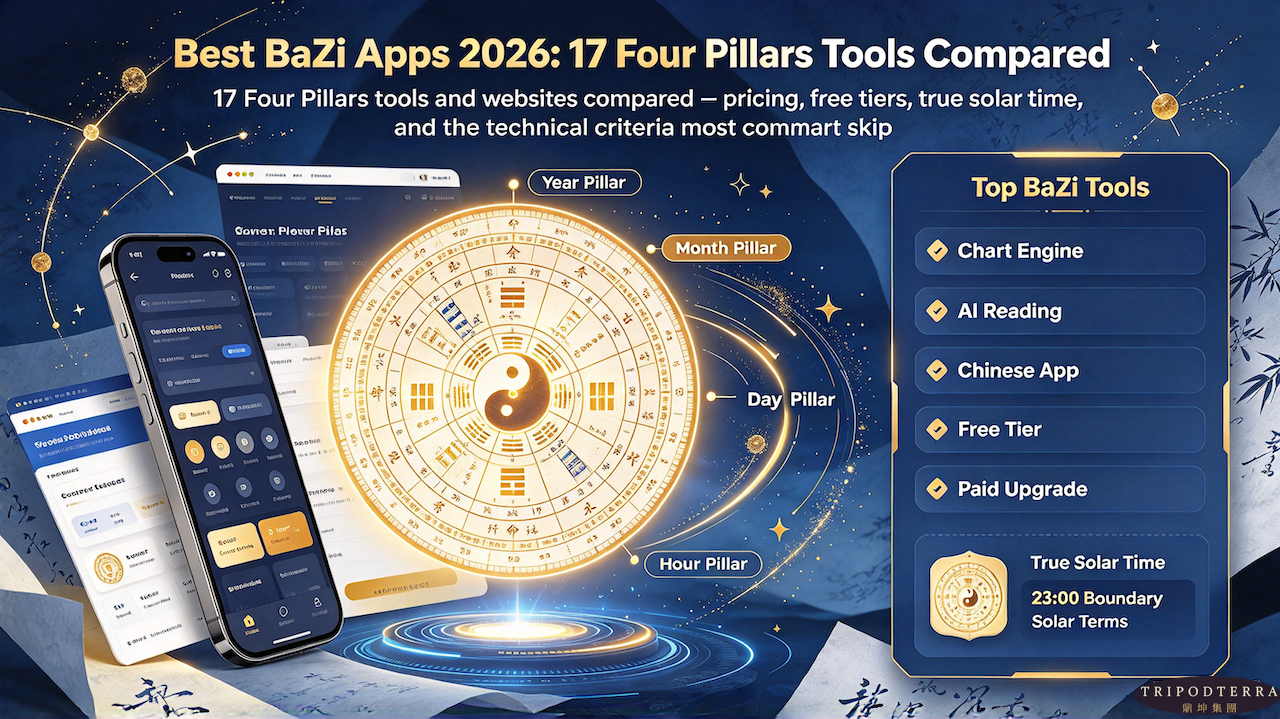
The best BaZi apps of 2026, compared across 17 Four Pillars tools and websites in English and Chinese — with verified pricing, real free tiers, and the technical criteria almost every comparison page skips. This guide explains what actually separates a trustworthy chart from a confident wrong one: true solar time correction, the 23:00 day-pillar boundary, and whether the month pillar is computed from solar terms or lunar month numbers. It covers chart-first engines, AI reading platforms, and Chinese-market apps that English rankings never mention, including a naming collision that makes one popular app effectively unsearchable. Along the way it answers what beginners actually ask — what is genuinely free, why two apps disagree about your chart, and how to handle an unknown birth hour. Our own platform is included and clearly disclosed, limitations and all.
4 readsSeptember 24, 2026
Contents
🧑
Free BaZi Chart
Enter birth info, get your BaZi chart + Five Elements analysis
Search for "the best BaZi app" in English and you will find something odd: nothing authoritative. There is no Wikipedia page of tools, no major publication that has ever reviewed the category, no established ranking to argue with. What you get instead is a scattering of app store listings, a few Product Hunt launches, and a great deal of content written by the vendors themselves.
That gap is why this page exists. BaZi (八字, the "Four Pillars of Destiny") is a two-thousand-year-old system with a genuine international audience, and the tools that serve it span four languages and about eight thousand years of accumulated calibration. Picking between them is not a small decision — and the criteria that actually matter are almost never on the marketing page.
This guide compares 17 BaZi apps and websites, grouped by what they are actually for. Prices were verified in September 2026.
Disclosure, up front, because it changes how you should read this page: we build one of the tools below. TripodTerra is our platform, and we have marked it clearly, including where it loses to a competitor. Every other entry is assessed on public information only.
Share
Daily Fortune Newsletter
One daily BaZi reading, straight to your inbox. Free, unsubscribe anytime.
1. What actually separates a good BaZi app from a bad one
Before the list, here are the four things that matter — and that almost no comparison page checks.
1. True solar time correction. This is the single biggest technical differentiator, and the one most English-language tools skip. Clock time is not solar time. If you were born far from your time zone's standard meridian — western China, the US west coast, anywhere with a history of daylight saving — your clock time can be off from the sun by twenty to forty minutes. Near a 时辰 boundary, that correction changes your hour pillar outright. A tool that ignores it will still give you a confident, well-designed, wrong chart. (Full explanation here.)
2. The 子-hour day boundary. By the traditional convention, a birth after 23:00 belongs to the next day's day pillar. Tools that get this wrong produce a chart that is wrong in two pillars at once.
3. Month pillar by solar term, not lunar month. The month pillar is defined by the 24 solar terms. A tool that computes it from lunar month numbers will be wrong for anyone born in the first half of a lunar month.
4. Whether it interprets or only calculates. Casting a chart is deterministic arithmetic — a solved problem. Interpretation is the actual product. Plenty of tools present a beautiful chart and stop, which is genuinely fine as long as you know that is what you bought.
2. The 17, at a glance
Tool
Type
Platform
Free tier
Paid
TripodTerra(ours)
AI reading + charts
Web, iOS
Full BaZi chart, no account
Subscription + one-time reports
Shunshi.AI
AI reading
Web
3 readings/day
$1.99/day, $3.99/week, $9.99/mo
FateCharts
Chart + AI + timing
Web
Free chart + AI
Free to start
FateForge
Multi-system AI
Web (fateforge.me)
Basic charts + 5 credits
4 credit packs, $1.99–$69.90
FateTell
BaZi + ritual
Web, iOS
Freemium
Subscription (prices not published)
InsightBaZi
Chart engine
Web
Deep chart, calculation trace
$14.99 report; $9.99/mo
BaziCalculator.ai
Chart (+AI preview)
Web
Deep free chart, no account
None live yet
Bazi.sg
Chart tools
Web
Full suite free
S$180 / 60-min session
Mingora
Chart + AI reading
Web
Free chart, no login
$9.90 one-time per reading
Fatelore
Multi-method AI
Web
Free trial credits
$5 / $20 / $50 credit packs
观象八字 (ba-zi.ai)
AI reading
Web
—
$4.99/day · $9.99/week · $19.99/mo
BaZiFlow
AI calculator
Web
Free calculator
Freemium plans
MyBaziDestiny
Chart (local)
Web
Free chart + PDF, browser-side
$9.90 one-time "Life Blueprint"
八字排盤 (Android)
Chart app
Android
Free
Ad-supported
易掌经
Chart toolkit
iOS (CN)
Free
Annual membership
天时子平八字
Chart + classics
iOS, Android (CN)
Free, no ads
Stated lifetime-free
占占
Human consultation
iOS (TW/HK/US)
1 free 5-min video call
Per-session
3. Chart-first tools: when you want the calculation and nothing else
3.1. InsightBaZi — the most transparent calculation
Platform: Web · Free tier: four pillars, hidden stems, Ten Gods, Na Yin, Day Master, five-element distribution, ten-year luck cycles, and — unusually — a full calculation trace · Paid: $14.99 personal report, $29.99 relationship, $9.99/month or $79.99/year for tools
InsightBaZi's distinguishing feature is not a feature at all: it shows its working. It documents its method — solar-term month boundaries, 23:00 true-solar-time day rollover, a public GitHub reference — and exposes the correction arithmetic (longitude offset plus equation of time) to the second.
Strengths: the most auditable tool here. If you want to verify a chart rather than trust one, this is where to start. Ten languages. Also handles two-person compatibility and auspicious-date selection. For an unknown birth hour it produces an explicit three-pillar chart rather than inventing a time, which is the honest behaviour.
Drawbacks: it is a chart engine, not a reading. Interpretation is deliberately left to you or to its paid reports. The interface is aimed at someone who already knows the vocabulary.
3.2. Bazi.sg — the best free tool suite
Platform: Web · Free tier: BaZi calculator, compatibility (合盤), date checker (擇日), luck cycle navigator, and a 64-hexagram reference — all free, no sign-up · Paid: S$180 for a 60-minute reading
Bazi.sg takes an explicit position: the tools are the map, the reading is the journey. Every calculation tool is free and unrestricted; you pay only for a consultation with a human.
Strengths: the most generous genuinely-free suite in English. Charts are cast from astronomical solar terms with solar-time correction, with 44 city presets and historical time zone data for Singapore and Malaysia. Birth data stays in browser localStorage and can be deleted instantly. It deliberately computes without interpreting — which means it never overstates what it knows.
Drawbacks: for an unknown birth hour it uses a clearly labelled noon convention, which some readers consider less honest than a three-pillar chart. And if you want interpretation, there is no self-serve option — you book a session or you get nothing.
3.3. BaziCalculator.ai — the deepest free chart with AI attached
Platform: Web · Free tier: Day Master, roles, chart type, element percentages, symbolic stars, clashes and combinations, luck cycles, plus short readings for the next five years · Paid: optional longer AI readings
Strengths: English-first while keeping the Chinese terms alongside English role names, which makes it unusually good for learning. It ships an English glossary and beginner articles. The "Life Dynamics" section on clashes and combinations is more than most free tools attempt. It publishes its calculation rules and reproducible test cases, and explicitly flags historical DST edge cases — the kind of detail that quietly separates a serious tool from a nice-looking one.
Drawbacks: shared chart links may expose your birth parameters, so be careful about sending them to anyone. And as of September 2026 there is no paid tier live at all — the AI chart reading is a preview capped at three readings per Beijing day, and the fuller AI Life Report is listed as planned with payment not yet open. That is excellent for users and worth knowing if you assume the free tier will last: this is a tool still deciding how to charge.
3.4. MyBaziDestiny — the privacy-first calculator
Platform: Web (English and Chinese) · Free tier: BaZi chart, Day Master, five-element balance, personality traits, favourable directions, PDF download — no account · Paid: $9.90 one-time for the "Life Blueprint" report
Strengths: if your concern is that a birth date, time and place together identify a person, this is the architecture you want. The site states it plainly: every calculation runs locally in your browser, and your date, time and place of birth never leave your device. That claim is specific and checkable, which is more than most privacy marketing manages. No account, no paywall on the chart, one clean one-time price with no subscription.
Drawbacks: there is no AI and no follow-up — the paid tier is a static guide (lucky numbers and colours, what to wear, routine, diet), not an interactive reading. And the site carries a scatter of unrelated sections — palm reading, a leaderboard, love match, Chinese name generator — which reads as a content farm built around the calculator. The chart itself is sound; treat the surrounding pages as SEO furniture.
4. AI-reading tools: when you want the chart explained
4.1. Shunshi.AI — the strongest English-language AI BaZi reader
Platform: Web · Free tier: 3 readings per day · Paid: $1.99/day, $3.99/week, $9.99/month
Shunshi is the most direct competitor to what we build, and it is good. It is a chat-first platform supporting five languages (English, Simplified and Traditional Chinese, Japanese, Korean) covering BaZi charts, compatibility, daily fortune and the Chinese almanac, with Zi Wei Dou Shu listed as in development.
Strengths: it applies true solar time by default when you supply a city or coordinates, and it handles the 23:00 子-hour boundary — the two things its own marketing correctly identifies as what most English tools get wrong. Chart generation is fast and free. And notably, the team has open-sourced its calculation engine under an MIT licence, along with an MCP server — so the arithmetic is independently auditable, which is rare and genuinely to their credit.
Drawbacks: the free tier is capped at three readings a day, which is enough to evaluate and not enough to use. Reports have described the calculator as "100% free" while the AI readings are freemium — the discrepancy is minor but worth expecting. And its multi-system coverage (Zi Wei, astrology, tarot) is announced rather than shipped, so treat the roadmap as a roadmap.
4.2. FateCharts — chart, AI, and decision timing
Platform: Web · Free tier: Free Bazi + AI · Paid: free to start
FateCharts launched on Product Hunt with a thesis worth quoting: BaZi is a framework for personality, energy cycles and timing, and the existing tools were either "90s-era websites or $200/hour masters." That is a fair description of the market, and it is roughly the same gap we started from.
Strengths: the standout is a decision timing engine — you ask questions like "should I switch jobs this year?" and it reads the answer against your chart and current cycles. That is a genuinely better framing than a generic yearly forecast, because it converts the chart into a decision. Physics: free chart, free AI, no sign-up friction.
Drawbacks: the decision-timing framing is the product's own invention rather than classical BaZi practice, and how well it holds up depends entirely on the quality of the underlying chart work. As with every young tool here, expect the interpretation quality to improve faster than the pricing page.
4.3. Mingora — the clearest one-time pricing
Platform: Web (EN, 简中, 繁中) · Free tier: four pillars, Day Master, five elements and main chart pattern with explanations, no login required · Paid: $9.90 one-time per reading; follow-up question credits at $2.99 / $6.99 / $19.99
Mingora is a clean, well-built AI reading tool with no subscription at all — you buy a reading, you own it. Its birth-city picker resolves a city name to timezone and coordinates rather than trusting a free-text label, which materially affects the hour pillar and is the kind of detail that separates serious tools from demos. Explanations keep the technical terms visible instead of hiding them, so you learn the vocabulary as you read.
Drawbacks: the readings are AI-generated and interpretive, and the product blocks medical, legal, investment, death, disaster, pregnancy and guaranteed-outcome questions. That is a defensible ethical line and also a real capability ceiling — if your question is in those areas, it will decline rather than answer. The free tier is a preview; anything substantial is behind the $9.90.
4.4. 观象八字 / Guanxiang (ba-zi.ai) — the cleanest tier structure
Platform: Web (Chinese-primary with an English mode) · Paid: $4.99 for 1 day, $9.99 for 1 week, $19.99/month
An AI BaZi platform covering charting, 合婚 pairing, 称骨 bone-weight, a personality test, a hundred-year fortune chart and PDF export with multi-turn follow-up. What makes it worth listing is the pricing shape: a $4.99 one-day pass with unlimited AI chat for 24 hours is the cheapest way we found to actually use a tool rather than sample it, and unlocked reports persist permanently after the pass expires.
Drawbacks: it is a newer, smaller product without independent review coverage, and it bundles several systems (bone weight, personality testing) whose depth we could not assess. The short passes are attractive precisely because the monthly price is high relative to better-known alternatives.
4.5. FateForge — one birth profile, many systems
Platform: Web · Free tier: basic charts and limited AI questions · Paid: credit packs from $1.99 to $69.90
FateForge runs a single birth profile through BaZi, Zi Wei Dou Shu, Western and Vedic astrology, numerology, plus Mei Hua, Liu Yao, Qimen, Da Liu Ren, tarot, runes and the daily almanac — a genuine multi-system "web atlas" rather than an app that lists seven systems and implements one.
Strengths: the breadth is real, and the BaZi side is not an afterthought — Gregorian or lunar input, Ten Gods, symbolic stars, ten-year luck pillars, with the 子-hour convention documented. Birthplace-based true solar time, and an explicit three-pillar chart when the birth hour is unknown rather than a silent default. Guest profiles stay largely in browser storage. It also does something few credit-based tools bother with: a failed or timed-out AI call does not spend your credits.
Drawbacks: the same breadth is the weakness — depth is spread thin, and a specialised tool will beat it in any one system. The free tier is genuinely thin: basic charts plus 5 credits, with daily credits available only on paid packs. And the four pack prices are labelled "founder pricing" against struck-through list prices of $39.90 / $99.90 / $249.90, which means today's rates may not hold. One AI chat costs 5 credits and a full report 20; unused daily credits expire the next day rather than rolling over.
4.6. Fatelore — multi-method with a distinctive visual hook
Platform: Web · Free tier: free trial credits, enough for a full reading, no card required · Paid: $5 for 500 credits (~40 readings), $20 for 2,000 (~150), $50 for 5,000 (~380)
Fatelore covers BaZi, tarot, I Ching, astrology and face reading, with each method performed traditionally and then interpreted by AI.
Strengths: the distinctive feature is a Life Timeline — you upload a photo, and it generates key imagined moments of your coming decades with you aged into each scene. It is a visualisation, and it is honest about being one. Credit packs are cheap per reading, and failed image generations are auto-refunded rather than charged.
Drawbacks: the headline feature is image generation, not BaZi — if you are here for chart depth, you are paying for something you will not use. Like several tools in this category, it labels itself entertainment and reflection rather than prophecy, which is the right framing.
4.7. TripodTerra — our platform
Platform: Web, iOS · Free tier: full BaZi chart, Day Master, element distribution, ten-year luck cycles, no account required · Paid: subscription tiers plus one-time reports
Our own tool appears here because it belongs in the comparison, and because leaving it out would be a stranger kind of bias than including it with a label.
What we do well: BaZi is the core of this platform, not a feature among twenty. Charts are cast with true solar time applied and the 子-hour boundary handled. Beyond the chart, the platform covers 19 divination services including Zi Wei Dou Shu, I Ching, tarot, face reading and palmistry — all drawing on the same birth profile. The AI reading works from your full four pillars, element balance and current luck cycle at once, which is the synthesis step a chart-only tool cannot do and a human does inconsistently.
Where we lose, plainly: we are not a chart engine for people who want to do the arithmetic themselves — InsightBaZi and Bazi.sg are better at that, and Bazi.sg gives away more for free. Shunshi.AI's open-sourced engine is more auditable than ours. FateForge covers more systems. And we are younger than most sites on this list, with a smaller community behind us.
Best for: anyone who wants a BaZi reading that is genuinely about their birth data, and anyone who wants Chinese metaphysics treated as the main subject rather than a novelty. Start with the free chart, and if the vocabulary is new, the BaZi section collects the introduction, the daily reading and the guides in one place.
4.8. FateTell — the most polished mobile experience
Platform: Web and iOS (no Android) · Free tier: freemium · Paid: subscription, prices not publicly listed
FateTell is a design-led BaZi app built around a "Pocket Book of Fate" reading, an AI companion grounded in the I Ching and Tao Te Ching, daily guidance with home-screen widgets and an "Energy Index", and — the distinctive one — Lunar Cusps, a digital version of the 擲筊 moon-block ritual with haptics.
Strengths: the most consumer-friendly presentation of BaZi on mobile, with ratings to match (4.76 in Taiwan, 4.62 in the US). The cultural ritual feature is done with genuine care rather than as a novelty. The company states it has over 100,000 users — note that earlier coverage citing 20,000 is simply an older milestone, not a contradiction.
Drawbacks: pricing is not published anywhere we could find, which is a genuine obstacle to comparison. The marketing leans hard on social proof — claimed press coverage we could not independently verify — and discloses less about its methodology than FateForge or BaziCalculator.ai do. And the 擲筊 feature is culturally specific enough that it may not travel.
5. Chinese-market apps: the tools English rankings never mention
The Chinese-speaking market is where most BaZi software actually lives, and it is almost entirely absent from English comparisons. These apps are worth knowing about even if you do not read Chinese — they are where the features originate.
5.1. 天时子平八字 (Tianshi Ziping BaZi) — the most technically serious free app
Platform: iOS; Android via Chinese download portals · Free tier: stated lifetime-free, no ads
Most free Chinese BaZi apps are ad-supported, sometimes aggressively. 天时子平八字 is the notable exception, and it is by some distance the deepest free tool in this whole list — not just "free and ad-free" but genuinely expert-grade. It supports real-solar-time versus Beijing-time switching, early/late 子-hour switching, unlimited charts, four-pillar-to-Gregorian reverse lookup across 5 AD – 2100 AD, chart capture from photographs of books, voice-input chart creation, side-by-side multi-chart comparison, a celebrity-chart wiki, and hundreds of classical texts including 渊海子平, 滴天髓, 三命通会 and 子平真诠.
Drawbacks: the developer's own listing says 免费无广告 and 终身免费, but the App Store page nevertheless carries an in-app-purchase badge, so treat the free claim as applying to the core 排盘 functions rather than to everything. Its 4.36 rating is well below its Chinese peers despite being a far more capable tool, which says something about how much presentation matters. And the name is contested — a different app called 辰时八字排盘 trades on the same title and outranks it.
5.2. 易掌经 (Yi Zhang Jing) — the highest-rated chart toolkit
易掌经 holds the highest rating of any app in this list on the China App Store — 4.93 across more than 72,000 ratings, which is an extraordinary number to sustain at that volume. It is a full working toolkit rather than a single-purpose app: 命盘 and 细盘 charting, 大运 and 流年 cycles, 六爻, 奇门遁甲, an electronic luopan, relationship and interpersonal 合盘, annual fortune charts, naming, 20-plus 灵签 systems, the 万年历 almanac and date selection.
Drawbacks: it is built by a single independent developer, which is simultaneously the reason it feels cohesive and a genuine long-term maintenance risk. It also monetises through an auto-renewing annual membership, so read the terms.
5.3. 问真八字 (Wenzhen Bazi) — a naming collision, not a product
Platform: iOS (China) · Free tier: free with in-app purchase
We included this in our research and it turned out to be a warning rather than an entry. There is no single stable "问真八字" app. The original 问真八字排盘 has been renamed to 诸葛八字排盘, and at least two other companies ship similarly-named apps — one of which has not been updated since June 2023 and now describes a 五运六气 tool rather than a BaZi one.
The practical point: if you go looking for this app, any rating, price or review you read for "问真八字" may refer to any of three unrelated products from three unrelated companies. Search results for this name are close to useless. This is worth knowing because it is a general hazard in the Chinese app market — names are not brands, and the same title can be reused by entirely different vendors.
The most-installed pure chart app on Android, carrying a high rating across tens of thousands of reviews. It is a 排盘 tool in the traditional sense — the full chart, dense and complete — and its popularity is a reminder that a large share of BaZi users want the calculation, presented well, and nothing else.
A note on the numbers: we could not verify this app's exact rating, review count or download total from a primary source, and secondary listings disagree with each other — one shows roughly 4.9 stars and a million-plus installs where another shows 4.7 and half a million. Install counts for Android apps are estimates at the best of times. We have left the figures out rather than print a number we cannot stand behind.
5.5. BaZiFlow — the other free English calculator
Platform: Web, plus a Firefox extension · Free tier: free AI BaZi calculator
A free English-language BaZi calculator with true solar time, a ten-year luck trend chart, compatibility readings and a Ziwei/astro fusion mode. Worth knowing about as a free alternative alongside Bazi.sg and BaziCalculator.ai, and notable for shipping a browser extension — an unusual distribution choice in this category.
Drawbacks: a newer and smaller entrant with limited independent coverage; we could not assess the depth of its interpretation against the more established free tools.
5.6. 占占 (ZhanZhan) — the human consultation marketplace
Platform: iOS only — available in Taiwan, Hong Kong and the US, but not in the mainland China App Store · Free tier: free natal chart; new users get one free 5-minute video call; seven consecutive daily check-ins earn a free question · Paid: per session
占占 connects users to a network of diviners — the app's own description says nearly 2,000, spanning BaZi, astrology and tarot — and supports video call consultations. Each question receives at least two voice answers, private to the person who asked. Ratings are strong across regions (4.80 in Taiwan across 2,689 ratings).
Drawbacks: it is a marketplace, not a tool — quality varies by practitioner, and the economics depend on each teacher's own pricing. Note the availability gap: despite being a Chinese-language app, it is not distributed in the mainland store, which is worth knowing before you go looking.
6. Choosing by what you actually need
You want the most accurate chart, and you will read it yourself. InsightBaZi for auditability and the calculation trace; Bazi.sg if you want a free suite with compatibility and date tools included.
You want the chart explained to you. Shunshi.AI for a strong free-tier AI reader with an open-source engine; TripodTerra (ours) if you want the reading to span Chinese systems beyond BaZi.
You are new and want to learn. BaziCalculator.ai for English-first terminology with the Chinese terms kept alongside. Then read what your BaZi element means.
You want to ask real questions and get answers. FateCharts' decision-timing engine, or an AI reading that works from your full chart rather than a template.
You care most about privacy. MyBaziDestiny computes in the browser and sends nothing; Bazi.sg keeps birth data in local storage you can clear.
You want a human. Bazi.sg's consultation, or 占占 if you read Chinese and want video sessions.
You want maximum systems from one profile. FateForge, and our own platform if Chinese methods specifically are the interest.
You want free and nothing else. Bazi.sg's entire tool suite, InsightBaZi's chart, or our free chart — none of which require an account. If you are unsure where to start, this overview of free paipan tools compares what the calculators each handle.
7. FAQ
What is the best free BaZi app? For calculation, Bazi.sg gives away the most complete suite with no sign-up, and InsightBaZi's free chart includes a calculation trace most paid tools do not show. For a free chart plus interpretation, our own free BaZi chart requires no account. Remember that "free" in this category usually means free calculation — interpretation is what vendors charge for.
Do I need my exact birth time? Yes, for a complete chart — the hour is one of the four pillars. If you do not know it, choose a tool that produces an explicit three-pillar chart rather than one that silently assumes noon. InsightBaZi, BaziCalculator.ai and FateForge all handle this honestly.
Which apps apply true solar time? Shunshi.AI applies it by default when you give a location, InsightBaZi exposes the correction arithmetic, FateForge uses birthplace-based correction, and we apply it on TripodTerra. Many others do not, so check before trusting an hour pillar.
Why do two apps give me different charts for the same birth data? Almost always one of three reasons: true solar time is applied by one and not the other, they disagree on the 23:00 子-hour day rollover, or one computes the month pillar from lunar month numbers instead of solar terms. Every one of those changes real pillars, not just presentation.
Is there an app that does BaZi and Western astrology together? Astra Nora lists Chinese astrology among 23 chart types, and FateForge spans the widest range of traditions overall. Our own platform stays within Chinese systems by design — BaZi, Zi Wei Dou Shu, I Ching, tarot and the rest — rather than mixing in tropical astrology.
Can a BaZi app predict my future? No app can. These tools apply a traditional framework to your birth data and describe tendencies and timing as that framework sees them. Treat the output as a structured lens for reflection and keep it well away from decisions about your health, your money or your family.
8. Start with a chart
The most useful next step costs nothing and takes a minute. Generate your free BaZi chart → — four pillars, Day Master, five-element balance and ten-year luck cycles, with true solar time applied and no account required. Then browse the BaZi section for the daily reading and the full guide set, or read the introduction to BaZi first if the vocabulary is new. Paid tiers, if you want a deeper reading, are on the plans page.
Best BaZi Apps 2026: 17 Four Pillars Tools — TripodTerra
 TRIPODTERRA