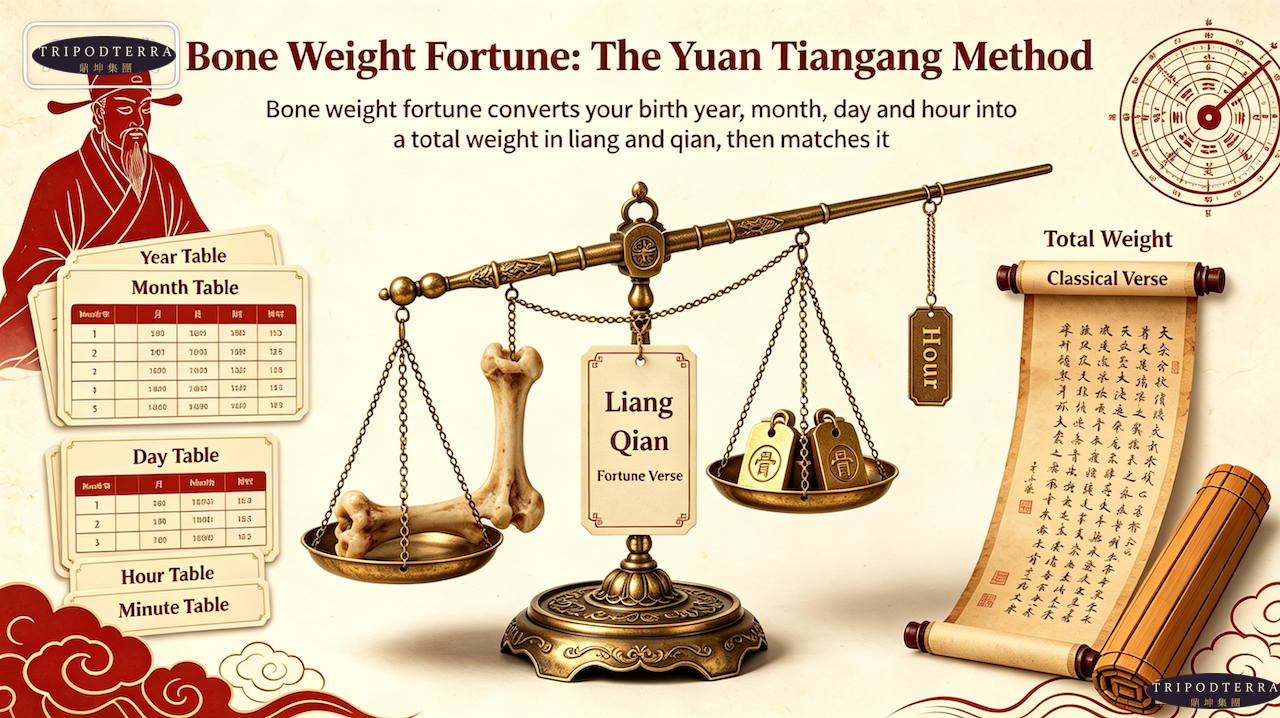
Bone weight fortune (称骨) converts your birth year, month, day and hour into a total weight in liang and qian, then matches it to a classical verse. Here is the history, the four tables, and how the reading works.
48 readsSeptember 18, 2026Edited September 18, 2026
🧑
Free BaZi Chart
Enter birth info, get your BaZi chart + Five Elements analysis
Most Chinese fortune systems ask you to sit down and study. A BaZi chart hands you eight characters, five elements, ten-year luck cycles, hidden stems, clashes and combinations — a whole grammar to learn before you can read a single line of it. Bone weight fortune does the opposite. It asks for your birth date and hour, looks up four numbers in four tables, adds them together, and hands you a verse of four lines.
That is the entire method. You can do it on the back of an envelope. And yet it has survived for well over a thousand years, outlived dynasties, and is still one of the first things an ordinary Chinese family reaches for when a baby is born. Understanding why that is — what this method actually claims, where it came from, and what it is genuinely useful for — is worth twenty minutes of your time.
This guide covers the tradition behind 称骨 (chēng gǔ, literally "weighing the bones"), the four weight tables and how a total is reached, what the classical verses actually say, how bone weight differs from a full BaZi reading, and how to get your own free bone weight reading in about thirty seconds.
What bone weight fortune actually is
Share
Daily Fortune Newsletter
One daily BaZi reading, straight to your inbox. Free, unsubscribe anytime.
称骨算命 — bone weight fortune-telling — is a weighting system. Instead of interpreting relationships between elements, it assigns every component of your birth moment a numerical weight, and then reads the sum.
The four components are:
Year — the sexagenary year (干支, gān zhī), one of sixty combinations
Month — the lunar month, 1 through 12
Day — the lunar day, 1 through 30
Hour — your birth hour, mapped onto one of the twelve two-hour periods called 时辰 (shí chén)
Each component has a weight drawn from a fixed table. Add the four together and you get your total bone weight, expressed in the traditional Chinese units 两 (liǎng) and 钱 (qián). That total — anywhere from 2 liang 1 qian to 7 liang 2 qian — points to exactly one entry in a collection of classical verses known as the 称骨歌 (chēng gǔ gē), the "Bone Weight Song."
There is no interpretation layer. No practitioner judgment. No debate about whether your chart is strong or weak. Two people with the same total weight get the same verse, word for word, forever. This is what makes bone weight the most deterministic system in the Chinese divination family — and also what makes it the fastest.
The Tang-dynasty origin story
The method is traditionally credited to 袁天罡 (Yuán Tiāngāng), a court astronomer and diviner of the early Tang dynasty, in the 7th century CE. He is one of the great legendary figures of Chinese fortune-telling — the man said to have predicted the rise of Wu Zetian when she was still an infant in a servant's arms, and the co-author, with Li Chunfeng, of the 推背图 (Tuī Bèi Tú), the notoriously cryptic prophecy book that has been reinterpreted by every generation since.
The attribution should be held the way historians hold most attractive origin stories: warmly, and loosely. The surviving text of the 称骨歌 is not a Tang-dynasty document. Versions differ between printings, some years carry different weights in different editions, and the four-line verses have clearly been polished and re-polished over many centuries. What we can say with confidence is that the method is genuinely old, genuinely traditional, and genuinely popular — it appears in household almanacs, temple pamphlets, and grandmothers' memories across the Chinese-speaking world.
What the Yuan Tiangang attribution does provide is a flavour. Bone weight has always been presented as a tool of the common people rather than the scholar's drawing room. It needs no teacher. It needs no expensive consultation. It needs a birth date and a printed table. That democratic quality is probably the real reason it outlived the more sophisticated systems that were contemporary with it.
The four weight tables
Here is the heart of the method. Every table is measured in 钱 (qián); ten qian make one liang.
The tables are not arbitrary. Look at the year table and you will notice something: the weights are spread across the sixty-year cycle in a way that deliberately avoids neat patterns, which is exactly why the system feels uncannily specific to the people who use it.
1. The year table — sixty 干支 combinations
Year (干支)
Weight
Year (干支)
Weight
Year (干支)
Weight
甲子 Jiǎ Zǐ
1 liang 2 qian
丙子 Bǐng Zǐ
1 liang 6 qian
戊子 Wù Zǐ
1 liang 5 qian
乙丑 Yǐ Chǒu
9 qian
丁丑 Dīng Chǒu
8 qian
己丑 Jǐ Chǒu
7 qian
丙寅 Bǐng Yín
6 qian
戊寅 Wù Yín
8 qian
庚寅 Gēng Yín
9 qian
丁卯 Dīng Mǎo
7 qian
己卯 Jǐ Mǎo
1 liang 9 qian
辛卯 Xīn Mǎo
1 liang 2 qian
戊辰 Wù Chén
1 liang 2 qian
庚辰 Gēng Chén
1 liang 2 qian
壬辰 Rén Chén
1 liang
己巳 Jǐ Sì
5 qian
辛巳 Xīn Sì
6 qian
癸巳 Guǐ Sì
7 qian
庚午 Gēng Wǔ
9 qian
壬午 Rén Wǔ
8 qian
甲午 Jiǎ Wǔ
1 liang 5 qian
辛未 Xīn Wèi
8 qian
癸未 Guǐ Wèi
7 qian
乙未 Yǐ Wèi
6 qian
壬申 Rén Shēn
7 qian
甲申 Jiǎ Shēn
5 qian
丙申 Bǐng Shēn
5 qian
癸酉 Guǐ Yǒu
8 qian
乙酉 Yǐ Yǒu
1 liang 5 qian
丁酉 Dīng Yǒu
1 liang 4 qian
甲戌 Jiǎ Xū
1 liang 5 qian
丙戌 Bǐng Xū
6 qian
戊戌 Wù Xū
1 liang 4 qian
乙亥 Yǐ Hài
9 qian
丁亥 Dīng Hài
1 liang 6 qian
己亥 Jǐ Hài
9 qian
The full table runs all sixty combinations, from 甲子 at 1 liang 2 qian up to 辛亥 at 1 liang 7 qian and 己卯 or 戊午 at 1 liang 9 qian. Note how much the weight varies within a single zodiac animal: someone born in a 子 (Rat) year could weigh anywhere from 5 qian (壬子, 1972, 2032) to 1 liang 6 qian (丙子, 1936, 1996). The animal alone tells you nothing.
One important note about the year: bone weight uses the 干支 year, which in the traditional reckoning begins at 立春 (Start of Spring, around 4 February), not on Lunar New Year's Day. If you were born in the last week of January or the first days of February, check which year your birth actually falls into before you look anything up. This is the same boundary rule that governs a full BaZi chart, and it is the single most common source of wrong readings in either system.
2. The month table — twelve lunar months
Lunar month
Weight
Lunar month
Weight
正月 Month 1
6 qian
七月 Month 7
9 qian
二月 Month 2
7 qian
八月 Month 8
1 liang 5 qian
三月 Month 3
1 liang 8 qian
九月 Month 9
1 liang 8 qian
四月 Month 4
9 qian
十月 Month 10
8 qian
五月 Month 5
5 qian
十一月 Month 11
9 qian
六月 Month 6
1 liang 6 qian
十二月 Month 12
5 qian
The months here are lunar months, not the Gregorian ones on your passport. Convert your birth date to the Chinese lunar calendar first — the third lunar month usually begins in April, so an early-April birthday may well fall in lunar month 2. If a leap month (闰月) is involved, the convention in this system is to use the weight of the month it repeats.
3. The day table — thirty lunar days
Lunar day
Weight
Lunar day
Weight
Lunar day
Weight
初一 Day 1
5 qian
十一 Day 11
9 qian
廿一 Day 21
1 liang
初二 Day 2
1 liang
十二 Day 12
1 liang 7 qian
廿二 Day 22
9 qian
初三 Day 3
8 qian
十三 Day 13
8 qian
廿三 Day 23
8 qian
初四 Day 4
1 liang 5 qian
十四 Day 14
1 liang 7 qian
廿四 Day 24
9 qian
初五 Day 5
1 liang 6 qian
十五 Day 15
1 liang
廿五 Day 25
1 liang 5 qian
初六 Day 6
1 liang 5 qian
十六 Day 16
8 qian
廿六 Day 26
1 liang 8 qian
初七 Day 7
8 qian
十七 Day 17
9 qian
廿七 Day 27
7 qian
初八 Day 8
1 liang 6 qian
十八 Day 18
1 liang 8 qian
廿八 Day 28
8 qian
初九 Day 9
8 qian
十九 Day 19
5 qian
廿九 Day 29
1 liang 6 qian
初十 Day 10
1 liang 6 qian
二十 Day 20
1 liang 5 qian
三十 Day 30
6 qian
Day weights swing widely — the range runs from 5 qian (day 1 and day 19) to 1 liang 8 qian (day 18 and day 26). Two people born three weeks apart in the same lunar month can differ by more than a full liang before any other component is counted.
4. The hour table — twelve 时辰
Hour period (时辰)
Clock time
Weight
子 Zǐ
23:00 – 01:00
1 liang 6 qian
丑 Chǒu
01:00 – 03:00
6 qian
寅 Yín
03:00 – 05:00
7 qian
卯 Mǎo
05:00 – 07:00
1 liang
辰 Chén
07:00 – 09:00
9 qian
巳 Sì
09:00 – 11:00
1 liang 6 qian
午 Wǔ
11:00 – 13:00
1 liang
未 Wèi
13:00 – 15:00
8 qian
申 Shēn
15:00 – 17:00
8 qian
酉 Yǒu
17:00 – 19:00
9 qian
戌 Xū
19:00 – 21:00
6 qian
亥 Hài
21:00 – 23:00
6 qian
Two notes. First, 子时 is the heaviest hour at 1 liang 6 qian, and it is also the awkward one: by the convention used in Chinese charting, a birth after 23:00 belongs to the next day's 子 hour. A child born at 23:40 on the 5th is, for charting purposes, born on the 6th. Get this wrong and both the day weight and the hour weight change. Second, if you were born near a time-zone boundary or in far western China, the clock time on your birth certificate may not match the traditional hour — the same issue that makes true solar time matter in BaZi applies here.
How the total is calculated
The arithmetic is addition, and only addition.
Step
Component
Example person's value
Weight
1
Year 干支
甲子 (1984)
1 liang 2 qian
2
Lunar month
正月 (month 1)
6 qian
3
Lunar day
初一 (day 1)
5 qian
4
时辰
子时 (23:00–01:00)
1 liang 6 qian
Total
3 liang 9 qian
Work in qian throughout, and convert only at the end — ten qian to the liang. So the example above is 12 + 6 + 5 + 16 = 39 qian = 3 liang 9 qian.
Now the distribution of possible totals, which is the part most people never see:
Total bone weight
What it represents
Rough share of the range
2 liang 1 qian – 2 liang 9 qian
The lightest band — verses in this range speak of hardship, self-reliance and late improvement
Lowest totals in the system
3 liang 0 qian – 3 liang 9 qian
The crowded middle — the most common landing zone, with the most varied verses
Very common
4 liang 0 qian – 4 liang 9 qian
Steady and workable — verses emphasise competence, middle-life stability and self-made outcomes
Very common
5 liang 0 qian – 5 liang 9 qian
Strong — wealth, reputation and ease recur; the "fortunate life" band most people hope for
Less common
6 liang 0 qian – 6 liang 9 qian
Very strong — classical imagery of office, honour and public standing
Uncommon
7 liang 0 qian – 7 liang 2 qian
The heaviest band, and the narrowest — only three entries exist
Extremely rare
The mathematical floor is 2 liang 1 qian and the ceiling is 7 liang 2 qian. There is no zero, no negative, and no infinite — the tradition built its scale with a hard bottom and a hard top, which is itself a quiet statement: even the heaviest reading is bounded, and even the lightest starts above nothing.
A common misunderstanding: people assume heavier is straightforwardly better. It is not, quite. The heaviest verses (7 liang 1 and 7 liang 2) are traditionally read as exceptional and demanding — "ten generations of accumulated virtue produced this person" carries an obligation as much as a blessing. Meanwhile several mid-weight verses are among the warmest in the collection. Weight is not a score.
Three famous verses, and what they say
The 称骨歌 has one entry for every possible total, each a four-line verse of seven characters. Ninety-nine percent of them are forgotten. A handful have become genuinely famous. Here are three, with plain-English translations of what they claim.
5 liang 7 qian — the classic "good life" verse
福禄丰盈万事全,一身荣耀乐天年;名扬威震人争羡,此世逍遥宛似仙。
Blessing and salary in abundance, all things complete; honour rests upon you, and you delight in your years; your fame spreads and your authority awes, and all vie in envy — in this world you wander free as an immortal.
This is the verse people quote when they want to describe what a heavy weight looks like. Notice what it actually promises: sufficiency first (福禄丰盈), then honour, then reputation, then ease. The ordering is not accidental. In the classical imagination, the good life is not wealth alone — it is wealth that has stopped being the point.
6 liang 3 qian — the scholar-official's verse
命主为官福禄长,得来富贵实非常;名题雁塔传金榜,大显门庭天下扬。
The master of this fate holds office, and blessing and salary endure; the wealth and honour won are truly beyond the common; your name inscribed on the Wild Goose Pagoda, spread on the golden roll — the house exalted and renowned throughout the land.
The Wild Goose Pagoda (雁塔) is where successful Tang-dynasty examination candidates had their names carved. This verse is a product of its era: the highest imaginable outcome in imperial China was not a fortune but a passing grade on the imperial exam. It is a useful reminder that these verses encode the aspirations of the society that wrote them, not universal truths about a good life.
2 liang 1 qian — the hardest verse in the collection
短命非业谓大空,平生灾难事重重;凶祸频临陷逆境,终世困苦事不成。
A short life, not of one's own making — calamity upon calamity, hardship pressing in, and at the last nothing brought to completion.
We quote this one deliberately, because any honest guide has to. It is bleak, it is the floor of the system, and a person who lands on it deserves more than reassurance — they deserve context.
Three things worth knowing. First, the classical 称骨歌 is a product of a pre-modern world in which infant mortality was ordinary, famine was periodic, and a four-line verse written on a printed card was never meant to be a life sentence. Second, the tradition itself softens the floor: several mid-range verses explicitly say the outcome depends on effort — "know that blessing depends on one's own cultivation" (4 liang 4 qian) is not the language of determinism. Third, and most importantly: this is a cultural artefact, not a prediction. If a reading upsets you, that is information about a centuries-old poem, not about your life.
Bone weight versus full BaZi
These two systems are often confused, and the difference matters if you are deciding where to spend your attention.
Bone weight (称骨)
Full BaZi (八字)
Inputs
Year, lunar month, lunar day, hour
The same four, plus birthplace for solar-time correction
The useful mental model: bone weight is a sketch; BaZi is a portrait. A sketch you draw in thirty seconds can still be recognisable and still be worth keeping. But you would not choose a spouse, a career or a city based on a sketch.
Where they agree is worth noticing. Both systems care about the year, month, day and hour — the same four pillars that underlie the entire Chinese calendrical tradition. Bone weight simply asks a cruder question of the same data: not "how do these interact?" but "how much do they weigh?" That crudeness is precisely why it survived. It is the fortune-telling equivalent of a pocket calculator: no theory required, no teacher, and it fits in an almanac.
If the sketch interests you, the natural next step is the portrait. A free BaZi chart will give you your four pillars, your Day Master, and your ten-year luck cycles — and if you are new to the vocabulary, start with what a BaZi element actually means before you go further. For the history of the tradition and the school that shaped how it is practised today, see the introduction to BaZi and the profile of Xu Ziping, the Song-dynasty figure after whom the dominant method is named.
If your interests run more to the physical than the calendrical, the platform's other free tools follow the same principle — palm reading line meanings and face reading moles are both deterministic lookups in the same spirit. And if you want a sense of what the same birth data looks like when it is read day by day rather than once, the daily almanac is a good place to look.
How to use the free bone weight page
The whole process takes about thirty seconds.
Step 1 — Open the calculator. Go to the free bone weight page. No account is required; the calculator runs in your browser.
Step 2 — Enter your birth date and hour. The form asks for your calendar date of birth and your time of birth. Enter it as precisely as you can — if you know only "early morning" or "just after lunch," pick the closest 时辰; the reading will still work, but the hour component is the shakiest part of anyone's input.
Step 3 — Read the four components. The page shows each of the four lookups separately: your year 干支 with its weight, your lunar month, your lunar day, and your 时辰. You can see exactly where each part of the total came from, which is far more useful than a single opaque number.
Step 4 — Read your total. Your bone weight is displayed in the traditional format — for example 3 liang 9 qian — so it matches the way you would hear it described in Chinese.
Step 5 — Read the verse. The matching entry from the 称骨歌 appears below, in Chinese with an English rendering. This is the reading itself: four lines, seven characters each, and whatever you make of them.
Step 6 — Go deeper if you want. Two buttons sit at the bottom of the result. One takes you to your full BaZi chart, where the same four pillars are read properly. The other opens an AI reading of your bone weight, which walks through your specific verse, what each of the four components contributed, and what the tradition says about a weight like yours — in plain language, with room to ask follow-up questions.
If you would rather browse before you commit, the BaZi section of the site collects the chart, the daily reading and the articles in one place, and works on mobile.
A note on how to hold a reading
Bone weight fortune is old, traditional, and beautifully simple — and it is not a verdict on your life. It is a cultural lens, a family tradition, a conversation starter, and a genuinely interesting piece of Tang-era literary inheritance. Treat the verse as a mirror for reflection rather than a forecast, keep it well away from any decision about your health, your money or your family, and it will reward you the way it has rewarded readers for a thousand years: with a small, memorable story about who you might be.
Get your reading
Two ways in, both free to start.
Free bone weight reading → — enter your birth date and hour, get your total weight in liang and qian, and read the classical verse that matches it. No account needed.
AI deep reading of your bone weight → — have your verse explained line by line, see how each of the four components shaped your total, and ask whatever the verse made you curious about.
Bone Weight Fortune (称骨): Yuan Tiangang's Method — TripodTerra
 TRIPODTERRA