
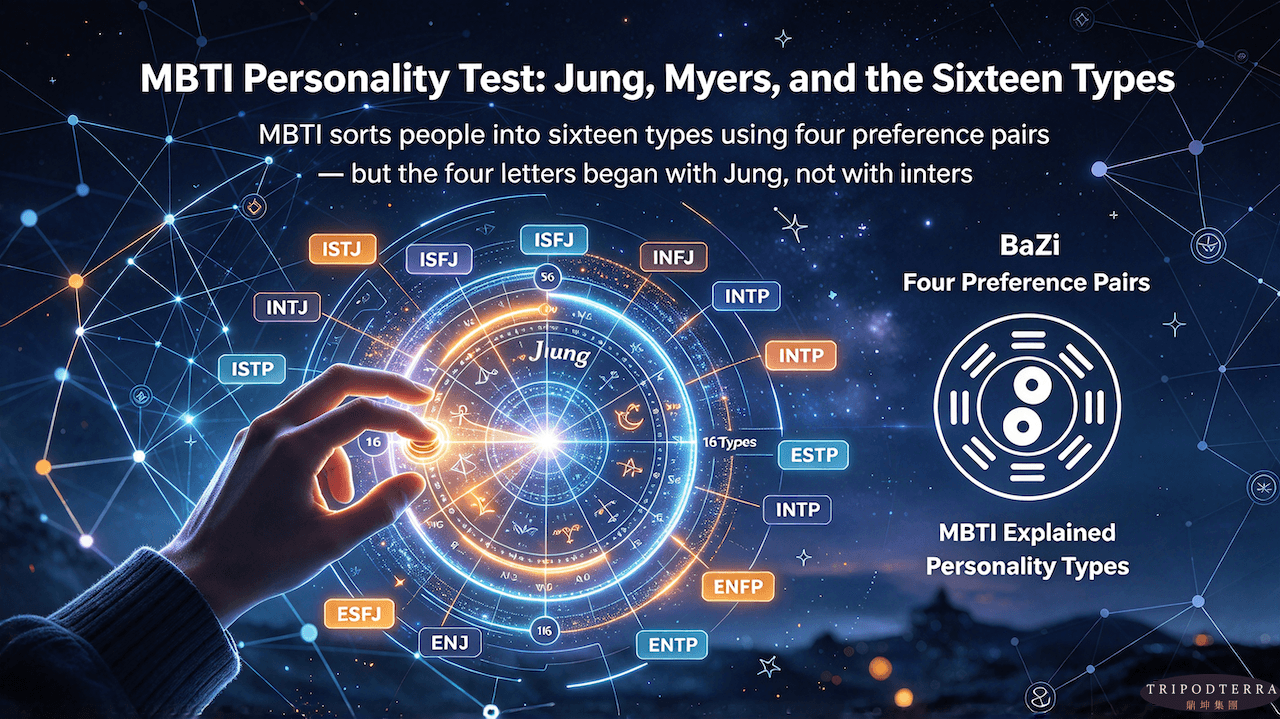
A note before we begin. MBTI® is a registered trademark of The Myers-Briggs Company. TripodTerra is not affiliated with, endorsed by, or licensed by that company. The reading on this site is a conversational, entertainment-focused assessment based on publicly described type theory. It is not the official MBTI instrument, not a psychological evaluation, and not a diagnosis. Personality type is a reference tool for self-reflection — for fun.
Four letters. That is all it takes to start an argument at a dinner table, a hiring meeting, or a first date. INTJ. ENFP. ISTJ. In English the codes arrive with job titles attached — the Architect, the Campaigner, the Logistician. In Chinese they were shortened further: i人 and e人, two characters that by 2023 had become a complete social vocabulary. "I'm an i person" can mean I need to leave the party early, I hate cold calls, I will not be performing enthusiasm in this meeting.
The gap between how much weight those letters carry and how little most people know about them is why this article exists. Ask a room of enthusiasts who invented the MBTI and you will hear "Myers-Briggs" — half right. Ask what the letters measure and you will hear "personality" — vague enough to be true and precise enough to mislead. Ask whether it is science and the answer will depend on which corner of the internet taught you.
This guide covers the theory, the history, the four pairs, all sixteen types, how MBTI compares with BaZi, and how to hold a result without letting it hold you.
1. What the MBTI actually is
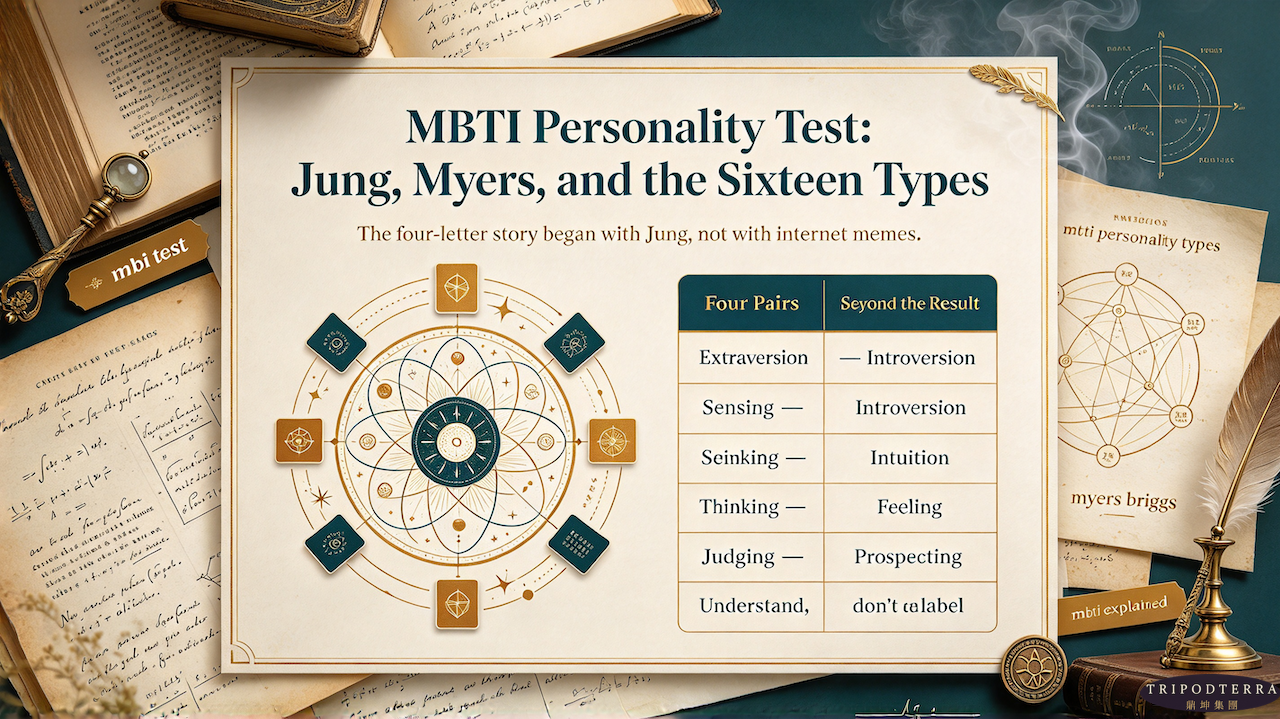
The Myers-Briggs Type Indicator is a self-report questionnaire. Every word in that sentence matters. Self-report: it asks you questions about yourself and summarizes your answers. It does not watch what you do, measure ability, or consult anyone who knows you. Questionnaire: a fixed set of items with fixed scoring, not an interview. Indicator: it points at a preference; it does not diagnose a condition.
Scoring sorts your answers along four either/or axes — extraversion or introversion, sensing or intuition, thinking or feeling, judging or perceiving — into one of sixteen four-letter codes, each with a description: a cluster of tendencies, values, and working styles.
A word on the name. MBTI® is a registered trademark of The Myers-Briggs Company, formerly Consulting Psychologists Press. The official instrument is administered by certified practitioners and sold with a specific interpretive framework. The company's own ethics guidance is explicit that the tool is for development and self-awareness, not for hiring or selection.
Which brings us to the most important disclosure in this article: what you will find on this site is not that instrument. It is a conversation. An official result comes with norms, scoring rules, and a licensed interpreter. Ours is built on publicly described type theory, delivered by an AI that asks follow-up questions. It can feel surprisingly accurate. It is not a measurement, a diagnosis, or a substitute for a psychologist.
Three limits. First, type descriptions are cultural products, not clinical facts; readability is not validity. Second, most people sit near the middle of at least one axis, so the letter at the margin can be a coin flip. Third, the four letters do not measure honesty, kindness, ambition, intelligence, mental health, or skill. If a description seems to cover those, it is overreaching.
2. The Jungian origin story
The story begins with a feud, not a questionnaire.
By 1921, Carl Gustav Jung had spent two decades inside the Freud-Adler argument. Freud read patients through desire and repression; Adler through power and compensation. Both were brilliant, and neither could explain the other. Jung's conclusion was uncomfortable and elegant: the theories disagreed partly because the theorists were different kinds of people. The observer was inside the observation.
That insight became Psychological Types (1921), a long, strange book. Its core fits on a napkin. Two attitudes: extraversion, where attention and energy flow outward toward objects, people, and events; and introversion, where they flow inward toward the subject and the inner world. Four functions: thinking (what is true, what follows from what), feeling (what matters, what is worth choosing), sensation (what is actually there), and intuition (what is hinted at, the pattern behind the particular).
Two translation traps. Feeling is not emotion; it is a judging function that evaluates. And "irrational," for sensation and intuition, means not based on judgment, not illogical. Thinking and feeling judge; sensation and intuition perceive. Everyone uses all four; type is about which is most differentiated — most trusted — and whether it faces outward or inward. Two attitudes times four functions gives eight types. Jung insisted that pure types do not exist: they are reference points, useful fictions, not boxes.
Then the theory left the clinic and arrived at a kitchen table in suburban Washington, D.C.
Katharine Cook Briggs (1875–1968) had a degree in agriculture, had taught and written, and had been building her own theory of personality from biographies and observation. In 1923, the English translation of Psychological Types appeared, and she found her private theory already mapped. She taught it to her daughter.
Isabel Briggs Myers (1897–1980) studied political science at Swarthmore, worked as a reporter, and wrote a detective novel, Murder Yet to Come, which won a national contest in 1934. Neither woman had a degree in psychology. That explains both the instrument's virtues and its vices: it is readable, humane, and built for ordinary people, and it is not the work of psychometricians.
The motivation was the Second World War: as men shipped out, women entered offices and factories, and Myers wanted a tool to help them find work suited to their nature. In 1942, with personnel manager Edward N. Hay, she assembled the first version and tried it on people entering the workforce. ETS published it in 1962; Consulting Psychologists Press took over in 1975. By the 1990s it was the most widely used personality instrument in the world.
The criticism arrived with the success: the instrument forces continuous traits into binary boxes; a substantial share of respondents — in some samples around half — get a different type when retested weeks later; it predicts job performance poorly; and its descriptions invite the Barnum effect. The academic mainstream moved to the Big Five, which keeps traits continuous and has a stronger research base. Annie Murphy Paul's The Cult of Personality Testing (2004) and Merve Emre's The Personality Brokers (2018) told the story to a general audience.
None of this makes the experience worthless. It makes it a different kind of object than most people think it is. The most useful sentence ever written about the MBTI may be this: it is a vocabulary, not a thermometer.
3. The four preference pairs
Each pair answers a different question. They are not four small quizzes; they are four axes, and the combination is the point.
| Pair | The question | First pole | Second pole | Common misreading |
|---|---|---|---|---|
| E / I | Where does your attention go first? | Extraversion: outward to people, action, stimulus | Introversion: inward to ideas, reflection, quiet | E = confident, I = shy |
| S / N | How do you take in information? | Sensing: concrete, sequential, literal, present | Intuition: patterns, associations, possibilities | S = dull, N = clever |
| T / F | How do you reach a decision? | Thinking: logic, consistency, principles | Feeling: values, impact on people, harmony | T = cold, F = irrational |
| J / P | How do you meet the outer world? | Judging: closure, plans, decisions made | Perceiving: openness, options, adaptation | J = rigid, P = lazy |
4. E / I — the direction of attention
Picture the last hour of a three-day conference. The sessions are over and the hotel bar is filling up. One person feels the day finally becoming interesting: the room, the noise, the new people. Another has been looking forward to the elevator ride and forty minutes of silence, and may join the bar afterward, revived. The first is describing extraversion; the second, introversion.
The question is not "do you like people?" It is "where does your attention go first, and what restores you?" An introvert can love a party and still need to leave it. The letters describe a default current, not a skill.
The misreading is E equals confident and I equals shy. Some of the most socially graceful people you know are introverts who learned the choreography; some extraverts are anxious in crowds and brilliant one-on-one. Shyness is about fear of judgment. Introversion is about where energy is directed.
5. S / N — the texture of information
Two people leave the same film. One describes the plot in order: who did what, which scene, how it ended. The other says the film was about grief wearing a heist movie as a disguise. Both saw the film. The first is leading with sensation; the second with intuition.
Sensing takes in what is concrete, sequential, and present — the details, the literal words, the way the machine actually behaves. Intuition takes in patterns, associations, and possibilities — what it resembles, where it is going, what it means. Neither is a depth contest.
The most damaging misreading in the system is that S means dull and N means clever. In the large US samples the publisher has reported, sensing is roughly seven in ten people. Intuition is not intelligence. It is a preference for the abstract over the concrete.
6. T / F — the criterion of decision
Your friend tells you they are thinking about quitting their job. A thinking-first response reaches for the spreadsheet: savings, runway, market, the offer they have not mentioned. A feeling-first response asks how they slept last week, what the job has been doing to them, and who they become when they walk into that office. Both are care. The failure mode of thinking is bluntness — solving the wrong problem with great precision. The failure mode of feeling is conflict avoidance — protecting the mood and postponing the truth.
Jung called feeling a rational function because it evaluates. It has a logic; the logic is values rather than consistency. The misreading — T is cold, F is irrational — confuses a decision criterion with an emotional capacity. What differs is what each reaches for first when a decision has to be made.
7. J / P — the face you turn to the world
This is the pair Myers added; Jung never used it. It is also the most misunderstood. J does not mean judgmental, and P does not mean lazy or disorganized. In the type system, J and P describe which side of you faces the outer world. If your extraverted function is a judging function — thinking or feeling — you present decisions, plans, and closure: J. If it is a perceiving function — sensing or intuition — you present openness, options, and adaptation: P.
Practical translation: the J traveler has the flights, the hotel, and a spreadsheet with three backup restaurants. The P traveler has a city, a date, and a rough idea, and finds the good stuff on the ground. Neither trip is better. The misreading — J rigid, P chaotic — confuses a preference for closure with a moral virtue.
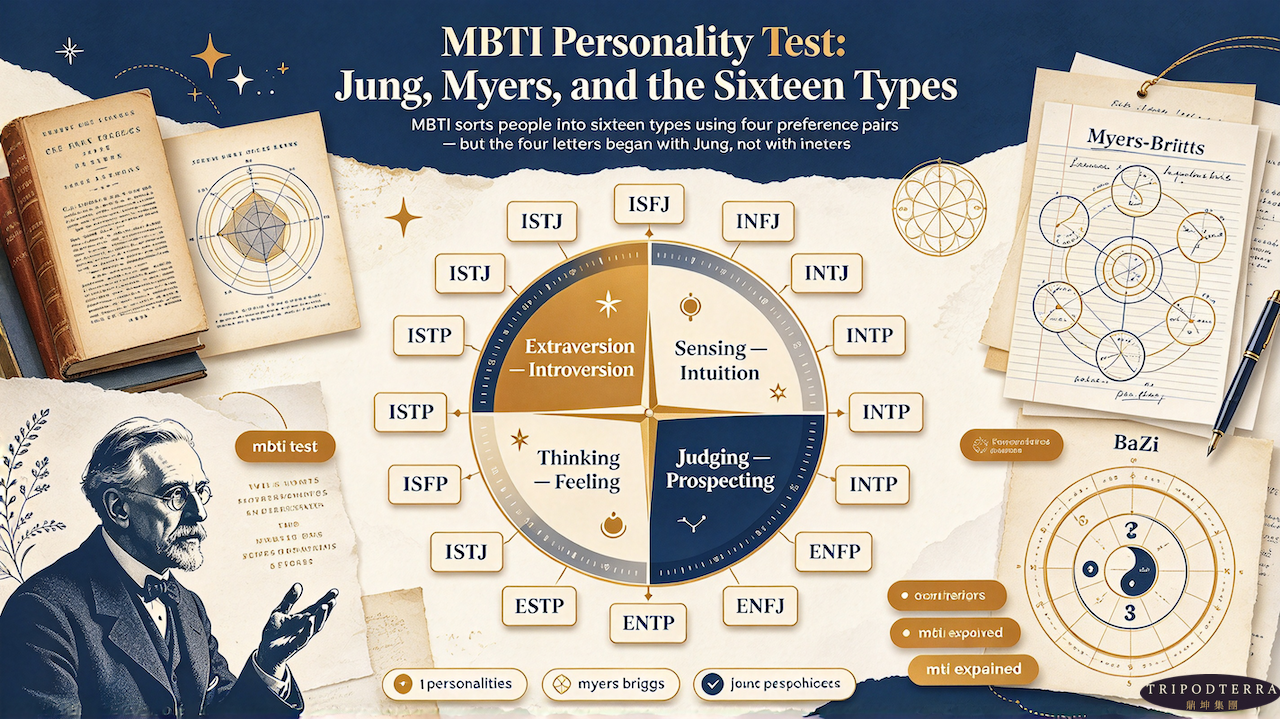
8. The sixteen types, at a glance
Multiply two by two by two by two and you get sixteen. The table gives each code a popular nickname and a one-line portrait. Two warnings. First, the nicknames are not official: The Myers-Briggs Company does not call INTJ "the Architect." They were popularized by 16Personalities, a separate commercial site whose NERIS Type Explorer blends MBTI vocabulary with Big Five research. Second, a one-line portrait is a horoscope sentence, designed to feel true. Read the table as a menu of vocabularies, not a diagnostic manual.
| Type | Popular nickname | One-line portrait |
|---|---|---|
| INTJ | Architect | Long-range planner with a low tolerance for wasted motion. |
| INTP | Logician | Idea mechanic who takes the system apart to see how it thinks. |
| ENTJ | Commander | Moves the group toward a decision, then owns the outcome. |
| ENTP | Debater | Argues both sides for the pleasure of finding the weak one. |
| INFJ | Advocate | Reads the room, then quietly tries to fix what it sensed. |
| INFP | Mediator | Inner compass first; the outer world is negotiated afterward. |
| ENFJ | Protagonist | Turns a group of strangers into a team, often without being asked. |
| ENFP | Campaigner | Sees twelve possible futures and wants to try three this month. |
| ISTJ | Logistician | Remembers how it went last time, and builds on that. |
| ISFJ | Defender | Notices what people need before they say it, and remembers. |
| ESTJ | Executive | Makes the plan, assigns the steps, checks the result. |
| ESFJ | Consul | Keeps the social weather warm and the calendar real. |
| ISTP | Virtuoso | Learns by taking it apart; calm in a crisis, allergic to meetings. |
| ISFP | Adventurer | Quietly aesthetic, quietly stubborn, deeply present. |
| ESTP | Entrepreneur | Reads the moment and moves; the plan can catch up later. |
| ESFP | Entertainer | Brings the energy; the room remembers them. |
9. INTJ — the Architect
The meme. INTJ is the type the internet loves to be. Black turtleneck, chessboard, a plan for everything, two emotions (annoyance and satisfaction), the villain in a hundred films and the founder in a thousand startup profiles. It is among the most self-assigned types in online polls — a fact about aspiration, not description.
The mechanism. In the popular function model, INTJ leads with introverted intuition — a private, convergent sense of where things are heading — supported by extraverted thinking, which organizes the external world to execute. The result is often a long-range model, a low tolerance for wasted motion, and a habit of saying the uncomfortable structural thing in a meeting. This stack is a later systematization, not something Jung wrote.
The misreading. INTJ does not mean "the smartest type," and the INTJ-CEO correlation is folklore. Many self-identified INTJs are introverted, analytical people who are tired of meetings. The feeling function is the least practiced, which is not the same as absent: INTJs are often intensely loyal to a small circle. And the cold-strategist image hides the most common real version: someone who plans carefully because being surprised is exhausting.
10. ENFP — the Campaigner
The meme. The golden retriever of the type world: chaotic creative, twelve projects, three finished, a business idea texted at 2 a.m., the friend who knows everyone at the party and has lost their phone twice.
The mechanism. ENFP leads with extraverted intuition — possibility generation, connection-making, the sense that everything is related to everything — supported by introverted feeling, an inner compass of values. The result is enthusiasm plus a fierce sense of authenticity: the ENFP can improvise wildly and still refuse a plan that feels false.
The misreading. ENFP does not mean flaky. The scattered-creative trope is funny and shareable, and most ENFPs are disciplined the moment a project touches their values.
11. ISTJ — the Logistician
The meme. The boring bureaucrat: rules, spreadsheets, the person who reads the terms and conditions and the person who actually files the receipt. "Logistician" is the nickname; "the adult in the room" is closer to the truth.
The mechanism. ISTJ leads with introverted sensing — a deep, detailed internal record of how things have gone — supported by extraverted thinking, which turns that record into dependable structure and execution. Reliability is the core: the ISTJ remembers what worked, what failed, and what it cost.
The misreading. ISTJ does not mean unimaginative. Sensing is not a lack of ideas; it is a high-resolution memory of experience, and some of the most inventive people work inside a craft tradition rather than against it. The political conflation — ISTJ equals conservative — is a category error. A type describes how someone processes information and decides, not what they believe.
Why these three? Because they are the most caricatured: the genius, the chaos, the bureaucrat. The useful exercise is not deciding which one you are. It is noticing which description made you defensive. That flinch is better data than the letter.
12. MBTI versus BaZi
These two systems are often compared, and the difference matters.
| MBTI | BaZi | |
|---|---|---|
| Input | Your answers about yourself | Birth date, hour, and place |
| Method | Self-report questionnaire | Calendar computation, four pillars, Day Master |
| What it describes | Self-perceived preference | Traditional symbolic tendency and timing |
| Stability | Can shift with mood and life stage | Chart is fixed; interpretation varies |
| Evidence base | Contested psychometrics | Traditional cosmology |
| Typical failure | Flattery | Fatalism |
| Best use | Vocabulary for self-reflection | A cultural lens and a language for tendency |
The deepest difference is grammatical. MBTI is first-person: its raw material is your account of yourself. BaZi is third-person: its raw material is the calendar — birth date, hour, and place, converted into four pillars, a Day Master, and five elements. One begins with your self-concept and summarizes it; the other begins with a datum you did not choose and interprets it.
That difference produces opposite failure modes. MBTI's failure is flattery: you answer as the person you would like to be, and the result confirms the story you already tell. BaZi's failure is fatalism: a symbol becomes a verdict, and a person starts living down to the chart. The first makes you complacent; the second makes you resigned. A good reading should make you more curious and more decisive, not more certain about who you are.
There is also a difference in claim. MBTI, at its best, describes preferences. BaZi, in the traditional reading, claims much more: temperament, family, career, wealth, and timing. Classical BaZi does talk about 性情, disposition, but its center of gravity is 格局, 用神, and 大运 — structure and timing, not a four-letter label. Calling BaZi "the Chinese MBTI" flattens both.
Now the honest part, in both directions. MBTI is not a scientific measurement: it is a commercial self-report instrument with a contested record, and its owner says it should not be used for hiring. BaZi is not a scientific theory of personality either: it is a traditional symbolic system with no claims to empirical validation. Neither should decide who someone is, who to hire, who to marry, or what to do with a life.
What is left is genuinely interesting: two languages for talking about temperament. Put them side by side and see where the coastlines agree.
A favorite example. In the traditional reading, a 辛金 Day Master is yin metal: not a sword but a jewel, a precision instrument — refined, exact, quietly proud, sensitive to careless handling. An INTJ in the popular description is exacting, systems-minded, allergic to sloppiness, with a private standard and a low tolerance for being handled carelessly. The overlap — precision, finish, a certain coolness — is real as a metaphor. It is not an identity. Plenty of 辛金 people are warm, messy ENFPs; plenty of INTJs have a 甲木 Day Master. The comparison is a prompt for reflection, not a proof.
If the comparison interests you, a free BaZi chart gives you your four pillars and Day Master; the BaZi introduction explains the grammar, and the Day Master guide explains what your element means. For professional life, the career reading shows how the same chart is read. And if your birth time is uncertain, true solar time explains why an hour can change the chart — a problem MBTI does not have.
13. How to use the MBTI chat on this site
The reading here is a conversation, not a form.
Step 1 — Open the chat. Go to the MBTI conversation.
Step 2 — Answer scenarios, not statements. The AI asks what happened, not what you are: what you do on a free Saturday, how you behave in a group project, how you argue, how you recharge after a bad week. It follows up, the way a good conversation does.
Step 3 — Hear the four pairs reflected back. Instead of a single verdict, you get a reading of each axis, including where you sit near the middle. "You look like an introvert with a strong extraverted streak at work" is more useful than one letter.
Step 4 — Ask the questions a test cannot answer. Why do I get INFJ on one test and INFP on another? What does the J actually mean? How would this show up in a management role? Where is this description overreaching?
Step 5 — Cross-check with your chart, if you want. If you have a BaZi chart, you can ask the AI to put the two vocabularies side by side. It will do so as an analogy, not a derivation — the only honest way to do it.
Step 6 — Keep the transcript. A conversation leaves a record of your own words. Reread it in a month; the parts that still feel true are more interesting than the parts that felt flattering.
What it is not: a standardized instrument, a normed score, a clinical assessment, or a hiring tool. It does not replace a therapist, a doctor, or a career counselor. It is a structured way to think out loud.
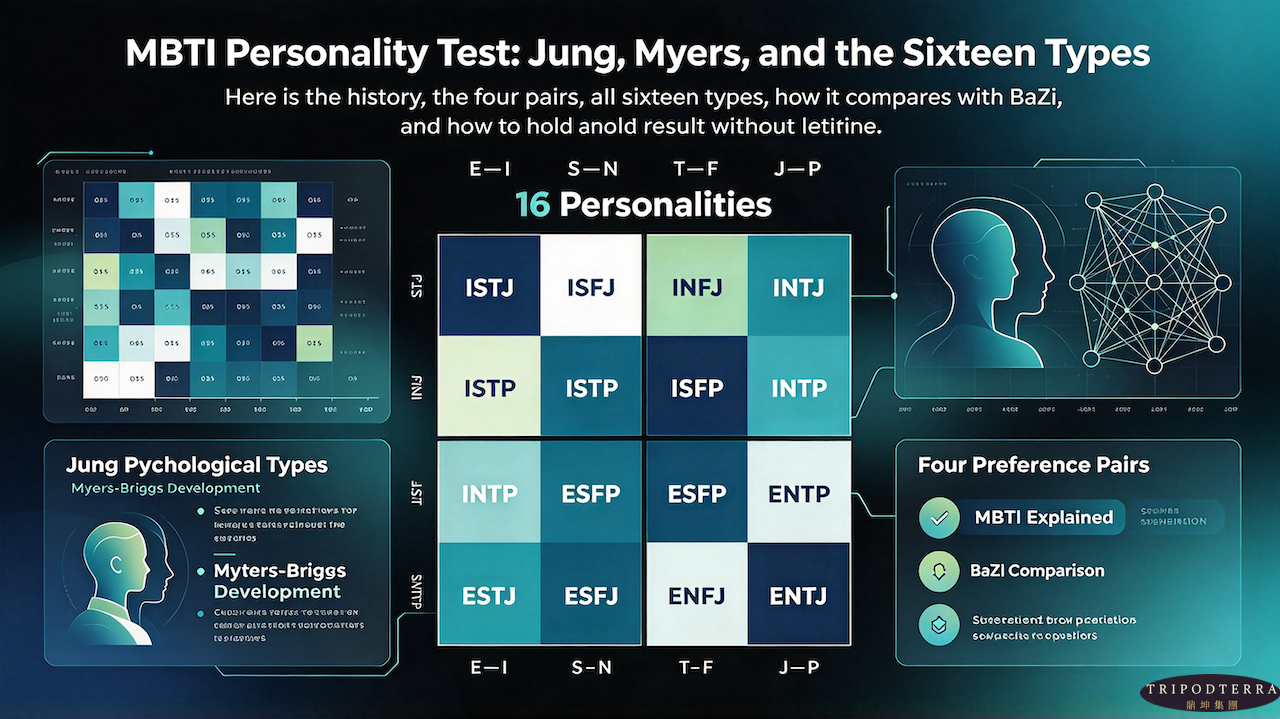
14. A note on how to hold a test result
Six rules, in descending order of importance.
1. Treat the type as a hypothesis, not an identity. "I am an INTJ" is a sentence about a test. "I plan in systems, I recharge alone, and I get impatient with meetings that have no decision" is a sentence about you.
2. Do not use the type as an excuse. "I can't do that, I'm an I" converts a preference into a limitation. Preferences describe defaults, not capacities. An introvert can learn to run a meeting; a thinking type can learn to open with the human question. The letter explains the cost of the stretch, not the impossibility.
3. Beware the flattery trap. Type descriptions are written to feel true. The Barnum effect — accepting vague, flattering statements as personally accurate — is doing a lot of work in every "this is so me" moment. A good test of a description is not whether it flatters you but whether it predicts something you could check.
4. Respect the middle. Most people sit near the midpoint on at least one axis, and the test turns a continuous score into a binary letter. If your T/F score is barely off center, the letter is a coin flip at the margin. Say "I lean F" rather than "I am an F."
5. Expect drift. Studies have reported that a substantial share of respondents — in some samples around half — get a different four-letter result when retested weeks later. A change is not evidence that the first result was fake; it is evidence that the instrument measures self-description, which moves.
6. Keep it out of high-stakes sorting. Do not hire, fire, promote, date, diagnose, or invest on the basis of four letters. The official publisher itself says the instrument should not be used for selection. In teams and relationships, use type to ask better questions — "do you want the plan or the options?" — not to assign roles or predict compatibility. The golden-pair charts are entertainment, and treating them as evidence is how a useful vocabulary becomes a small prison.
One more thing, for anyone who has ever felt reduced by a result: a type description is a cultural product, not a verdict. If it fits, use it as a mirror. The point of a mirror is to see yourself more clearly, not to become the reflection.
15. Get your reading
Two ways in, both free to start.
Start the MBTI conversation → — answer a few scenario questions, see the four pairs reflected back, and ask whatever the letters made you curious about. If you want the full menu first, the chat page lists every service.
Get your free BaZi chart → — the other map. Four pillars, a Day Master, and a vocabulary for timing that MBTI does not have. Browse the BaZi section if you would rather look around first.
The four letters are a starting point. The conversation is where they become useful.