
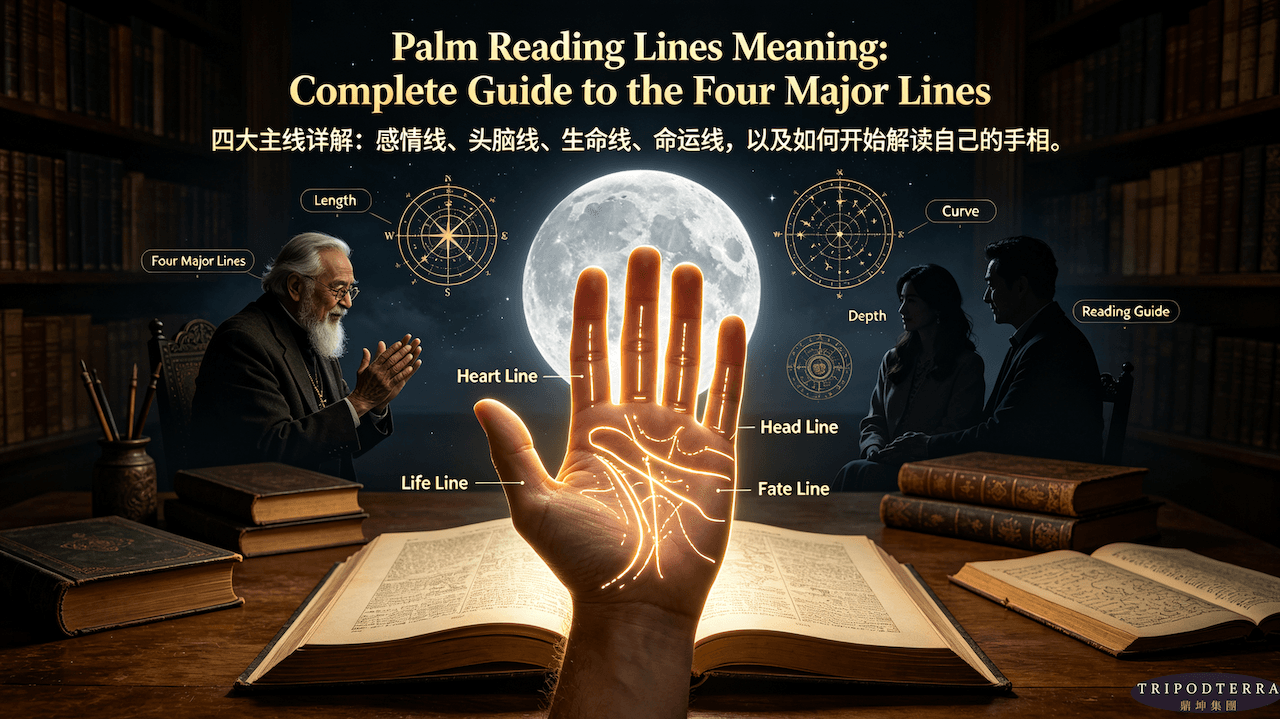
Open your hand and look at your palm. Those three or four deep creases running across it are not random wrinkles — in palmistry (Shouxiang, 手相) they are read as a chart of how you tend to think, feel, love, and move through life. This guide covers what palm reading lines mean in full: which hand to read, the four major lines, the minor lines most people never notice, how female and male hands are traditionally read differently, and how to run your first reading in about ten minutes.
One framing note first, because it matters for everything below. Palmistry is not a verdict. The lines are read as tendencies — patterns of temperament and habit a person leans toward, not fixed outcomes waiting to happen. Read this way, palm reading works best as a mirror: a structured way to think about your own patterns. Nothing here is medical or financial advice, and the same caveat applies to the related systems on this site, such as BaZi and face reading.
1. Which Hand Should You Read?
This is the first question every beginner hits, and the answer is more interesting than "read your left hand because you're right-handed."
The basic rule: read both hands, and read them against each other.
- Your dominant hand — the one you write with — is traditionally read as the hand of the present and the active life: what you have made of your raw material, the habits you have built, the direction you are currently pushing.
- Your non-dominant hand is read as the hand of birth and potential: the inherited baseline, the temperament you arrived with, the things that come to you without effort.
The real reading is the comparison. If your non-dominant head line is long and straight while your dominant head line wanders, the story is not "you are unfocused" — it is that you were born with a certain kind of mental wiring, and your life's work has been to adapt it. If the two hands match closely on the heart line, your emotional style has been remarkably consistent since childhood.
Practical setup: good light, a relaxed hand, palm up, fingers slightly spread. Don't press or stretch the skin — stretched skin flattens creases and changes how they look. Photograph both palms in the same light so you can compare them side by side rather than from memory.
2. A note on "reading the left hand"
The older Western convention was "left hand for women, right hand for men." That convention is a relic of a time when it was assumed men were the active public party and women the passive private one. Modern readers have largely dropped it in favour of the dominant/non-dominant rule, which works regardless of gender. We will come back to the female and male difference below, because there are real traditional differences — but they are not about which hand you choose.
3. The Basic Palmistry Approach
Before the lines, three things to understand about how a palm is read at all.
1. The three zones of the palm. The palm divides vertically into three zones. The upper zone (below the fingers) relates to the mental life and ideals; the middle zone (the hollow of the palm) to the practical and social life; the lower zone (the base) to instinct, vitality, and the emotional body. A line that runs long through one zone and fades in another is read accordingly.
2. The eight mounts. The fleshy pads at the edge and base of the palm — Venus (base of the thumb), Moon (opposite edge), Jupiter, Saturn, Apollo/Sun, Mercury, and two Mars mounts — describe the texture of the person. Mounts qualify the lines: a deep heart line on a hand with a prominent Venus mount reads differently from the same heart line on a flat palm.
3. Lines are not scars. A permanent crease forms where the skin attaches to underlying fascia and where the hand repeatedly folds, so deep lines are usually structural — present from before birth. This is why a palm's main lines stay stable across a lifetime while the fine lines shift, and it is the honest, non-mystical reason palmistry pays attention to depth: depth means this is a structural feature of how this hand works.
4. The Four Major Lines
Almost every palm has four major lines. Three are near-universal; the fourth, the fate line, is famously optional. Here is what each one means and how to read its length, depth, and curve.
5. The Heart Line — 感情线
Where it is: the topmost of the major lines, running horizontally across the upper palm, starting under the pinky edge and heading toward the index or middle finger.
What it governs: emotional style — how you give and receive affection, how you handle closeness, how much of your feeling you show.
How to read it:
- Ending under the index finger (Jupiter): an idealistic emotional style. You tend to love with your whole self and set high standards for the people you let close. Warm, but easily disappointed.
- Ending under the middle finger (Saturn): a pragmatic emotional style. You are affectionate but clear-eyed; you rarely lose your head, and you expect partnership to work, not just to feel good.
- Ending between the two: the balanced reading — a blend of idealism and practicality.
- Long, deep, and gently curved: emotionally fluent. You express affection easily and form deep attachments without losing yourself in them.
- Short and straight: economical with emotion. Not cold — selective. You have a small circle and you mean it.
- Chained (looking like a series of small links rather than one clean line): emotional complexity. You feel a great deal and it takes you time to sort out what is yours and what you have absorbed from others.
- Broken with an overlap: a transition rather than a catastrophe. Traditionally read as a significant shift in how you relate to people — a period where your emotional operating style was rebuilt.
- A straight heart line with a branch rising toward the index finger: the classic "warm idealist" marking.
- Small feathering branches downward: emotional generosity that can tip into giving too much. Worth noticing.
6. The Head Line — 智慧线
Where it is: the second line from the top, running across the middle of the palm, usually starting between the thumb and index finger, sometimes joined to the life line at its origin.
What it governs: thinking style — how you reason, how you learn, where your attention naturally goes.
How to read it:
- Joined to the life line at the start: a cautious, deliberate thinker. You were careful as a child and you still like to know the ground before you step. Independence comes later and is earned.
- Separated from the life line (a clear gap): early independence of mind. You have been your own authority on things for as long as you can remember.
- Long, running to the outer edge of the palm: far-ranging and quick. You make connections across fields and think fast. Watch for scattered focus.
- Short, stopping around the middle of the palm: practical and focused. You think deeply about a narrow band of things rather than broadly about everything.
- Straight: linear and logical. You build arguments step by step and trust structure.
- Curved, sloping down toward the base of the palm: intuitive and imaginative. You arrive at answers before you can explain the reasoning. Write down what you know before you talk yourself out of it.
- Branches, forks, and islands: forks at the end usually read as versatility — two directions at once. Islands read as periods of confusion or overload, usually transitional.
7. The Life Line — 生命线
Where it is: the long arc curving around the base of the thumb, from between the thumb and index finger down toward the wrist.
What it governs: vitality and the quality of your life force — energy level, resilience, how you recover. It is the most misunderstood line in palmistry, so read the next sentence twice: the life line is not a death clock. Its length has no bearing on how long you will live. It describes how much energy you have available and how you tend to spend it.
This is covered in far more depth in our dedicated article on the life line meaning in palm reading, including broken-line readings and the "short life line" myth. The summary:
- Long and sweeping well around the thumb base: strong reserves. You recover quickly and can sustain effort over long stretches.
- Short: lower stamina or a tendency to spend energy fast. These readings often describe someone who runs hot in bursts rather than steadily — which has its own advantages.
- Deep and unbroken: steady vitality.
- Chained or heavily islanded: a tendency toward fatigue and stress load. In palmistry this is framed as energy management, and it is a good cue to look at sleep and workload — not a medical signal of any kind.
- Multiple fine lines radiating from it: traditionally read as branching interests and a lot of nervous energy.
- A sister line running parallel inside it: the "double life line," traditionally read as extra reserves and a supportive influence. A resilience marking.
8. The Fate Line — 命运线
Where it is: the vertical line running up the center of the palm, from near the wrist toward the middle finger. Sometimes called the line of destiny or the Saturn line.
What it governs: your relationship to work, direction, and the sense that life has a visible trajectory. How much of your path is shaped by outer circumstance versus your own choice.
How to read it:
- Long, deep, and unbroken from wrist to middle finger: a strong sense of direction and a path that has been legible to you from early on.
- Starting at the wrist: self-made direction. Your path is your own and you built it.
- Starting mid-palm: a direction that clarified later — often after a period where you were not sure what you were doing, and then it clicked.
- Starting high, under the fingers: a trajectory shaped by outer circumstance, family, or opportunity that arrived rather than being chosen.
- Absent or very faint: this is common and it is not a bad sign. Traditionally it reads as a life less driven by a single linear career — someone whose path moves through relationships, interests, and phases rather than one track. In a world of portfolio careers and mid-life reinvention, this reading has aged rather well.
- Broken and resumed with an offset: a deliberate change of direction. Usually read as a career pivot that you chose, not one that happened to you.
- Multiple faint fate lines: capacity for several parallel pursuits at once.
9. Quick Reference: The Four Major Lines
| Line | Position on the palm | Primarily reads as | Long / deep | Short / faint | Key variants |
|---|---|---|---|---|---|
| Heart line 感情线 | Topmost, horizontal, pinky edge toward index/middle finger | Emotional style, affection, closeness | Emotionally fluent, deep attachments | Selective, economical with emotion | Chained = complexity; broken = transition; ending under Jupiter = idealist |
| Head line 智慧线 | Middle, thumb-index gap toward outer palm | Thinking style, reasoning, attention | Far-ranging, quick, broad interests | Practical, focused, narrow and deep | Joined to life line = deliberate; curved = intuitive; straight = linear |
| Life line 生命线 | Arc around the thumb base, down to the wrist | Vitality, energy, resilience (not lifespan) | Strong reserves, quick recovery | Bursts of energy, spends fast | Double line = extra reserves; chained = fatigue load |
| Fate line 命运线 | Vertical, wrist up toward middle finger | Work, direction, sense of trajectory | Strong early sense of direction | (Absent is normal) path moves through phases | Starts mid-palm = late clarity; broken = deliberate pivot |
10. The Minor Lines
Beyond the four majors, a palm carries a set of finer lines. They are fainter, more variable, and generally read as supporting detail rather than headline material — but they are where a reading gets specific.
11. The Sun Line (Apollo Line) — 太阳线
A short vertical line (or lines) running up toward the ring finger, in the lower-to-middle palm. It reads as recognition, creativity, and how visible your work is in the world. A clear sun line suggests a person whose efforts tend to attract notice; a faint or absent one reads as someone who does excellent work quietly. Neither is a verdict on talent — only on visibility.
12. The Mercury Line (Health Line) — 健康线
A diagonal line running from near the wrist up toward the pinky. Traditionally associated with the nervous system, business instinct, and how much inner activity a person carries. A strong, clean mercury line is read as sharp commercial instinct and quick thinking. A wavy or broken one reads as a lot of internal motion — the kind of person whose mind does not idle. In modern reading this is framed squarely as temperament and stress style, never as a health diagnosis, and it is a good prompt for ordinary self-care rather than alarm.
13. The Marriage Line (Relationship Lines) — 婚姻线
Short horizontal lines on the edge of the palm just below the pinky, between the heart line and the base of the finger. What they indicate is significant attachments rather than literal marriages — the number of lines is not a count of spouses, a point most reputable readers make clearly. Deeper lines read as more consuming attachments; lighter ones as lighter connections; a line that forks at the end is traditionally read as an attachment with a complicated ending or an important friendship attached to it. For a fuller picture of how relationship patterns are traditionally assessed across systems, see our guide to the zodiac compatibility chart.
14. Other Minor Lines Worth Knowing
- The Girdle of Venus: a curved line above the heart line, arcing from under the index to under the pinky. Reads as emotional intensity and sensitivity — a person who feels things at volume.
- The Line of Intuition: a curve from the outer palm up to the pinky. Attunement to other people's unspoken states.
- The Travel Lines: short horizontal lines on the outer edge of the palm below the heart line, read as movement, relocation, and restlessness.
- The Line of Mars: a line running parallel to the life line on the inside. Traditionally read as an extra charge of physical energy and courage.
- The Influence Lines: short vertical lines under the index or pinky finger, read as the presence of people who changed your direction.
Minor lines shift more across a lifetime than major ones, which is exactly why traditional readers treat them as the "current conditions" layer of a reading.
15. Reading Lines for Female vs Male Hands
The search term palm reading lines meaning female and its counterpart for men both point at a real tradition, so it is worth being precise about what that tradition actually says — and what it does not.
What it does not say: it is not a claim that men's and women's hands encode different fates, and it is not a claim that the same line means opposite things. Any reader who tells you a deep heart line means one thing on a woman's hand and the opposite on a man's is improvising.
What the tradition actually says: in classical palmistry — and especially in the Chinese Shouxiang tradition, where the reading of the hand sits alongside the reading of the face and the birth chart — hands are assessed as finer/softer versus firmer/broader, and gender has historically been used as shorthand for that distinction. A softer, more finely lined hand is read as a more sensitive and receptive temperament; a firmer, broader, fewer-lined hand as a more outward-driving one. Modern readers apply that same distinction without gendering it, because hand texture tracks far more closely with body type, work, and age than with sex.
Where the genuine gender difference sits — the childbearing line. The one traditional female-specific reading concerns the line between the heart line and the base of the pinky, specifically the presence of vertical lines descending from the pinky edge of the heart line. Traditionally these are read as children, and their number and depth are considered. This is the reading that generates most of the "female vs male" search interest. Two honest caveats: first, the line count is explicitly not literal — most traditional readers treat it as a general indicator of family orientation, not a headcount; second, reading it as a prediction about fertility is not something a responsible reader does, and this site does not present it that way. It is a traditional motif, described here so you recognize it, framed as tendency and self-reflection only.
Where modern reading has moved. The dominant/non-dominant hand rule has largely replaced the left-hand/right-hand-gender rule. The four major lines are read the same way on any hand. What differs in practice is comparison: because women's hands and men's hands differ in average skin thickness and subcutaneous fat, raw line depth is not comparable between two people — only within one person's two palms. That means the female and male palms are read with the same method and a different baseline. Our take: read the individual, use the tradition as vocabulary, and ignore anyone offering gender-based verdicts.
| Question | Traditional answer | What modern readers do |
|---|---|---|
| Which hand to read? | Left for women, right for men | Both hands — dominant = present/active, non-dominant = potential |
| Do the four major lines mean different things by gender? | No | No — same meanings, read both hands |
| Is there a female-specific line? | Childbearing lines under the pinky edge | Noted as a traditional motif; not treated as a literal count or prediction |
| Can line depth be compared between two people? | — | Only within one person's two hands; skin thickness differs by gender and age |
| Are hands read differently in Chinese Shouxiang? | Softer/finer vs firmer/broader | Same distinction, applied without gendering |
16. How to Start Reading Your Own Palm
You do not need a teacher to run a first reading. You need ten minutes and a willingness to be honest about what you notice. Here is the sequence professional readers follow, adapted for self-reading.
Step 1 — Photograph both palms in even light. Same distance, same light, palms up and relaxed. Comparison across paper beats comparison from memory, because the eye adjusts to whichever hand it looks at and loses the reference.
Step 2 — Identify the four major lines. Trace each one with a fingertip before you interpret anything. Most beginner mistakes come from misidentifying lines rather than misreading them — the head and heart lines are frequently confused on hands where the head line starts high.
Step 3 — Read the non-dominant hand first. Note the raw features: is the head line long or short, is the heart line curved or straight, is there a fate line at all? Write three words per line, no interpretation yet.
Step 4 — Read the dominant hand, then compare. Where the two hands agree are your stable traits. Where they differ are the places life changed you, or where you built something that did not come naturally. The gaps are the interesting part.
Step 5 — Add the minor lines. A sun line that is faint on the dominant hand and absent on the other is a story about effort that is beginning to show.
Step 6 — Check the mounts against the lines. Read the lines as the melody and the mounts as the key signature.
Step 7 — Write one paragraph, not a list. The most useful habit in palmistry is refusing to output isolated claims. "Long head line, broken heart line, faint fate line" is noise. "You think broadly, you rebuilt how you attach to people once, and you never had a single career track — which is why you feel behind when you are simply on a different shape of path" is a reading. This kind of synthesis is what an AI palm reading is genuinely good at, because it holds every feature at once.
Step 8 — Date it and re-read in six months. Minor lines change. Two snapshots tell you what no single reading can: whether the pattern is moving.
17. Common Misconceptions
"The life line tells you how long you will live." The single most persistent myth in palmistry, and the least true. The life line is read for vitality and energy quality, not duration. See the full treatment in our life line article.
"Lines never change." Major lines are structural and largely stable. Minor lines are not — they appear, deepen, and fade over months and years. Anyone who tells you your palm is a fixed contract has not looked at enough palms.
"A broken line is a bad line." Almost never read that way in serious tradition. Broken-with-overlap usually means transition; a break with a parallel line beside it is frequently read as a period that produced resilience rather than damage.
"You can read one hand." One hand is half the information. The whole method depends on the comparison.
"More lines means a more complicated life." It means finer skin and a more emotionally differentiated temperament in most cases. Fine-lined palms are common in people who are highly attuned and highly analytical, and the line density correlates strongly with age and with how much the hand has been used.
"Palmistry predicts events." It describes tendencies in temperament and pattern. Events come from an enormous number of causes and no crease in a hand is one of them. Read as a structured mirror for self-reflection, palmistry is genuinely useful. Read as a forecast, it is not.
"A chained line means illness." Chained lines read as emotional or mental complexity, and in the case of the life line as fatigue load. Palmistry is not a diagnostic system and should never be used in place of medical advice.
18. Where Palmistry Fits With the Other Systems
Palm reading rarely stands alone in the Chinese metaphysical tradition. Shouxiang (手相) sits beside face reading (Mianxiang, 面相 — see our guide to face reading moles for how the face is mapped the same way), and both sit downstream of the birth chart. The logic is layered: your BaZi chart describes the raw material you arrived with, the zodiac compatibility chart describes how your patterns interact with other people's, and the hand and face are traditionally read as the visible surface of the same underlying pattern — the places where your constitution shows through.
If you find the reading compelling, the natural next step is to check your Day Master with a free BaZi chart, which gives you the element-level baseline that the hand is then read against. Even something as incidental as the stroke count and element balance in your name has traditionally been assessed as part of the same layered picture. For a worked example of what a full palm service session covers, see our palm reading service page.
19. Start With Your Own Hands
Here is the short version. Read both hands. Take the non-dominant as potential and the dominant as practice, and read the difference between them as the story. Remember that the life line is about energy, not duration. Treat the fate line's absence as information rather than deficiency. And treat the whole exercise as what it is: a structured way to look at your own patterns with more clarity than you had before you opened your hand.
When you want a second perspective on what you are looking at — or a synthesis across all the lines at once instead of one at a time — try a free AI palm reading. Upload a photo of both palms, and the reading will walk through your four major lines, your minor lines, and what the pattern between your two hands suggests. If you would rather start at the foundation and build outward, generate your free BaZi chart first and bring the element-level picture to the palm. And if you want a quick grounding in the daily rhythms that palmistry and BaZi both draw on, the daily almanac is a good place to start each morning.