
Search "best tarot apps" and something revealing happens: nearly every list at the top of the results is hosted on the domain of one of the apps it recommends, and that app is ranked first.
This is not a conspiracy, it is an SEO strategy, and it works because nobody has done the boring version. So here is the boring version. We compared fourteen tarot apps and platforms by actually using them, grouped them by what they are genuinely good at, and reported what each costs, what the free tier actually gives you, and — this is the part that matters most — where each one loses.
Disclosure, before anything else, because it changes how you should read this page: we build one of the products below. TripodTerra is our platform. It appears in this list, marked clearly, assessed on the same criteria as everything else, and we have written down the places where competitors beat it. Every other entry is assessed on public information only.
One more framing note that governs the whole page. Tarot is a mirror for reflection and a structured prompt for thinking, not a prediction mechanism. Nothing here is medical, financial, or legal advice, and no app on this list — including ours — can tell you what is going to happen. Read the whole thing in that register and it will be genuinely useful.
1. How we picked and judged
Four categories, because the apps in this space are not competing with each other. A flashcard-based learning app and a $4-per-minute live reader are different products that happen to share a search term.
Learning apps teach you the deck. Judged on: quality of the card meanings, whether they teach structure or just keywords, breadth of free content, and whether there is a curriculum.
Daily-draw apps build a habit. Judged on: the pull experience, whether it journals, whether it keeps history, and how much it nags you to subscribe.
AI interpretation apps turn cards into a reading. Judged on: whether the interpretation responds to your question or returns the same text to everyone, whether it remembers past sessions, whether it handles reversals and full spreads, and how honestly it presents itself.
Live reader platforms connect you to a person. Judged on: screening, transparency of pricing, the real terms of the free offer, and how quickly the meter starts.
Across all four: pricing accuracy, whether the free tier is a genuine allowance or a preview, and whether the app still gets updated. A dead app with a beautiful interface is a dead app.
Two caveats on the data. First, app prices and tiers change constantly, and several of the numbers below are ranges rather than fixed rates because the platforms themselves price per advisor or per credit. Second, ratings are as displayed in the App Store and Google Play at the time of checking and should be treated as directional.
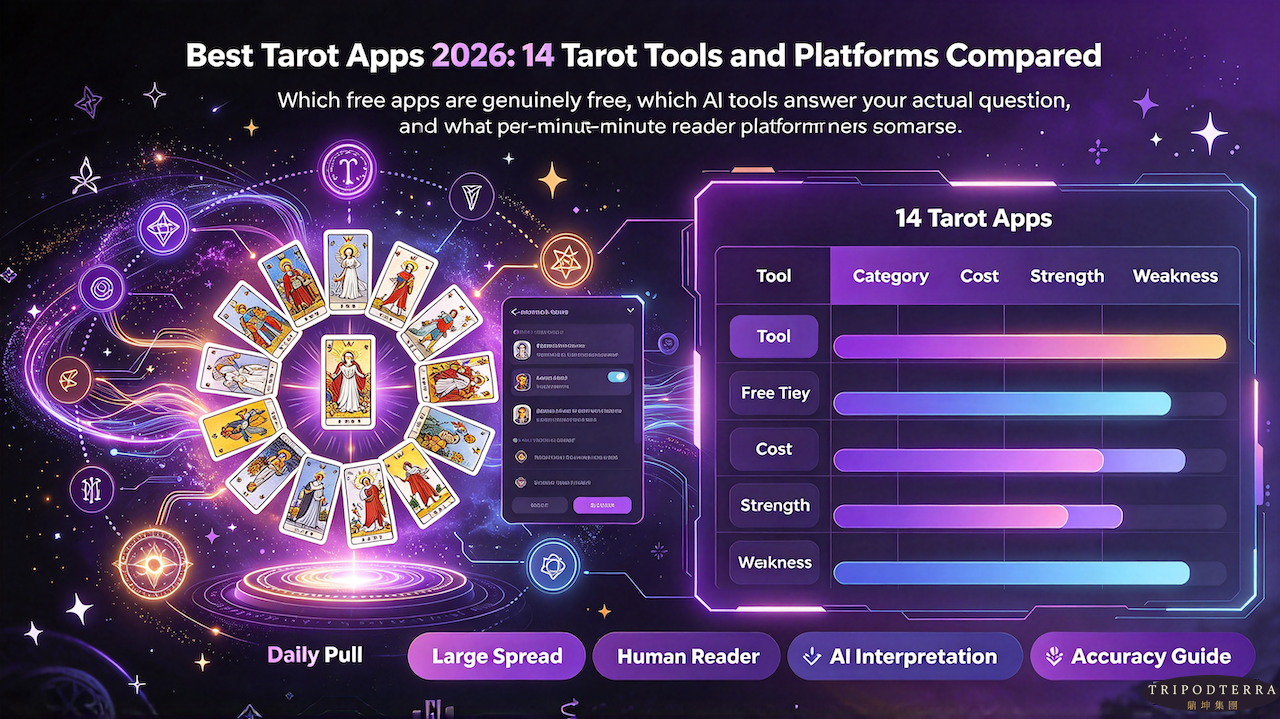
2. Learning apps
2.1. 1. Labyrinthos — best for actually learning the cards
Platform: iOS, Android. Price: Free with a premium tier.
The strongest free tarot education available on a phone. Labyrinthos is built as a school rather than an oracle: flashcard-style drills, a structured academy path, clean card meanings, and a genuinely generous free tier that covers more than most people will ever use. The premium tier adds extras like custom spreads rather than gating the basics.
Where it loses: the interface is a learning tool, not a reading tool. If you already know the deck and want to interpret a spread in context, this is not the app you open. It also teaches its own phrasing of the meanings, which is fine for fluency and slightly limiting if you later want to read a different tradition.
Who it is for: anyone in their first six months with tarot, and anyone who wants a no-cost daily practice.
2.2. 2. Golden Thread Tarot — still free, no longer maintained
Platform: iOS, Android. Price: Free.
Golden Thread is the minimalist gold-on-black deck app from the same creator as Labyrinthos, and for years it was the best free daily draw on mobile. The daily pull, the journaling, and the stark visual style still hold up.
The honest caveat: Golden Thread is no longer being updated. The app's own description points users to Labyrinthos, and its last substantive update was years ago. It remains available and free, which makes it a perfectly reasonable daily-draw tool today — but do not build a long-term practice on something the developer has explicitly stepped away from.
Who it is for: daily-draw minimalists who want zero cost and no subscription pressure.
2.3. 3. Biddy Tarot — the best free written reference, courses cost real money
Platform: Web. Price: Free reference content; paid courses.
Biddy Tarot has been the internet's default tarot dictionary for well over a decade, and its free card meanings are among the clearest written anywhere. If you are learning, the free pages are genuinely enough.
The business is the courses, and they are priced like professional education rather than a hobby purchase. That is not a criticism — it is the correct expectation to set. The site is also modern-reading in orientation, which means it leans psychological and reflective rather than predictive. Some readers find that exactly right; those who want the older divinatory tradition will find it thin.
Who it is for: readers who learn best from long-form text, and anyone who wants a free reference to keep open beside a physical deck. Pair it with our own tarot card meanings list for the full 78-card structure.
2.4. 4. The Fool's Dog — the deck-collector's app
Platform: iOS, Android. Price: Per-deck apps, typically a few dollars each.
The Fool's Dog publishes individual apps for a long catalogue of tarot decks, often with the deck creator's own book text included. If you read with a specific deck — or want to study one — this is frequently the only way to get it in digital form with proper commentary.
Where it loses: it is not a platform. There is no journal, no daily practice, no cross-deck anything. You buy the deck you want, and that is the product.
Who it is for: readers with a strong deck preference who want that deck's own guidebook rather than a generic interpretation.
3. Daily-draw and reference apps
3.1. 5. Galaxy Tarot — free, offline, Android-first
Platform: Android, with limited iOS presence. Price: Free with ads.
A long-running Android favourite. Galaxy Tarot works offline, includes meanings, spreads, and a daily card, and costs nothing. It has no AI and does not try to have any — the interpretations are the traditional text, which for many readers is exactly the point.
Where it loses: presentation is dated, the ad-supported model is visible, and the iOS experience is not comparable. If you want something that feels current, look elsewhere.
Who it is for: Android users who want a free, offline, no-nonsense reference and daily draw.
3.2. 6. Mystic Mondays — the design-forward daily draw
Platform: iOS, Android. Price: Free with in-app purchases.
Mystic Mondays is built around a bright, contemporary deck and an app that leans into aesthetics: bold colour, a clean daily card, and a tone aimed at people who came to tarot through design and social media rather than through occult study.
Where it loses: the visual identity is the product, and the interpretive depth is thinner than a dedicated learning app. It is excellent at making tarot feel approachable; it is not where you go to study the minor arcana.
Who it is for: casual readers and anyone who wants tarot to feel like part of a modern aesthetic practice.
3.3. 7. Tarot.com — the largest library, the most constrained free tier
Platform: Web, iOS, Android. Price: Free tier with heavy ad load; paid readings and subscriptions.
Tarot.com has been operating since the mid-1990s and has the largest reading library of any site in the category, with an enormous archive of card meanings and spread interpretations. For sheer volume of reference material it is hard to beat.
Where it loses: the free experience is ad-heavy and more constrained than the marketing suggests, and the site pushes paid readings hard. As a free reference it is useful; as a free reading it is limited. Read the tiers carefully before you assume you are getting an unlimited free product.
Who it is for: people who want breadth of reference material and do not mind ads.
3.4. 8. AstroTarot — free, multilingual, self-reviewed
Platform: Web and app. Price: Free.
AstroTarot offers free tarot readings across a reported ten languages, which makes it one of the few genuinely multilingual free options in the category.
One transparency note that applies here more than anywhere else on this list: AstroTarot's own "best tarot apps" comparison ranks AstroTarot highly. That is the exact pattern this article exists to correct, and it is worth knowing when you read that page.
Who it is for: non-English speakers who want a free reading without signing up for a subscription.
4. AI interpretation apps
This is the category that changed most between 2023 and 2026, and the one where the marketing is furthest ahead of the reality. The dividing line is simple and worth stating plainly: an AI tarot app is only interesting if its interpretation responds to your question. If you draw the same card on two different days with two different questions and get the same paragraph, you are looking at a card dictionary with a shuffle animation.
4.1. 9. TripodTerra — our platform, and the one we can vouch for
Platform: Web (works on mobile browsers); no download required. Price: Free tier with a real message allowance; paid plans from $19.90/month with a multi-day trial.
Full disclosure again: this is ours. Here is what it does and where it loses.
TripodTerra's tarot reading draws a spread and interprets it against the question you actually asked, and it remembers your previous sessions rather than resetting. Its real differentiator is that it is not a tarot-only product: the same chat runs nineteen services — BaZi, Zi Wei Dou Shu, I Ching, palmistry, face reading, Qi Men Dun Jia, dream interpretation, naming, date selection and more — and the tarot reading is informed by your birth chart. That cross-system grounding produces readings a tarot-only app cannot, because it has context the others are not collecting.
Where it loses, honestly. It is not a card learning app — if you want flashcards and drills, Labyrinthos is better and free, and we would tell you to use it. It has no native iOS or Android app, only the mobile web. It cannot teach you the deck; it assumes you will either know the cards or look them up in our meanings list. And it is a subscription product, which is the correct model for something whose cost scales with use but is still a subscription.
Who it is for: readers who want a spread interpreted in context, want their history remembered, and want tarot connected to the rest of their chart rather than standing alone.
4.2. 10. aimag.me — AI tarot as a PWA, one free reading a day
Platform: Web (PWA — installable, no app store). Price: Free tier of one reading per day; paid tiers above that.
An AI tarot tool delivered as a progressive web app rather than a native download, which makes it fast to try and easy to abandon if it does not suit you. The free tier is a hard one reading per day, which is enough for a daily practice and not enough for much else.
Where it loses: the daily limit is the model, so anything more serious pushes you to paid quickly, and as with every AI tool in this list, the quality of the interpretation is the whole product — try it side by side with a competitor using the same question before you commit.
Who it is for: daily-practice users who want an AI reading and do not want to install anything.
4.3. 11. Elvi — AI tarot in Telegram
Platform: Telegram bot. Price: Not fully free; paid tier.
Elvi delivers AI tarot through a Telegram bot, which is a genuinely good fit for the medium: no install, no app store, and the conversation lives where you already are. It keeps track of previous readings rather than treating each one as isolated, which puts it ahead of most of the category on memory.
Where it loses: it is not free, and the Telegram format means the interface is a chat window — no spread visualisation, no card imagery to sit with. If you read cards partly for the images, this strips that out.
Who it is for: Telegram users who want the reading in their existing chat and do not want another app.
4.4. 12. Faladdin — the most-downloaded Turkish fortune app, with a caveat attached
Platform: iOS (US storefront), Android, web. Price: Subscription and credits; price varies by storefront. Free with heavy gating.
Faladdin is the breakout Turkish fortune app — coffee-cup reading, tarot, and horoscopes in one chat-style product — and it is unambiguously AI-powered. Its iOS listing carries 4.60 stars from roughly 89,900 ratings, and the Android build reports 10 million-plus installs, which makes it the highest-volume app in this entire list by a wide margin. Its landing page now brands it as an "AI chat and entertainment app," a visible de-emphasis of the fortune-telling framing that is worth noting on its own.
Two things you should know before installing it, both verifiable and neither in the marketing copy.
It has been pulled from the Turkish App Store. A lookup against the Turkish storefront returns nothing; a Turkish-language search surfaces only unrelated apps. Turkish users report the app simply being unavailable, with support replies confirming it. If you are in Turkey, do not expect to install this from the App Store.
The owner is under indictment. In September 2025, an Istanbul indictment sought three to seven years plus a judicial fine against Sertaç Taşdelen, the founder behind both Faladdin and Binnaz, on money-laundering charges connected to the apps' revenue. Separately, Turkey's Advertising Board halted advertising for Faladdin and the Binnaz domains in January 2024. The app itself was last updated in September 2026 and the brand now routes through a Dubai entity, so it remains an operating product — but it is a product with an unresolved legal situation around it. That is a fact about the business, not about the tarot, and you should weigh it accordingly.
Where it loses as a tarot tool: the reading is localised around Turkish fortune traditions, English support is uneven, and interpretation depth varies sharply by reading type. Also worth saying plainly — the download and user figures the company publishes are company figures. No audited daily-active-user number exists.
Who it is for: Turkish-speaking users who want the coffee-cup tradition, and anyone studying how AI fortune apps actually scale. Check regional availability first.
4.4.1. 12b. Falbakar — two different products share the name
Worth separating, because most listicles conflate them.
falbakar.com is the older service: a human-reader platform whose pitch was explicitly "real interpreters," launched around 2016, with a website footer that has not moved since. The iOS listing is delisted in both the US and Turkish storefronts, and the last version dates to 2016. Treat it as dormant.
falbakar.io is a live, separate product — a web-only AI app run by a UK company. It is explicit that it is AI ("yorumlar yapay zeka tarafından üretilmektedir") and carries a refreshingly honest disclaimer that its readings have no genuine divinatory quality. It covers eight-plus reading types including coffee-cup image reading, the full 78-card tarot deck, Katina, palm reading, dream interpretation, numerology, and compatibility. Pricing is in pounds rather than lira: roughly £2.99 monthly, £23.99 yearly, with credit packs from £0.99, and a free tier of three summary readings a day plus one detailed reading a week. Its published rating and usage numbers are self-reported on its own homepage, with no third-party source, so treat them as marketing.
The connection between the two is unverified, and the naming is genuinely confusing. If you go looking for "Falbakar," you may land on either.
Who it is for: Turkish-language readers who want an AI reading on the web without installing anything.
4.5. 13. CyberOmen — cross-system AI, paid per reading
Platform: Web. Price: Per reading. We could not verify a current figure — treat any number you see, including ones quoted elsewhere, as unconfirmed.
CyberOmen's positioning is the part we can state: it combines tarot, BaZi, astrology, and numerology in a single AI reading rather than treating them as separate products, and it prices by the reading rather than by subscription. The cross-system approach is the same bet TripodTerra makes — that a reading informed by several frameworks is more specific than one that uses a single system.
Where it loses: we could not confirm that the main domain currently serves a live product, and the pricing we found varied across the pages that do exist. Per-reading pricing drifts in this category anyway. Check that the site works and what it charges before you pay anything.
Who it is for: readers who want a cheap trial of cross-system AI interpretation without a subscription.
5. Live human readers
For some questions, an app is the wrong answer and you want a person. These are the platforms where that happens, and the terms matter more than the marketing.
5.1. 14. Keen — the largest reader directory
Platform: Web, iOS, Android. Price: Roughly $1.99–$9.99 per minute depending on advisor, with wider reported spans. New users: commonly $1 for the first 5 minutes with participating advisors.
Keen has been running since 1999 and lists more than 1,700 advisors, which makes it the deepest directory in the category. Advisors set their own rates, so the range across the platform is wide. Its introductory offer is a discount rather than a free reading — five minutes for a dollar with selected advisors is the standard shape.
Where it loses: price varies enormously between advisors and the rate is not a reliable guide to quality. As with every per-minute platform, sample several readers briefly rather than committing to one at length — and read the terms of the intro offer, because it does not apply to every advisor.
6. Also worth knowing: Purple Garden, Kasamba, Sanctuary, Binnaz
Four more, briefly, because they serve different needs.
Purple Garden (web and app) is app-first with chat, phone, and video readings, quotes rates from $0.99 per minute and operates a credit system rather than straight per-minute billing, and offers a $30 new-user credit — the most generous in absolute terms in this list. Reviews have flagged a monthly maintenance fee on balances left inactive for an extended period, so read the terms.
Kasamba (web) has been running since 1999, offers three free minutes plus a first-session discount with participating advisors, and is one of the few platforms offering email readings — worth knowing if you want a written reading rather than a live one. Note that the free minutes require a payment method on file before the clock starts, that Kasamba does not publish its advisor count, and that it shares an owner with Keen.
Sanctuary (app) is subscription-based, oriented around astrology with live reader sessions available, and is the most polished mobile experience of the four. It is priced as an astrology subscription rather than a tarot product.
Binnaz (web, plus an iOS app) is the human-reader counterpart to Faladdin — often described as the biggest live reader platform in the Turkish market, with written, voice, and video sessions and readers who set their own per-minute rates. Its iOS listing carries 4.42 stars from about 1,027 ratings. Two caveats: the app is not currently available on the Turkish App Store, so do not plan on installing it there, and its published complaints pattern is the one common to per-minute marketplaces — login and verification failures, sessions cutting out, and pricing discrepancies at checkout. Worth knowing: a Google Play app called "Birnaz Abla" is a copycat, not the real platform.
7. The comparison table
| # | App | Category | Platform | Free tier | Standout | Main weakness |
|---|---|---|---|---|---|---|
| 1 | Labyrinthos | Learning | iOS, Android | Generous — full basics | Best free tarot education on mobile | A school, not a reading tool |
| 2 | Golden Thread | Daily draw | iOS, Android | Fully free | Clean minimalist daily pull + journal | No longer maintained |
| 3 | Biddy Tarot | Learning | Web | Free reference | Clearest written card meanings online | Courses are expensive |
| 4 | The Fool's Dog | Learning | iOS, Android | None (per-deck purchase) | Deck-specific apps with creator text | No journal, no daily practice, no platform |
| 5 | Galaxy Tarot | Daily draw | Android | Free with ads | Works offline, no AI, traditional text | Dated UI; weak on iOS |
| 6 | Mystic Mondays | Daily draw | iOS, Android | Free tier | Best-looking daily draw | Shallow interpretation |
| 7 | Tarot.com | Reference | Web, iOS, Android | Limited, ad-heavy | Largest reading library, running since the 90s | Free tier more constrained than advertised |
| 8 | AstroTarot | Reference | Web, app | Free | Free across many languages | Its top listicle ranks itself first |
| 9 | TripodTerra (ours) | AI reading | Web | Real message allowance | Cross-system: tarot informed by your BaZi chart, remembers sessions | No native app; not a learning tool |
| 10 | aimag.me | AI reading | Web PWA | 1 reading/day | Installable PWA, no app store | Daily cap pushes to paid fast |
| 11 | Elvi | AI reading | Telegram | No | Lives in Telegram; remembers past readings | Not free; no card visuals |
| 12 | Faladdin | AI reading | iOS, Android, web | Free with heavy gating | 4.60 stars / ~89.9K ratings; 10M+ Android installs; coffee-cup tradition | Pulled from the Turkish App Store; founder under indictment; uneven depth |
| 12b | Falbakar | AI reading | Web (falbakar.io) | 3 summary/day + 1 detailed/week | 8+ reading types; openly labels itself AI | Confusingly shares a name with a dormant 2016 human-reader service |
| 13 | CyberOmen | AI reading | Web | None (pay per reading; price unverified) | Cross-system AI reading without a subscription | Live availability and pricing both unconfirmed |
| 14 | Keen | Live reader | Web, iOS, Android | $1 for first 5 min (selected advisors) | 1,700+ advisors since 1999 | Advisor rates $1.99–$9.99+/min, quality unpredictable |
| — | Purple Garden | Live reader | App, web | $30 new-user credit | Video readings; from $0.99/min | Inactive-balance maintenance fee |
| — | Kasamba | Live reader | Web | 3 free min + first-session discount | Email readings available | Free minutes limited to participating advisors |
| — | Sanctuary | Live reader | App | Subscription trial | Most polished mobile experience | Astrology-first, not tarot-first |
| — | Binnaz | Live reader | Web, iOS | Credit top-ups, no subscription | 4.42 stars / ~1,027 ratings; written, voice and video sessions | Not on the Turkish App Store; recurring checkout and reliability complaints |
8. How to choose: by what you are actually doing
You are learning the cards. Labyrinthos, free, plus a physical deck. Add Biddy Tarot's free written meanings and our full 78-card list for structure. Do not pay for anything in your first three months; there is nothing a paid course gives you that daily practice will not.
You want a daily pull. Golden Thread if you want free and minimal and accept that it is frozen in time. Mystic Mondays if you want it to look good. Galaxy Tarot if you are on Android and want it to work offline. Any of the three is a fine habit-builder.
You want a spread interpreted, not just drawn. An AI reading, and the test is the one above: ask two different questions on two different days and see whether the answer changes. Try our AI tarot reading or aimag.me side by side with the same question before you subscribe to either.
You want tarot connected to the rest of your chart. That is the specific pitch of TripodTerra and CyberOmen, and it is the reason we built ours the way we did — a tarot spread that knows your BaZi reads differently from one that does not. Judge that claim by testing it, not by reading our paragraph about it.
You want a person. A live platform. Use the intro offer with a low-cost advisor to sample three readers briefly rather than one at length, and know that per-minute sites price between roughly a dollar and several dollars a minute, so a half-hour session has a very wide cost range.
You have a specific yes or no question. A single card with a tightly framed question will outperform any app here — the method matters more than the tool. Our yes or no tarot guide covers the one-card and two-option three-card versions.
You are still deciding whether to use a tool at all. Our online tarot reading guide walks through the five business models hiding behind the word "free," how the one-card, three-card, and Celtic Cross spreads differ, and how to frame a question before you open anything.
9. Common questions
What is the best free tarot app? Labyrinthos for learning, and it is not close. Golden Thread for a daily draw if you accept that it is no longer updated. Both are genuinely free rather than free trials.
Are any tarot apps actually accurate? None of them predict the future, and none claims to honestly. What separates a good AI tarot app from a bad one is not accuracy — it is whether the interpretation responds to your specific question and context, or returns the same generic paragraph to everyone.
Do I need an app at all? No. A physical deck and a meanings reference will teach you more, faster, than any app. Apps are for people who want the draw, the journal, and the interpretation in one place — which is most people, most of the time.
Which AI tarot app is best? By our criteria — context-responsive interpretation, session memory, honest self-presentation — we would put TripodTerra and Elvi at the top, with the caveat that one of those is ours. CyberOmen occupies the same functional slot as TripodTerra at a pay-per-reading price, but we could not confirm that it is currently live, so we are not sending you there; the category has one verified option and it is ours, which is exactly the kind of claim you should discount. Test any of them with your own question before paying; the difference between a real interpretation and a card lookup is obvious within two readings.
Is it worth paying for a live reader? Sometimes. A live reader can notice what you avoid saying, which no AI does. If what you want is to be questioned by a person, yes. If what you want is a structured reflection on a question, an AI reading or a free daily pull will get you there for nothing.
10. The short version
Learn with Labyrinthos. Build a habit with a free daily-draw app. Get spreads interpreted by an AI reading, and test it with your own question rather than trusting the copy on its website. Talk to a human when you want to be seen rather than answered. And treat every "best tarot apps" list that ranks its own author first — including, in principle, this one — with the scepticism the format has earned. The difference here is that we told you which entry is ours and where it loses.
If you want to start with a reading rather than a download, try the AI tarot reading free and see how a three-card spread reads when it is answered in context. For a fuller picture of what a paid session covers, see the tarot service page, and for the one-question decision format, the yes or no guide.