

Feng shui consultation has quietly moved online, and a surprisingly small number of people have noticed what that changed. For most of the tradition's history, a consultant came to the house — because the tradition assumed an actual compass reading taken at the actual door, with the practitioner standing in the actual space. When consultants began working from floor plans, photos, and video calls instead, they did not just replace a plane ticket with a Zoom link. They changed which parts of the method survive the trip.
That is the real question in 2026, and it is not the one most searches ask. The useful comparison is no longer remote versus in-person. It is AI versus human — and the two formats have almost opposite strengths, which is why the honest answer is to use both for different jobs.
This guide covers what an online consultation actually involves, what the market charges across every price band, where the classical methods break down when the practitioner is not in the room, and what an AI reading can and cannot do. TripodTerra is our platform, and this article's CTA points to our AI feng shui service — so read the section on AI's limits with that in mind and judge whether we hold the line honestly.
1. How an online feng shui consultation actually works
Strip away the marketing and almost every remote consultation follows the same three-stage shape, whether the practitioner charges nothing or a thousand dollars.
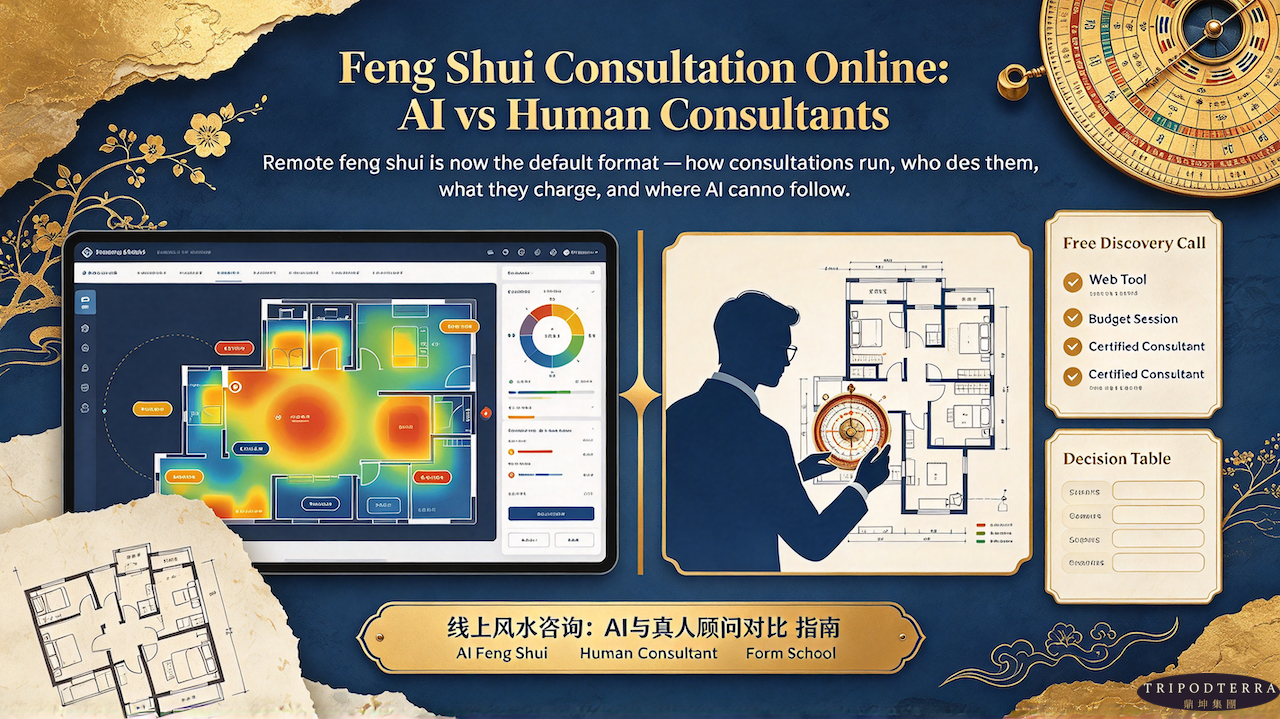
Stage 1 — Intake. You send a floor plan, a set of photos, and a video walkthrough. The floor plan matters more than most clients expect: without it, the practitioner cannot establish the bagua grid or, in compass school, relate the rooms to the building's orientation. A photograph of your bed tells them the bed's position; it does not tell them which direction it faces.
Stage 2 — Analysis. The practitioner works the plan before the call. In the Compass School (理气派) this is where the building's sitting and facing directions determine the Eight Mansions (八宅) configuration and, where the school uses it, the Flying Star (飞星) chart for the period. This is desk work and it is why remote consultation works at all — the analysis was never done by standing in the room. It was done from a plan and a bearing.
Stage 3 — Delivery. A video call, typically 60 to 90 minutes, followed by a written report. This is where the format genuinely differs from in-person. A good remote consultant walks you through the plan on screen, marks the sectors, and records the call; several consultancies send screenshots after. What you lose is wandering into a hallway to check one thing. What you gain is a document you can reread in six months, when you have forgotten everything that was said.
The intake is where most first consultations go wrong. The checklist at the end of this article covers what to prepare.
2. The two schools, and why the distinction decides whether AI can help
Almost every practical disagreement about online feng shui — including whether AI can do it — traces back to a split that is centuries old. You cannot evaluate any consultant, human or otherwise, without it.
The Form School (形势派) reads the space. It works with what is physically there: the shape of the site and the surroundings, the flow of traffic through a room, whether the bed faces the door, whether a beam presses down on where you sleep, whether a mirror bounces light back into a corridor. Its remedies are physical — move the bed, block the sightline, soften the corner, hang a screen. For a bedroom-level consultation, most of what our feng shui bedroom guide covers is Form School reasoning.
The Compass School (理气派) reads the directions. It works with bearings and time: the Eight Mansions system relates a person's Kua number to the building's sitting and facing directions, and the Flying Star system produces a time-varying chart of nine palaces — which is why the same house can be assessed differently in one nine-year period than another. Two systems sit inside this school and the practitioners who use them are not interchangeable.
Why this determines everything about online and AI work:
Form School assessment is visual. Traffic, sightlines, clutter, bed position, and beam placement are all things a photo shows. This is the half of feng shui where an AI reading from photographs is genuinely capable, and it is the half where most everyday questions actually live — mirrors, plants, colours, which corner the bed faces.
Compass School assessment is positional and numerical. It requires a real bearing and a real period. No photograph contains that information. This is the hard boundary, and we will come back to it in detail.
The practical consequence: any consultant — human or AI — who gives you a full Eight Mansions or Flying Star analysis without asking for a compass bearing is not doing that analysis. They are doing Form School and calling it something else.
3. What online consultations cost, and what you get for it
Prices in this market are unusually opaque. Many certified consultants, including most of the International Feng Shui Guild (IFSG) directory, do not publish rates at all — you contact them for a quote. But enough practitioners publish that the shape of the market is clear, and the spread is enormous: from free to roughly a thousand dollars for the same nominal service.
Here is the market as it actually prices itself, gathered from published rates and industry survey data.
4. Free — discovery calls and web tools
The free end of this market is real, and it comes in two forms worth distinguishing.
Free discovery sessions. Some consultants offer a short introductory video call — commonly around thirty minutes — to establish what you need and whether they are the right person, before any paid engagement. Valérie Sandrin, a certified practitioner of the Françoise Chevalier school of Tibetan feng shui, publishes exactly this structure: a free discovery session of about thirty minutes by video, with the actual consultation priced separately and delivered remotely via WhatsApp video, working from your plans, photos, and videos rather than a site visit.
Free tools. A newer category. Web-based generators such as AI Fengshui run free and require no account, taking a floor plan or room photo and returning bagua overlays, five-element balance notes, and layout suggestions. FateFolio runs on a similar model — no registration, images processed in memory rather than stored, history kept in the browser. These are legitimate starting points for orientation and for the vocabulary, and they cost nothing to try.
What free is good for: an orientation pass, a second opinion on a single question, and learning what the terminology means before you pay someone who uses it.
What free is not good for: a specific recommendation you can act on. A free tool can tell you where the wealth sector sits on your plan. It cannot tell you whether your bed should move, because that depends on details no free tool asks for.
5. The budget band — roughly $150 to $400 per session
This is where the real market sits for single-room and residential remote consultations, and it is the band where most people reading this will actually transact.
Published examples give a fair picture of the range. A one-hour remote floor-plan analysis sits at the low end, around AUD $149, typically including a bagua overlay, sector-by-sector advice, remedies, and a map check. A one-hour virtual consultation for a smaller home runs around £395 in the UK market. A phone/online residential consultation working from floor plan and photos sits around $299, with an hourly alternative of about $200/hour on a two-hour minimum.
Industry survey data for the US market places virtual consultations broadly in the $200 to $500 range, and describes them as cheaper than in-person visits precisely because there are no travel costs — while noting that remote sessions can be less thorough for very large or complex buildings.
What you get at this price: a proper intake on your plans, an hour of analysis, sector-level recommendations, and usually a written report. Turnaround on the report is commonly up to a week. Deposits and 48-hour cancellation rules are standard, and they are worth reading before booking — some practices require a 50% deposit.
6. The premium band — roughly $400 to $1,000+
At the top of the market you are buying a named consultant's time, and the effective hourly rate climbs steeply. Published UK rates illustrate it well: roughly £360 for a single hour covering one room up to 300 square feet, £480 for 90 minutes covering a two-to-three-room apartment, £660 for two hours on a house, and around £900 for urgent or extra-large properties. One UK practice prices an hour of remote consultation at £395 to £595 depending on home size, bundled with a written report and a thirty-minute follow-up call.
A fuller virtual engagement — a whole-home remote consultation over one and a half to two hours by video — has been published at around $649.
Two practical notes about this band. First, the deliverable at the top is often identical in kind to the budget band: sector analysis, remedies, a report. What changes is the practitioner's experience and, at the very top, their availability — one well-known consultant's non-urgent slots were booked into the following year. Second, certification itself is not cheap, which is part of why rates run where they do: a Gold Level IFSG-aligned certification programme has been priced at around $315 per month for twelve months, roughly $3,780 in total.
7. The AI end — free to low monthly
An AI feng shui reading prices completely differently, because you are buying inference rather than someone's afternoon. Ours runs on the AI feng shui service with a real free tier, and the pattern holds across the market: web tools are free, and app-based tools with compass features price by subscription — one current example charges about $8.99 per week or $59.99 per year for the app tier.
What AI is genuinely good at: reading a photo or plan for Form School issues — sightlines, bed position, door alignment, clutter, beam pressure, mirror placement. Holding a large body of rules consistently, so that you do not get the answer that happens to be the consultant's favourite topic. Working instantly, at 2am, on a question too small to book a consultation for. And answering the same question repeatedly as your layout changes, which no hourly consultant will do.
What AI cannot do: read a compass. Which is the next section.
8. The honest limits of AI feng shui
This is the part that decides whether an AI reading is useful for your question, and it deserves to be stated without hedging.
An AI cannot take a bearing. The Eight Mansions system needs the building's sitting and facing directions; the Flying Star chart needs the period alongside them. No photograph contains either. An AI that reads your floor plan and tells you your house "faces east" has inferred it from the shape of the plan, which is a guess — and in a compass-based system, a guessed bearing produces a confidently wrong analysis rather than a vague one.
An AI cannot assess period and time. Flying Star analysis is time-dependent: the chart for a building shifts with the nine-year period, and the annual star moves every year. Any serious use of it requires the period, the year, and ideally the move-in date. A tool that gives you a static reading is doing something else.
An AI cannot feel the room. The tactile half of traditional assessment — dampness, smell, the feeling of a corridor, whether a space is oppressive in person, the state of the building's maintenance — is unavailable to any remote format, human or machine. This is a limit of online consultation generally, not of AI specifically, and it is why a remote consultant will sometimes say "I would need to see this in person."
An AI cannot know your Kua relationships across a household. When two people share a home with different favourable directions, the practical recommendations genuinely conflict, and resolving that requires knowing everyone's birth data. This is a solvable problem technically, and it is where a platform that also computes birth charts has an advantage — ours will read the space against a BaZi chart — but the general point stands: an AI given only a floor plan is working with half the inputs.
So where does that leave it? For Form School questions — the ones in our bedroom guide, the mirror placement article, the bedroom colour guide, and most questions about wealth plants and lucky bamboo — an AI reading from photographs is doing the same category of work a Form School consultant does. For Compass School work, it is not, and you should take your own bearing with a phone compass and input it, or hire someone who will.
The honest recommendation: use AI for the visual and everyday questions and for the volume of small decisions a house generates. Hire a human when the question is compass-based, when the property is complex, or when you want someone accountable for the recommendation. If you want to know what a human session looks like end to end, our feng shui service page describes the format.
9. Human consultants: what you are actually paying for
The practical answer is three things, and only one of them is analysis.
In-person experience. A consultant who has stood in hundreds of homes recognises patterns from a floor plan faster and more reliably than someone seeing their first. This is genuine and it is what certification programmes are trying to encode.
Accountability and dialogue. You can argue with a person. You can say "that will not work because the radiator is there" and get a real answer. This matters more than clients expect, because feng shui remedies are physical and a recommendation that ignores your actual constraints is worthless.
Compass competence. A practitioner trained in the Compass School arrives with a bearing already taken — from your plan, your own phone compass reading, or their site visit — and the analysis follows from it. This is the one capability that genuinely cannot be substituted from a photo.
What you are not necessarily paying for: a better report. At the budget band the deliverable is similar in structure to what an AI produces; the difference is expertise, dialogue, and accountability rather than page count.
A note on choosing one. Because individual practitioners vary enormously and platform-level ratings are close to meaningless in this market, the useful filters are specific: a published rate, a named school, a stated certification, and a clear statement of what the session includes. In the IFSG directory, for example, listings commonly state format and availability — one professional member's listing confirms virtual consultations available by phone or computer and credit card acceptance — while others in the same directory state classical Compass School training with Flying Star and Chinese astrology. Both kinds of listing are useful, for different reasons: one tells you the transaction will be easy, the other tells you what the analysis will be. Read the individual listing, ask directly which school they work in, and ask whether the price includes a written report and a follow-up.
10. Free vs paid, AI vs human: the decision table
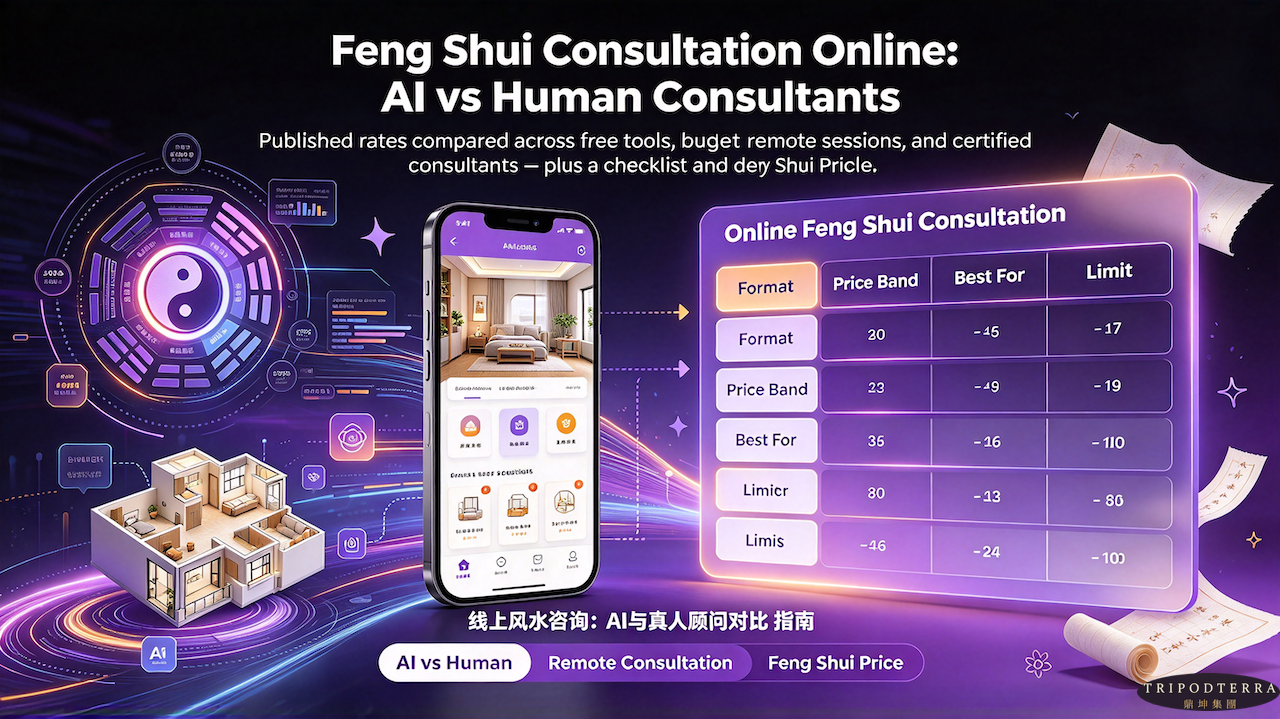
| Question you actually have | Best format | Rough cost |
|---|---|---|
| "Is my bed position a problem?" | AI or Form School consultant | Free to $300 |
| "Where do I put a mirror?" | AI | Free |
| "Which plants for the wealth corner?" | AI or a guide | Free |
| "What colours for the bedroom?" | AI or a guide | Free |
| "What is my Kua number and my favourable directions?" | AI or human — needs birth data | Free to $400 |
| "Which sectors of my home need work this year?" | Human (needs bearing + period) | $200–$1,000+ |
| "Full Eight Mansions or Flying Star analysis" | Human, Compass School trained | $300–$1,000+ |
| "I am renovating and need decisions that hold up" | Human, with dialogue | $400–$1,000+ |
| "Second opinion on a consultant's report" | AI, as a check | Free |
| "Something feels wrong and I cannot name it" | Human, in person | $200–$500+ |
Read the table by column three. Everything free in this market is free for the same reason: the question is visual and the inputs are ones you already have.
11. What to prepare before you pay anyone
Whether you book a person or use an AI reading, the intake determines the output. Prepare these six things and you will get a materially better session from either format.
- A floor plan with room labels. Hand-drawn and photographed is fine — accurate proportions matter more than neatness. Without it, nobody can place the bagua grid or relate rooms to orientation.
- A compass bearing. Stand at your front door, facing out, and take the reading from a phone app. This single number is what unlocks every compass-based method and what no photograph can supply. You could also read the compass through our service if you would rather work out the direction systematically.
- A walkthrough video. Slow, one room at a time, holding the camera at chest height. This is closer to a site visit than any photo.
- Photos of the specific problem. The bed, the mirror, the beam, the corner. Photograph what you are worried about rather than what looks good.
- Rough dimensions and the address or city. Size determines pricing bands; location matters for orientation checks.
- Your actual question, written down. "Something feels off" gets a generic answer from a human too. "The bedroom is above the garage and I sleep badly" is a question someone can work with.
Two more things worth knowing before you book. First, ask whether the written report is included or costs extra, because in some practices it is a separate line item. Second, ask about the follow-up window — a recommendation you cannot ask questions about for a month is worth less than one with a thirty-minute follow-up call built in.
12. Frequently asked questions
Is an online feng shui consultation as good as an in-person one? For Form School work, close to it. For Compass School work, it depends entirely on whether a real bearing is taken — if it is, the analysis is the same desk work either way, which is why many consultants now work virtually by default. What you genuinely lose is the tactile assessment of a space and the ability to wander into the next room mid-session.
Is there a genuinely free feng shui consultation online? Yes, in two forms: free discovery sessions from consultants (commonly around thirty minutes) and free web tools that require no account. Neither produces a specific remedial plan for your home. Both are legitimate ways to learn the vocabulary and to work out whether the question is worth paying for.
Can AI do feng shui accurately? For visual and Form School questions, yes — sightlines, bed and door position, mirror placement, clutter, and colour are all readable from good photographs, and consistency is an AI advantage because it does not favour its own specialism. For compass-based work, no: an AI cannot take a bearing, and a system built on directions collapses if the direction is guessed. Take the bearing yourself or hire someone who will.
What does a feng shui consultation cost? Virtual consultations broadly run from free to around $1,000. Budget remote sessions for a room or a floor plan sit around $150 to $400; industry survey data places typical virtual consultations at $200 to $500; premium named-consultant sessions run from around $400 to $900 and upward for large or urgent properties. Many certified consultants do not publish rates at all, so a quote request is often the only way to find out.
Do I need to give a compass reading? If you want anything beyond Form School advice, yes. It is the single input no photograph can supply, and it is the difference between a general layout review and an actual directional analysis. Take it from your front door facing outward.
What is the difference between Form School and Compass School? Form School (形势派) reads the physical space — shapes, sightlines, flow, furniture placement, and surroundings. Compass School (理气派) reads directions and time, including Eight Mansions (八宅) and Flying Star (飞星). Most practical home questions are Form School; the questions that require a consultant rather than a photograph are Compass School. Our bedroom guide sits mostly in the first camp.
How do I choose a consultant? Look for a published rate, a named school, a stated certification, and a clear session outline. Ask which school they work in and whether a written report and follow-up are included. Treat platform ratings as nearly meaningless in this market — individual practitioners vary far more than directories suggest.
Can I combine an AI reading with a human consultation? Yes, and it is often the best value: use an AI reading for the small decisions a house generates continuously, and book a human for compass-based work, complex properties, or anything you need someone to be accountable for. The AI pass also makes the paid session better, because you arrive knowing what to ask.
Is feng shui medical or financial advice? No, and it should never be used as a substitute for either. Feng shui is a cultural and design tradition; it does not diagnose illness, treat health conditions, or predict financial outcomes, and no responsible practitioner presents it that way. The material on this site is for cultural reference and self-reflection. If you have a health or financial concern, consult a qualified professional in that field.
13. Start where the question actually is
The reason this comparison is worth making carefully is that feng shui consultations have a cost structure that rewards getting the format right. A free web tool and a $900 session are not competing for the same job — one is for the question you have at midnight about which way the sofa should face, the other is for a property-level analysis that requires a bearing and a period.
The pragmatic split that holds up:
Use AI for the visual layer. Bed position, mirror placement, plant choices, colour, clutter, sightlines, and the stream of small decisions a home generates. Start a free AI feng shui reading with a photo of the room — include two or three angles and say what has been bothering you. If you want the compass and the elements worked through properly, bring a fresh BaZi chart to it so the reading works against your actual constitution rather than a generic template, and the BaZi basics walkthrough explains the element vocabulary if it is new.
Hire a human for the compass layer. If your question genuinely needs Eight Mansions or Flying Star, no photograph will answer it. Take your own bearing first, then pay someone who works in that school and who will put the reasoning in writing.
And do the intake properly either way. The floor plan, the bearing, the walkthrough video, and one clearly written question will improve a free reading and a thousand-dollar one by the same amount.