
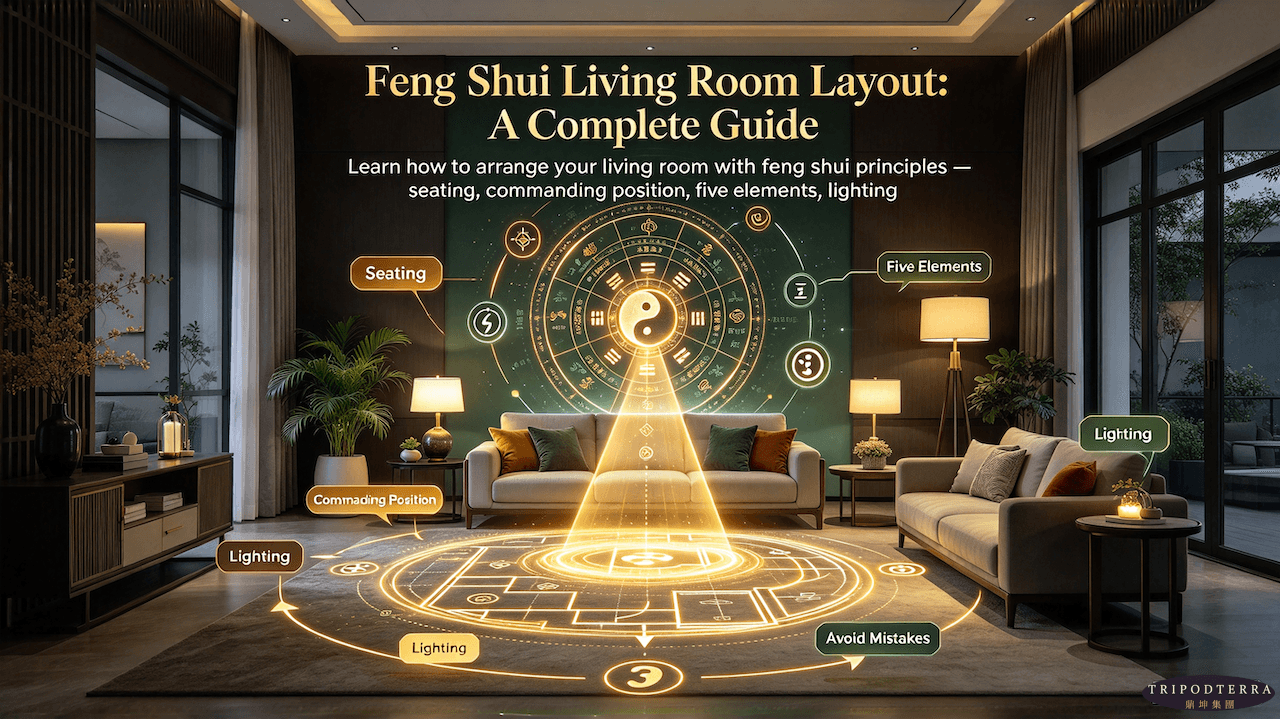
1. Why the Living Room Matters in Feng Shui
In traditional Chinese metaphysics, the living room is often called the "bright hall" (明堂) of a home. It is where qi gathers, where family members meet, and where guests first form an impression of the household. Unlike the bedroom, which favors stillness and rest, the living room should feel open, balanced, and gently active — a place where energy circulates without rushing through.
This guide walks through practical feng shui living room layout principles: the commanding position, traffic flow, the five elements, color and lighting, and the mistakes that quietly drain a room's atmosphere. Treat everything here as a design framework for reflection, not a guarantee of outcomes — feng shui is a tradition of observation and balance, and results vary by home and household.
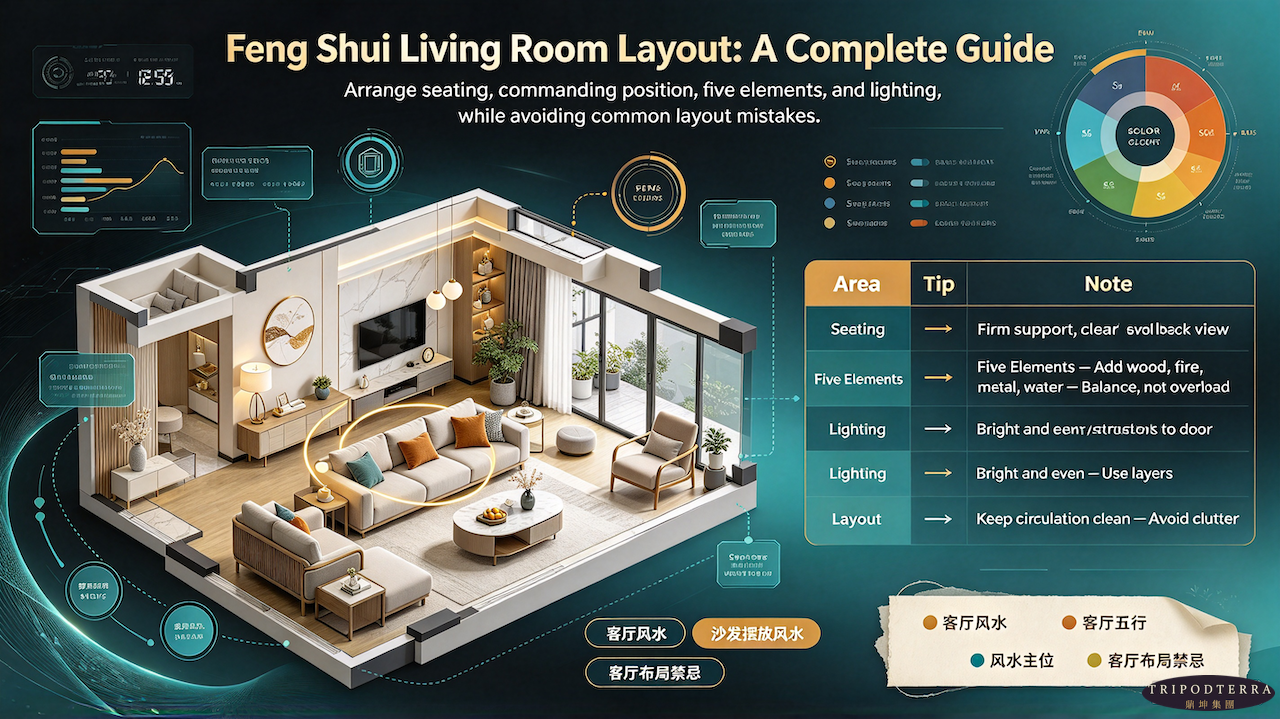
2. Start With the Commanding Position
2.1. What the commanding position means
The single most important layout rule is the commanding position (also called the armchair command). The idea: the main sofa should sit against a solid wall, with a clear view of the room's main entrance — but not directly in line with it. From that seat, you can see who enters without being startled, and your back is protected.
2.2. Applying it in real rooms
- Place the primary sofa with its back to a solid wall, not a window or a walkway.
- Angle or offset it so the door is visible diagonally rather than straight ahead.
- If the room forces the sofa to face away from the door, add a mirror or a reflective surface so the entrance is visible — see our notes on feng shui mirror placement for where mirrors help and where they cause problems.
- Avoid seating directly under a heavy beam or a low sloped ceiling; these are traditionally read as pressure on the head.
If you want to understand the underlying logic — how a space's orientation interacts with a person's birth chart — the basics of BaZi and personal direction offer useful context.
3. Design the Flow of Qi
3.1. Keep the entry clear
The path from the front door into the living room should be unobstructed. Shoes, bags, and clutter at the threshold are said to block incoming qi. A small console table with a lamp or a plant works better than a pile of storage.
3.2. Avoid a straight line from door to window
A door aligned directly with a large window or balcony door creates what practitioners call "qi entering and immediately exiting." In practice this is also a design issue: it makes a room feel like a corridor. Break the line with a rug, a low bookshelf, a plant, or an angled armchair.
3.3. Give the room a center
A living room without a focal point feels scattered. A coffee table, a rug, or a fireplace can anchor the center. In feng shui terms, this is where qi settles — the room should have a still point, not just edges.
4. Balance the Five Elements
4.1. A quick element checklist
Chinese metaphysics organizes everything into five elements — Wood, Fire, Earth, Metal, and Water. A balanced living room usually contains all five in modest amounts. For a fuller explanation, see our introduction to the five elements.
- Wood: plants, wooden furniture, green tones, vertical shapes
- Fire: lamps, candles, red or warm accents, triangular forms
- Earth: ceramics, stone, square shapes, yellow and beige
- Metal: metal frames, white and grey, round or arched forms
- Water: glass, mirrors, dark blue or black, flowing curves
4.2. Practical balance
Most modern living rooms are already heavy in Earth and Metal (beige sofas, grey walls, square furniture). Add Wood through a healthy plant, and a touch of Water through glass or a dark accent. Too much Fire — bright red walls, many lamps, sharp triangles — can make a room feel restless rather than welcoming.
Element balance also connects to color choices; our guide to feng shui bedroom colors explains the same logic applied to rest spaces, which is useful for keeping the whole home coherent.
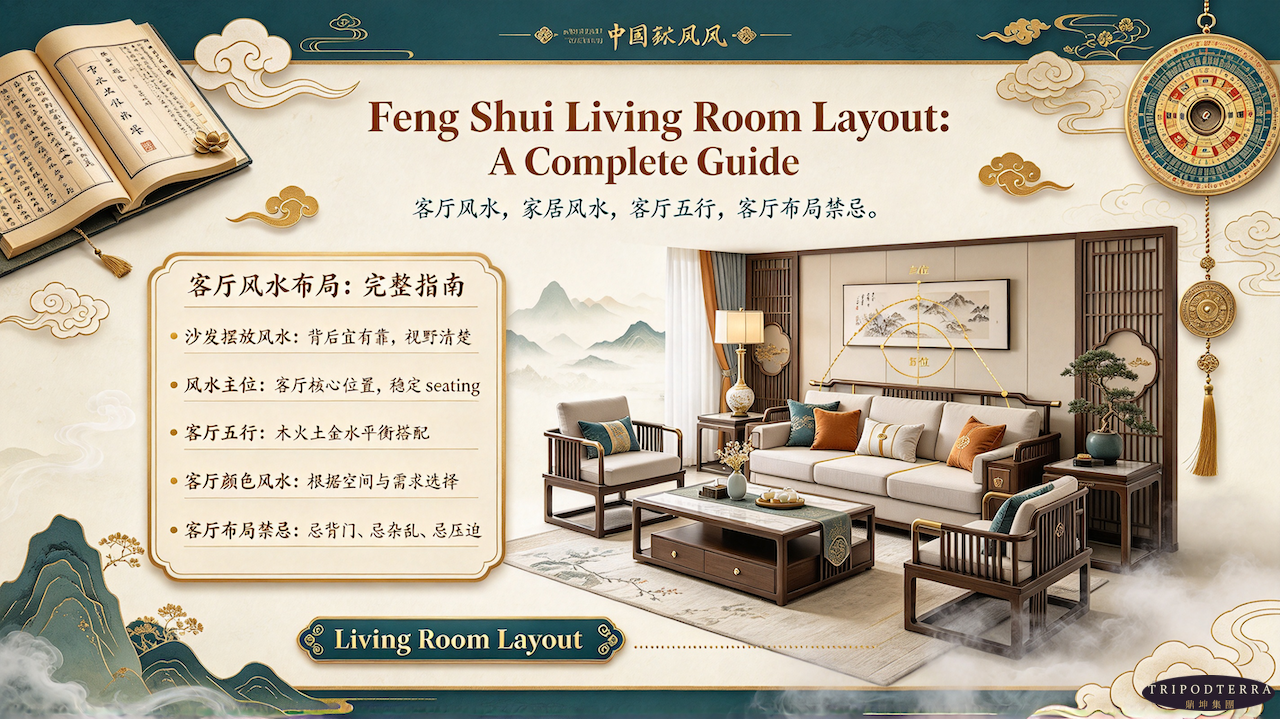
5. Furniture Arrangement Details
5.1. Sofa and chairs
U-shaped or L-shaped seating encourages conversation and "holds" qi in the center. Avoid single chairs pushed against walls facing nothing. If the room is long and narrow, split seating into two conversational zones rather than one stretched line.
5.2. Coffee table
Round or oval tables soften a room; sharp-cornered tables should be positioned so nobody walks into a point. Keep the table surface mostly clear — a small tray, one book, one object is enough.
5.3. Shelving and storage
Open shelving with too many small objects creates visual noise. Group items in odd numbers, leave empty space, and keep the top of tall shelves below eye level when seated.
5.4. Plants
Living plants add Wood energy and improve air quality. Choose rounded, soft-leafed plants for living rooms; avoid spiky or thorny plants near seating. If you like symbolic plants, the lucky bamboo stalks meaning covers the traditional counts and placements.
6. Lighting and Acoustics
6.1. Layered light
Feng shui favors layered lighting: ambient light from the ceiling, task light from a floor lamp, and accent light from a small table lamp. A single harsh overhead light creates glare and, in traditional terms, a sharp downward pressure. Warm-toned bulbs are generally preferred in living spaces.
6.2. Soften hard surfaces
A room with tile floors, bare walls, and glass tables reflects sound and feels cold. A rug, curtains, and upholstered seating absorb sound and slow qi — the room feels calmer immediately.
7. Common Layout Mistakes
7.1. Clutter at the entrance
Piles at the door are the most common issue in real homes. Clear the threshold first; everything else is secondary.
7.2. Sofa under a window
A sofa backed by a window has no support behind it. If you cannot move it, add heavy curtains and a tall plant behind the sofa as a partial remedy.
7.3. Mirrors facing the front door
A mirror directly opposite the entrance is traditionally said to push incoming qi back out. Place mirrors on side walls instead.
7.4. Television dominating the room
A very large screen can become the room's only focal point. Balance it with plants, artwork, or a bookshelf on the opposite wall.
7.5. Overfilled corners
Corners are where qi can stagnate. Keep at least one corner light and open, with a lamp or a plant rather than stacked boxes.
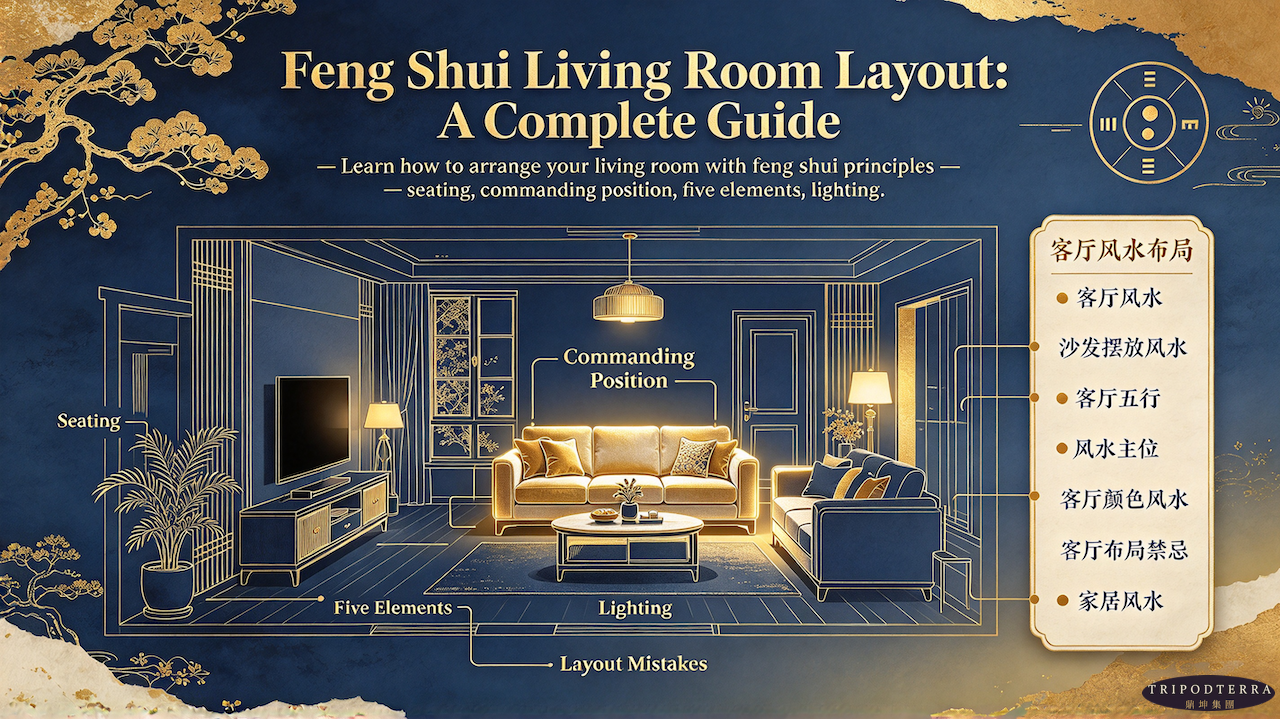
8. A Simple Step-by-Step Plan
- Clear the entry path and the room's center.
- Identify the commanding position for the main sofa.
- Break any straight line between door and window.
- Check the five elements — add what is missing, reduce what is excessive.
- Layer the lighting and soften hard surfaces.
- Remove clutter from corners and shelf tops.
- Live in the room for a week and notice what still feels off.
9. Final Thoughts
Feng shui living room layout is less about rigid rules than about attention: where you sit, what you see, how light falls, and whether the room feels settled. Small, deliberate adjustments usually matter more than expensive renovations.
If you want a more personal reading — for example, how your own birth chart interacts with directions and elements — a BaZi consultation or a Zi Wei chart reading can add depth. For daily timing questions, the almanac and auspicious dates are a practical companion.
This article is for reference and cultural interest only. Feng shui is a traditional practice, not a substitute for professional design, medical, or financial advice.