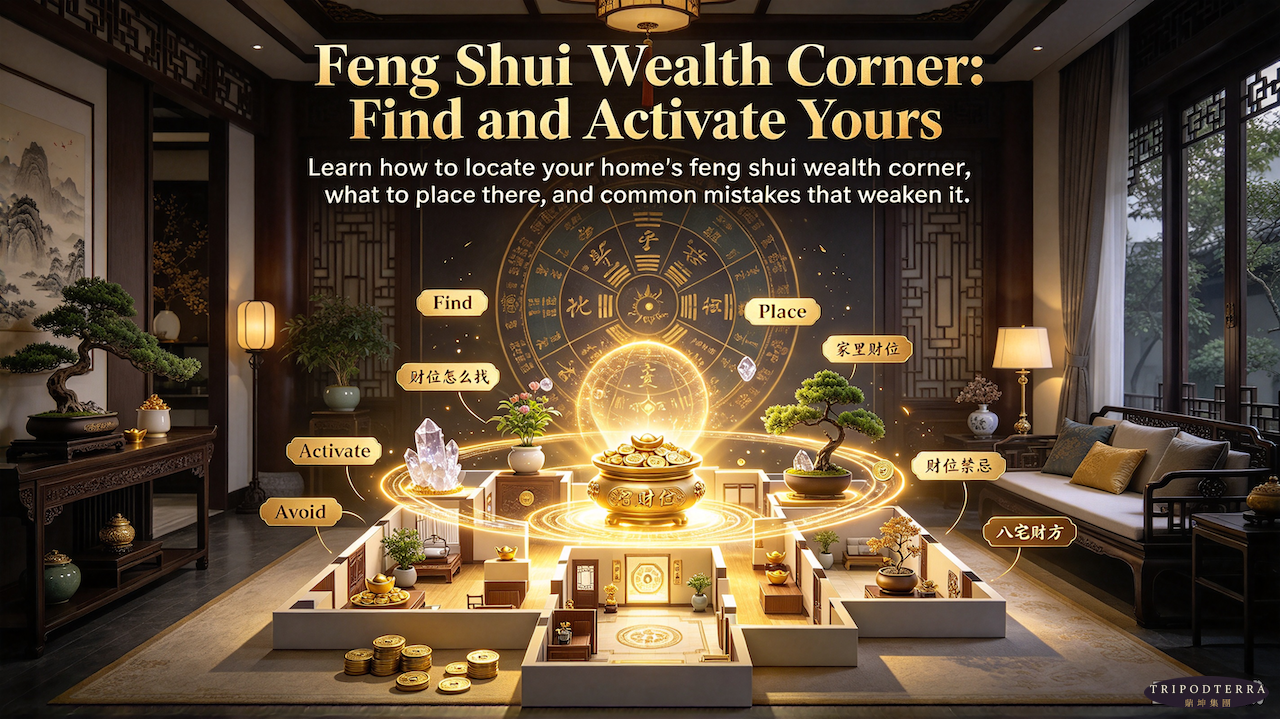
In feng shui, the "wealth corner" (财位, cái wèi) is the area of a home or room most closely associated with the accumulation of resources — money, opportunity, and the sense of security that comes with them. It is not a magic switch that makes money appear. Think of it instead as the part of your space that represents your relationship with abundance: how you receive it, how you hold it, and how well you care for it.
Classical feng shui approaches the wealth position from several angles. The simplest and most popular method is the diagonal corner of the main entrance. More precise schools use the BaZi chart of the occupant, the flying star system, or the eight-mansion (ba zhai) formula to determine an individual's personal wealth direction. This article focuses on the practical, widely used methods you can apply yourself, with notes on when a professional reading adds value.
2. Finding Your Wealth Corner: Three Methods
2.1. 1. The Diagonal Corner Method (Beginner-Friendly)
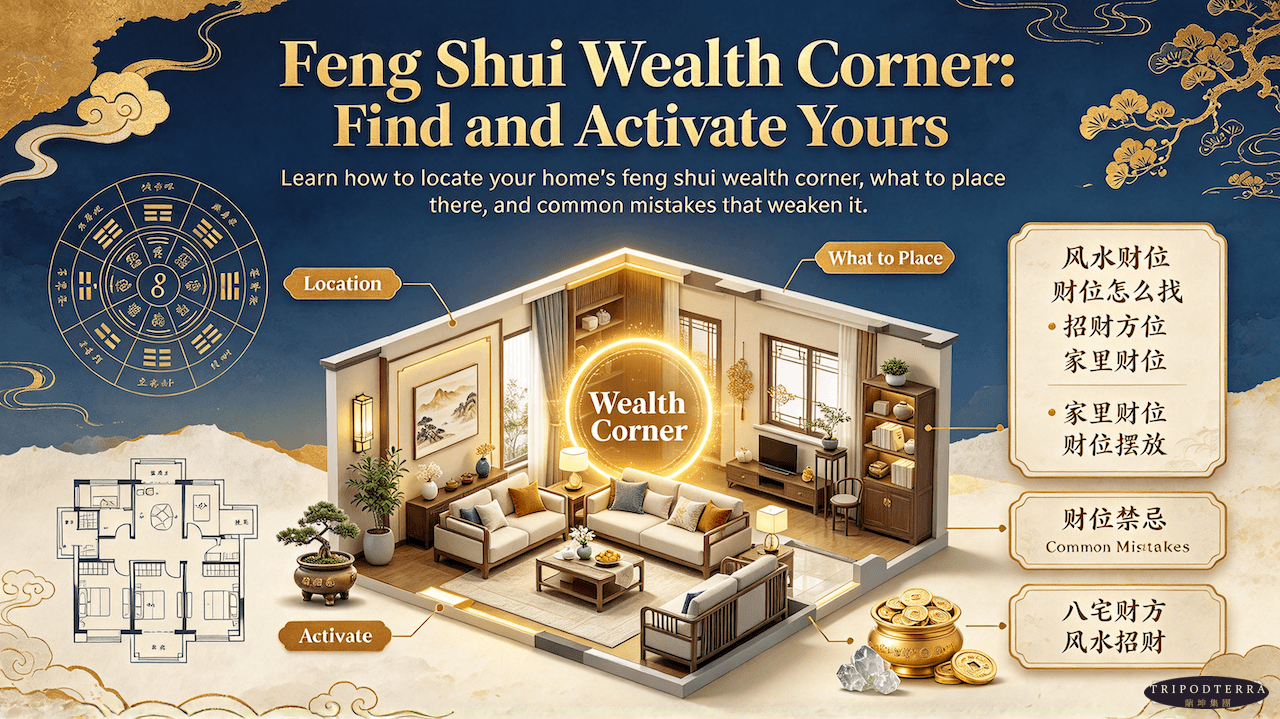
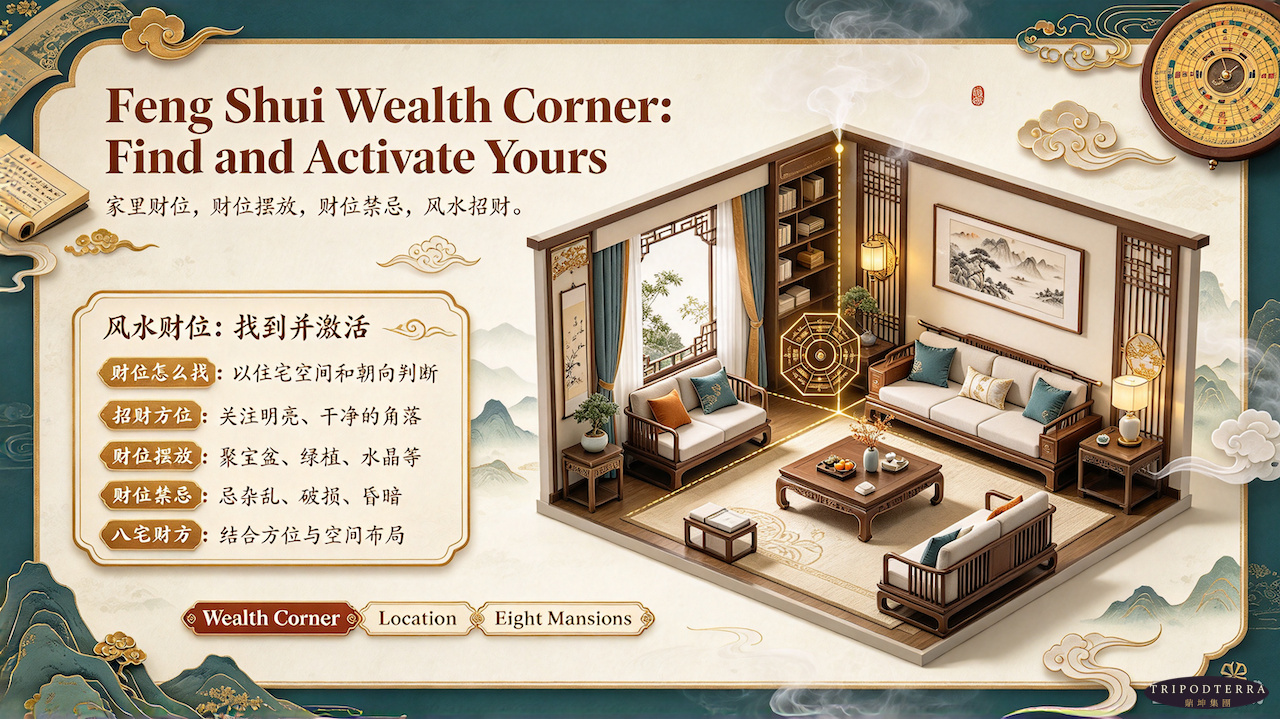
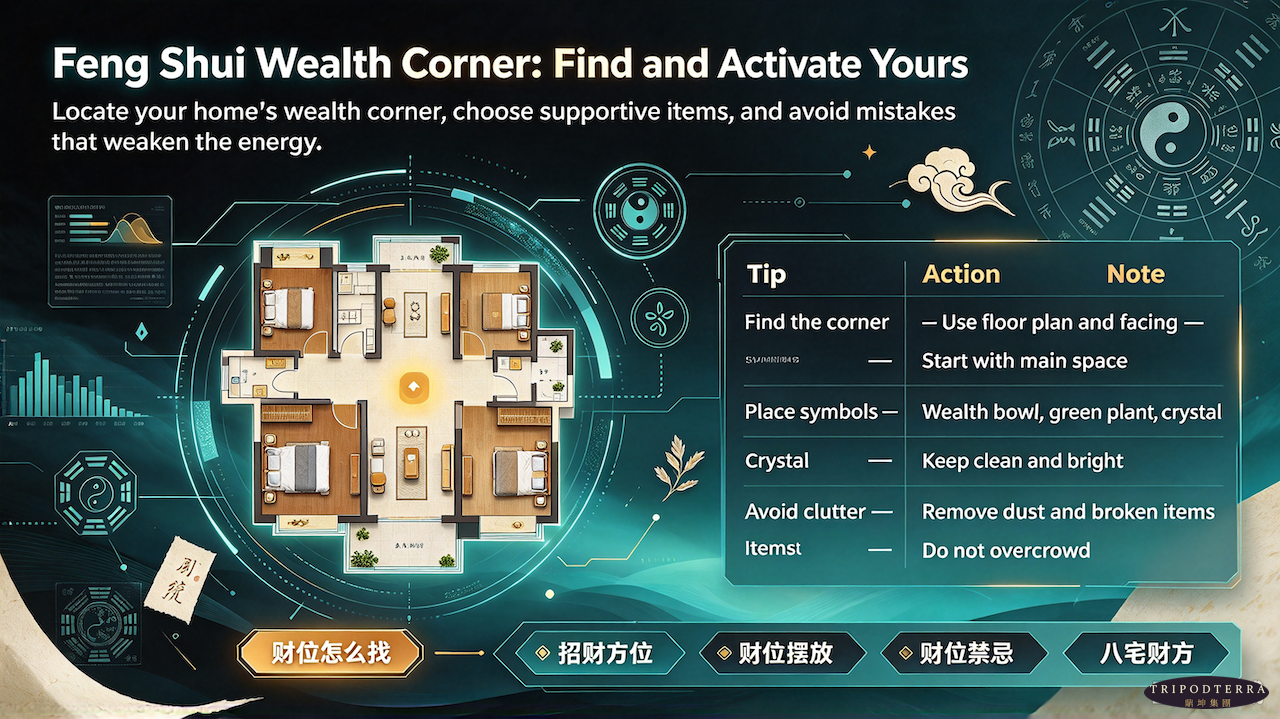
Stand at your front door, facing into the home. The far corner diagonally opposite the door — the corner you must walk the longest distance to reach — is traditionally treated as the wealth corner. If the door opens into a long hallway, apply the same logic to the main living space.
Share
Daily Fortune Newsletter
One daily BaZi reading, straight to your inbox. Free, unsubscribe anytime.
If your entrance sits in the middle of a wall, you may have two diagonal corners. In that case, the corner to the left as you enter is usually preferred, though some practitioners choose based on which corner is more enclosed and better lit.
2.2. 2. The Ba Zhai Personal Direction
In the eight-mansion system, each person has four auspicious and four inauspicious directions derived from their birth year and gender. The "Sheng Qi" (生氣, Life-Generating) direction is often used as a personal wealth direction. This requires knowing your correct birth data — and if you were born near a time-zone boundary or during daylight saving, true solar time can shift the calculation.
2.3. 3. Flying Star and Annual Shifts
In flying star feng shui, the wealth-related star (usually star 8 in the current period) moves each year. Annual wealth positions are calculated from the facing direction of the building. This is the most technical layer and is best confirmed by a practitioner, especially for businesses or homes where major renovations are planned.
A practical note: Different methods sometimes point to different corners. Choose one system, apply it consistently, and observe how the space feels over a few months. Feng shui is a practice of attention, not a one-time formula.
3. What to Place in the Wealth Corner
The general principle is stability, care, and gentle movement — nothing chaotic, nothing neglected.
3.1. Good Choices
A healthy plant with rounded leaves, such as a money tree or pothos. Avoid sharp, spiky plants here; if you keep lucky bamboo, review the lucky bamboo stalk meanings so the number of stalks matches your intention.
A small bowl or tray for coins, crystals, or a smooth stone — a container signals "holding" rather than "scattering."
A lamp or warm light to keep the corner bright. Dark corners are read as stagnant.
Something meaningful to you: a photo, a small sculpture, a stone from a trip. Personal resonance matters more than price.
A plant or object in a supportive element color, chosen according to the five elements and what your chart favors.
3.2. What to Avoid
Clutter, unopened boxes, broken items, and dead plants.
Trash bins, laundry baskets, or cleaning supplies.
Heavy storage that blocks access — if you cannot reach the corner, you cannot "use" it.
Mirrors that reflect the corner back on itself or face the front door; see feng shui mirror placement for the reasoning.
Sharp-edged furniture pointing into the space.
4. Common Mistakes
4.1. Treating the Corner as Storage
The single most common problem is a wealth corner piled with bags, boxes, and things "to deal with later." In feng shui terms this represents blocked or postponed abundance. Clearing it is often the most effective first step — and it costs nothing.
4.2. Overloading It
A crowded corner with ten symbolic objects is not stronger than a clean corner with one. Excess reads as anxiety, not prosperity. Choose one anchor object and keep the surrounding area open.
4.3. Ignoring the Rest of the Room
A perfect wealth corner in a room with a leaking tap, a broken door, or constant noise will not compensate. Fix the fundamentals first: light, air, function, and repair.
4.4. Confusing Symbolism with Action
Placing a wealth object is a ritual of intention. It does not replace budgeting, skill-building, or asking for a raise. The value is in the daily reminder — the corner becomes a cue to check in on your finances.
5. A Simple 20-Minute Activation Routine
Clear everything out of the corner. Wipe the surfaces.
Assess the light. If it is dim, add a small lamp.
Choose one anchor object that fits your intention — growth, stability, or gratitude.
Add one living element if conditions allow (a plant that suits the light level).
Place a small container for coins or savings notes.
Sit with the space for a minute. Notice whether it feels calm or cramped.
Return weekly to dust, water, and tidy.
6. When to Consult a Practitioner
If you are buying a home, planning a renovation, running a business from home, or feel that a space has never "settled" despite your efforts, a professional reading can clarify the building's facing direction, annual star positions, and your personal chart. A BaZi consultation or Zi Wei reading can also indicate which elements and directions support you individually, which is more precise than a generic corner rule.
For related adjustments, our guide to feng shui bedroom colors covers how to harmonize the private areas of the home without overcorrecting.
7. Final Thoughts
The wealth corner works best as a small, honest mirror. If it is clear, lit, and cared for, it reflects a household that pays attention. Start with the diagonal corner, remove what does not belong, and add one thing you genuinely like. Then let the practice be ordinary: dust it, water it, and notice what changes.
This article is for reference and cultural interest only. It does not constitute financial, medical, or professional advice.