 TRIPODTERRA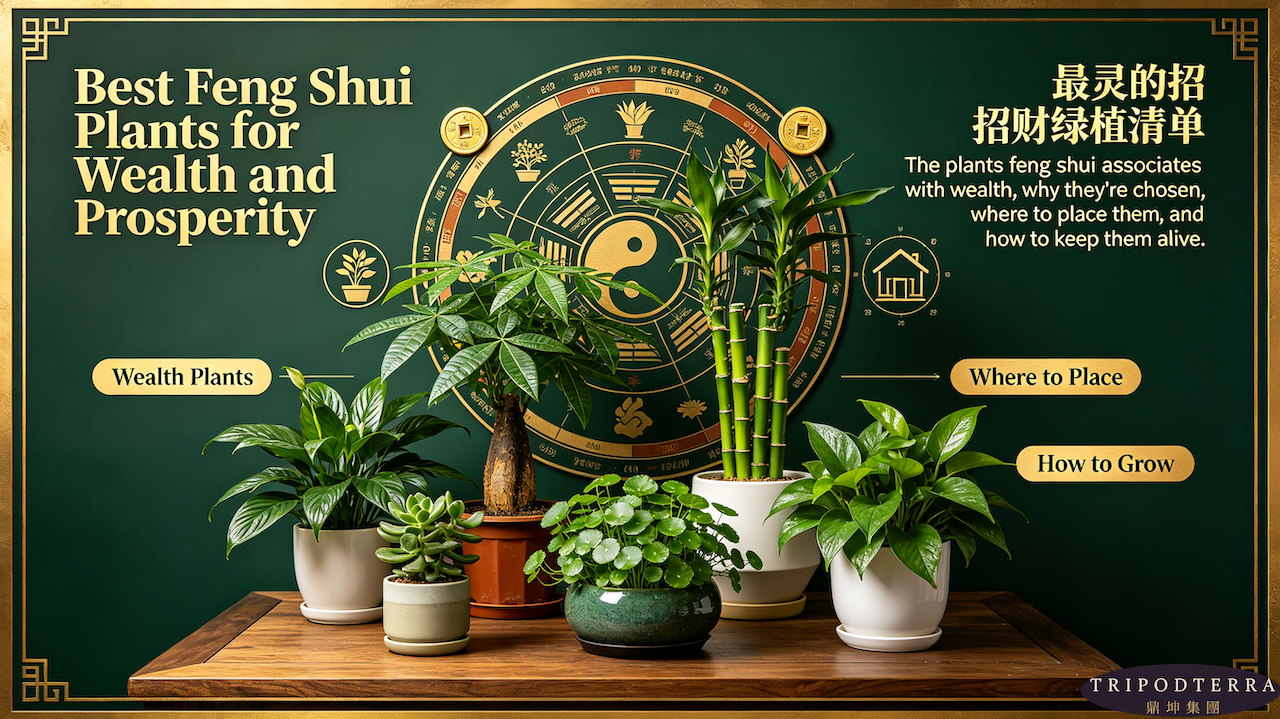
Feng shui treats plants as living qi — the one element in a room that is visibly growing. When it comes to wealth, the tradition picks plants whose names, shapes, or habits "read" as money. Here are the ones that keep showing up, and why.
The classic wealth plants
1. Money tree (Pachira aquatica) — 发财树
The braided-trunk money tree is the default wealth plant. Its five-lobed leaves echo the five elements, and the braided trunk is said to "bind" wealth into the home. It tolerates low light, which makes it practical for offices and living rooms.
2. Money plant / Golden pothos (Epipremnum aureum) — 绿萝
Round, coin-shaped leaves are the whole story here: round leaves read as coins. Pothos is nearly indestructible, and in feng shui terms a plant that survives neglect is a plant whose qi keeps flowing — a dead plant is the opposite of wealth luck, so hardiness matters.
3. Jade plant (Crassula ovata) — 玉树
Thick, plump, coin-like leaves on a slow-growing succulent. The jade plant is associated with steady, compounding wealth — the kind that grows quietly. In many homes it sits near the entrance or on a desk, where its compact size fits small spaces.
4. Lucky bamboo (Dracaena sanderiana) — 富贵竹
Not bamboo at all, but the name stuck. Lucky bamboo is usually sold in stacks of stems: three for happiness, five for health, eight for wealth and prosperity. The number eight — 发 — is the classic wealth number, which is why an eight-stem arrangement is the one to buy for a wealth corner.
5. Peace lily (Spathiphyllum) — 白掌
White, sail-shaped blooms over glossy leaves. The peace lily is more "prosperity" than "cash" — it clears stale air and stale qi, which feng shui treats as the precondition for anything good arriving.
Where to place them — the wealth corner
Classical feng shui places wealth in the southeast of a room or home — the 财位 (wealth position). Practical rules that survive translation into a modern apartment:
- Southeast corner of the living room, if the layout allows.
- Near the entrance, but not blocking the path — plants at the door are said to catch qi as it enters.
- On or beside the desk for a work-from-home setup — the jade plant and money tree are the desk classics.
- Avoid the bedroom for large plants — the tradition reserves the bedroom for rest, not active growth. (For bedroom-specific feng shui, see our feng shui bedroom guide.)
The one rule that outranks all placement
A thriving plant attracts; a dying plant repels. If your money tree is dropping leaves, moving it to the perfect southeast corner won't save the symbolism — water it, repot it, or replace it. Feng shui is, at bottom, a practice of noticing: a home where living things flourish is a home where the people in it are paying attention. That attention is the real wealth habit.
Want a personalized take on your space? Ask the TripodTerra feng shui consultant — describe your layout and it will walk through each area of your home in plain language.