
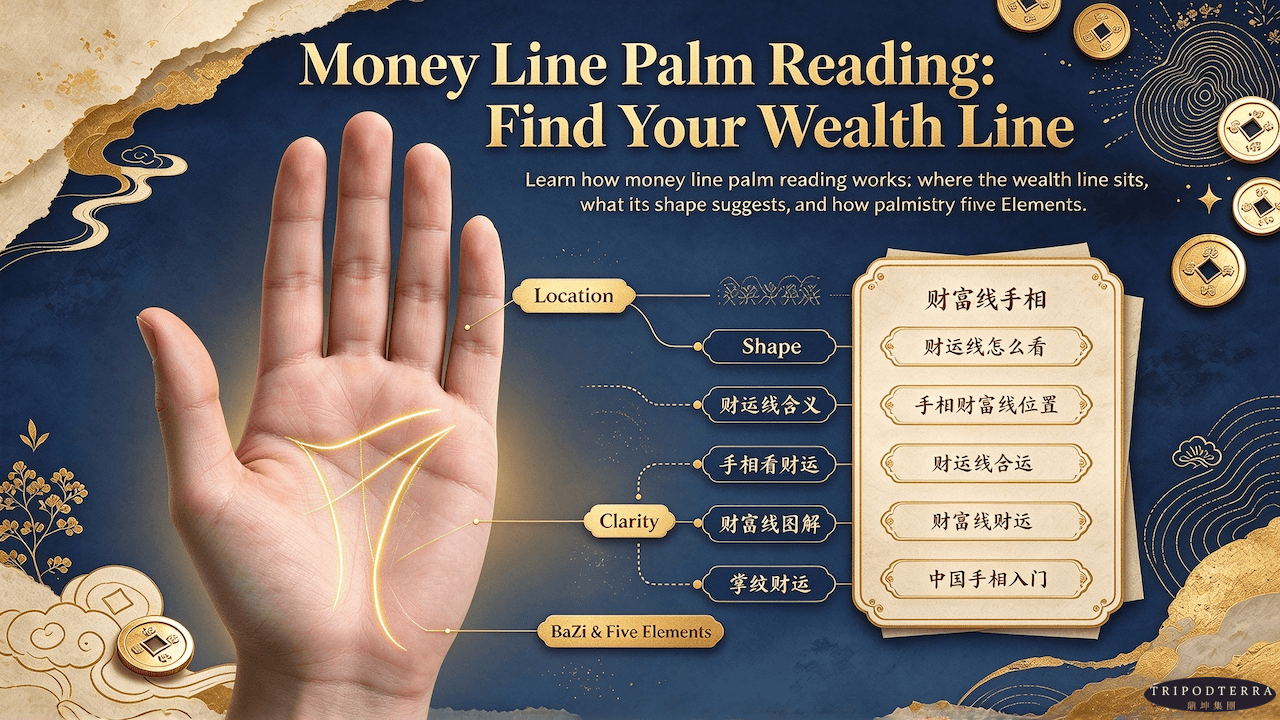
1. Money Line Palm Reading: An Introduction
Palmistry treats the hand as a map of habit, temperament, and potential. Among the many lines practitioners look at, the "money line" — often called the wealth line or cai yun xian in Chinese palmistry — draws the most curiosity. It is worth saying at the outset: no line on a hand guarantees income. What the money line offers is a symbolic language for thinking about how you relate to resources, effort, and opportunity.
This guide covers where the money line sits, how palmists read its shape, and how palm reading fits alongside other Chinese metaphysics tools such as BaZi and the Five Elements.
2. What the Money Line Is — and Is Not
In traditional Chinese hand reading, the wealth line is usually described as a fine vertical line rising toward the ring finger or little finger, often near the base of the fingers or on the mount beneath them. Western palmistry sometimes equates it with the "fate line" or with small vertical strokes under the ring finger.
Because traditions differ, the honest answer is: the money line is a concept rather than one fixed crease. Practitioners look for:
- Short vertical lines beneath the ring finger (the mount of Apollo)
- Fine lines rising from the head line or heart line toward the fingers
- The overall texture and clarity of the mounts
What it is not: a promise of riches, a lottery number, or a substitute for a budget. Treat it as a mirror for reflection, not a forecast.
3. Locating the Wealth Line on Your Palm
- Hold your dominant hand palm-up in good light.
- Find the ring finger and the fleshy pad beneath it.
- Look for thin vertical strokes — they may be faint, broken, or several in number.
- Compare both hands; many readers treat the non-dominant hand as inherited tendency and the dominant hand as developed habit.
If you find nothing obvious, that is common. Many hands show no distinct wealth line, and palmists do not read that as poverty. It may simply mean the person's resources are expressed through other markers, such as a strong life line.
4. Reading the Shape of the Money Line
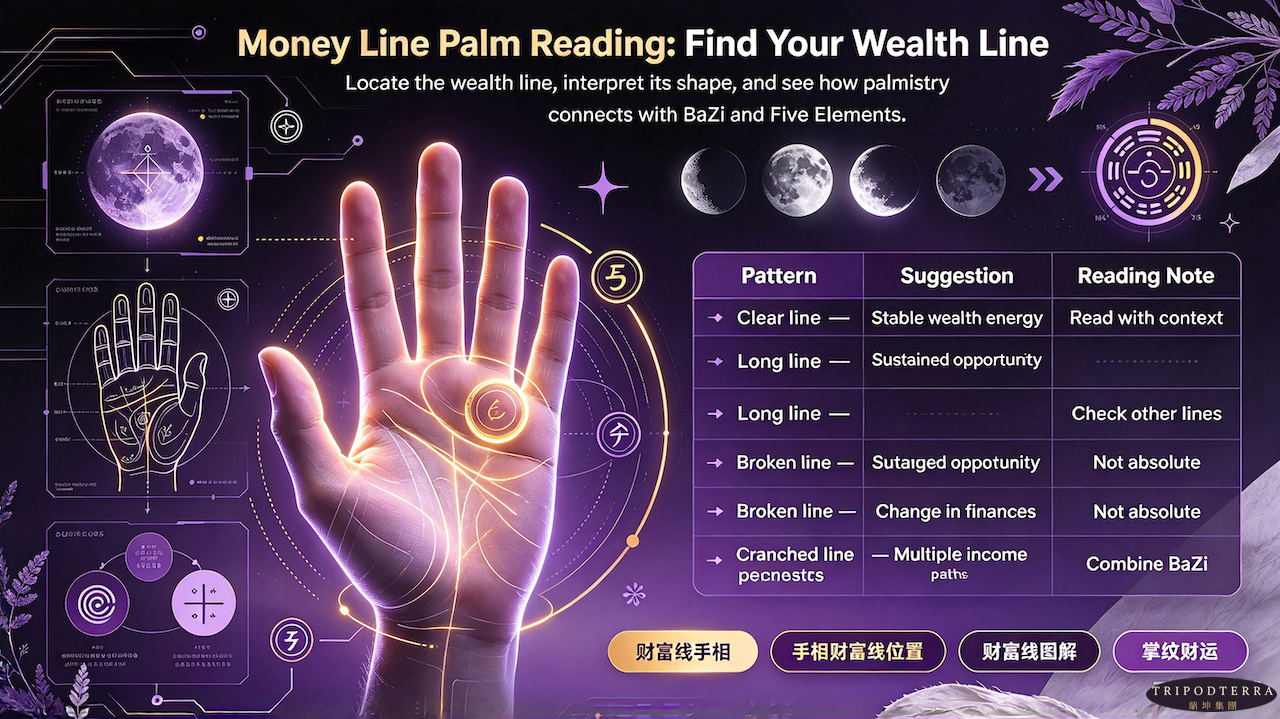
4.1. Clear and Unbroken
A single, clean vertical line is often read as steady, focused effort — money arriving through consistent work rather than sudden windfalls. The emphasis is on reliability.
4.2. Multiple Thin Lines
Several fine strokes suggest scattered income streams or varied interests. In practice this often maps onto freelancers, side projects, or people juggling several roles. The reading is neutral: variety can be strength or distraction.
4.3. Broken or Chained
Interruptions are traditionally linked to fluctuating finances or changes in career direction. A responsible reading frames this as a prompt to build reserves during stable periods, not as a warning of ruin.
4.4. Deep and Long
A deep line reaching well up the finger is sometimes associated with strong drive and visible results. Again, drive is a habit, not a destiny.
4.5. Faint or Absent
Faint lines may point to someone whose relationship with money is quiet or indirect — perhaps supported by family, or focused on non-material values.
5. The Mounts and the Five Elements
Chinese palmistry reads the hand through the lens of the Five Elements. Each finger and mount is assigned an element, and the balance between them is said to describe temperament:
- Wood — growth, planning, long horizons
- Fire — visibility, risk, quick decisions
- Earth — stability, saving, patience
- Metal — discipline, structure, precision
- Water — adaptability, flow, intuition
A palmist might note that a strong Earth mount paired with a faint wealth line suggests a saver who does not chase visible status. A prominent Fire mount with many thin lines might suggest someone who earns through visibility and variety. These are interpretive frames, not measurements.
6. How Palmistry Complements BaZi
BaZi (Four Pillars) maps the birth chart; palmistry maps the hand. Practitioners often use them together: BaZi for the broad pattern of timing and element balance, palmistry for how a person currently carries that pattern in body and habit.
If you want a structured reading of your chart, the BaZi service provides a full analysis. Palm lines, by contrast, are read as changing over time — many readers say the hand reflects the last few years of habit.
7. Common Misreadings
- "No money line means no money." Not a traditional reading. Absence is neutral.
- "A deep line means guaranteed wealth." Depth reflects emphasis, not outcome.
- "Lines never change." Many readers observe subtle changes over years; the hand is treated as living.
- "Palmistry replaces planning." It does not. Financial decisions belong with professionals, not with creases.
8. Practical Ways to Use a Money Line Reading
- As a reflection prompt. If your line is broken, ask what changed in your work life recently.
- As a conversation starter. Compare hands with a friend and notice how differently each person relates to resources.
- As a complement, not a verdict. Pair it with a chart reading or a journaling practice.
- As a reminder of agency. Every tradition that reads the hand also assumes the hand is shaped by use.
9. A Note on Cross-Tradition Curiosity
Many readers of palms also explore tarot, face reading, and dream interpretation. If you enjoy symbolic systems, you might look at face reading and moles or browse a tarot card meanings list. These are different languages for similar questions about direction and temperament.
10. Disclaimer
Palmistry is a traditional symbolic practice. This article is for educational and entertainment purposes only and is not financial, medical, or psychological advice. For financial decisions, consult a qualified professional.
11. Final Thoughts
The money line is best understood as a small window onto how a person works, saves, and spends — not a receipt for the future. Read it with curiosity, compare both hands, and let it prompt better questions rather than fixed conclusions.