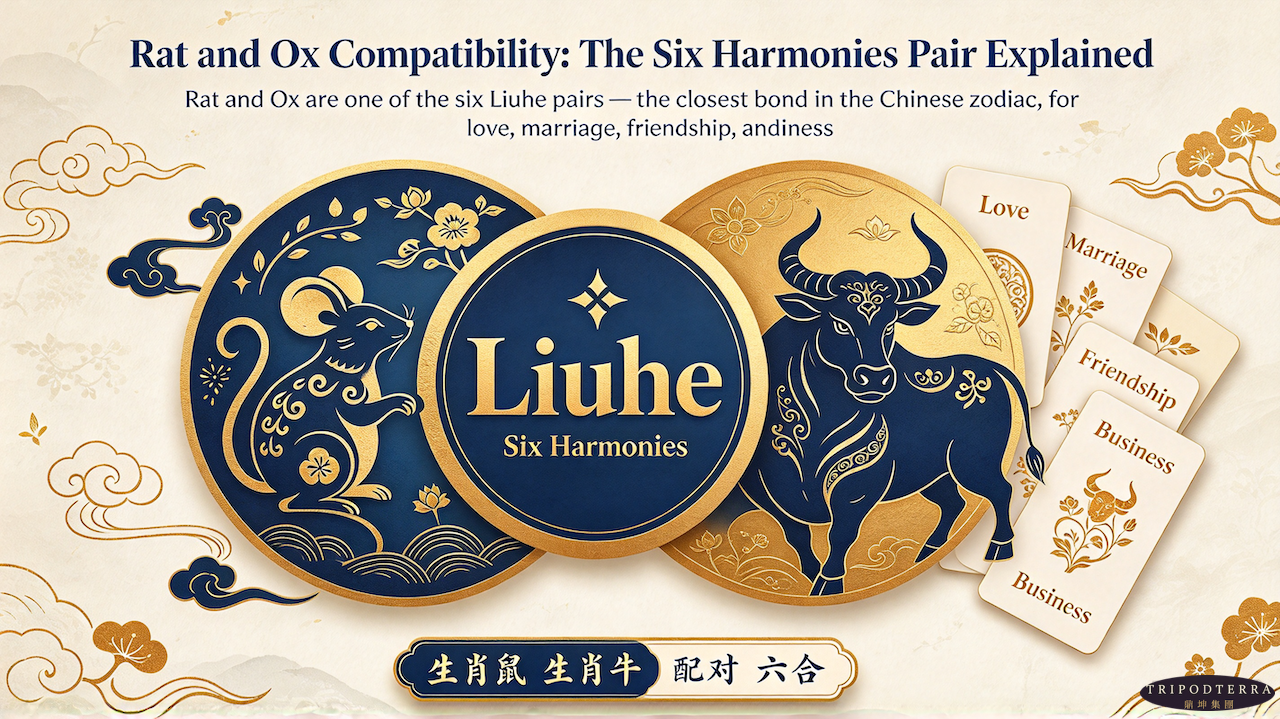
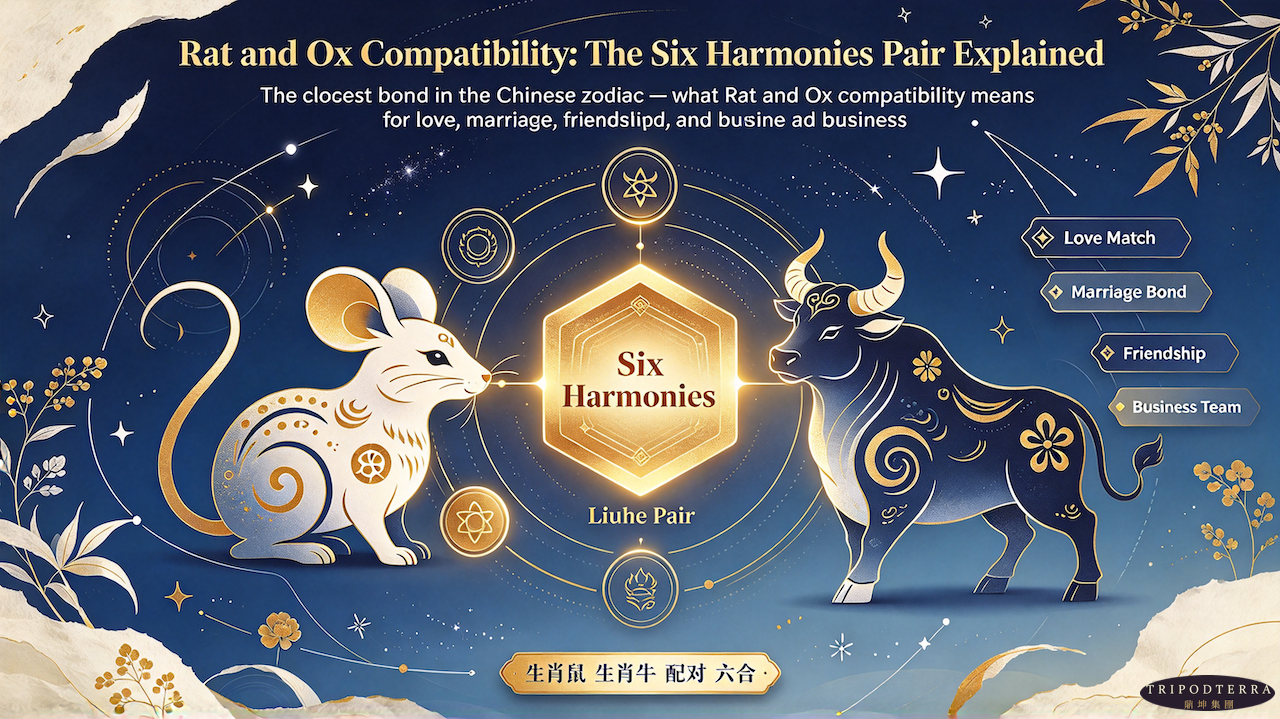
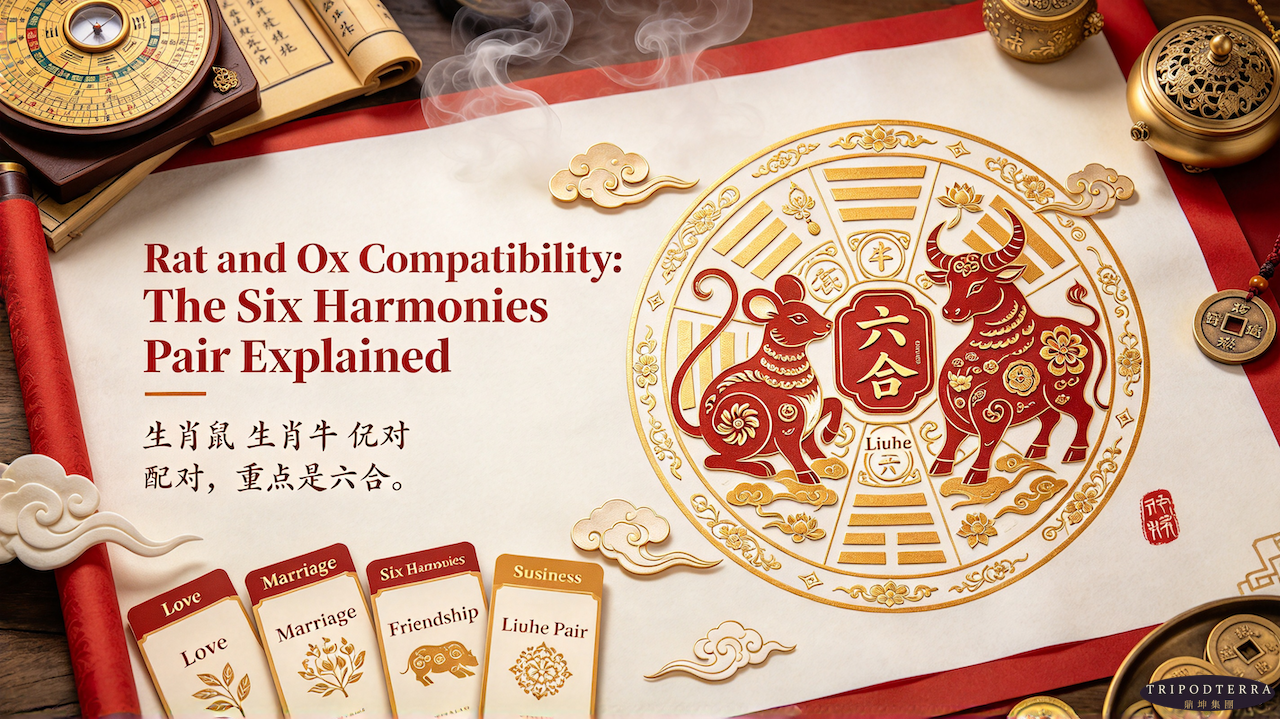
Rat and Ox Compatibility: The Six Harmonies Pair Explained
Rat and Ox are one of the six Liuhe (Six Harmonies) pairs — the closest bond in the Chinese zodiac. Here is what that means for love, marriage, friendship, and business.
4 readsOctober 4, 2026
Contents
🧑
Free BaZi Chart
Enter birth info, get your BaZi chart + Five Elements analysis
Rat and Ox are the first of the twelve animals and the second — a small, quick, night-dwelling creature paired with the largest, slowest, most patient beast on the farm. On paper they could hardly look more different. In the Chinese zodiac they are treated as one of the closest and most workable matches in the whole system.
They form a 六合 (Liuhe, "Six Harmony") pair, which is the strongest category of pairing the tradition recognizes. Search for "rat and ox compatibility" and most pages will simply tell you this is a great match and move on. This article tries to do the harder thing: explain why the tradition rates them so highly, where the friction actually shows up, what birth-year animals can and cannot tell you, and whether the year you are living through right now changes any of it.
One framing note before we begin. Chinese zodiac compatibility describes traditional tendencies, not verdicts. It is a lens for reflection and conversation, and nothing here is medical, legal, or financial advice. A harmonious pair still has to do the work; a supposedly difficult pair can build a beautiful life.
Share
Daily Fortune Newsletter
One daily BaZi reading, straight to your inbox. Free, unsubscribe anytime.
To understand why the Rat and the Ox get along, it helps to see where they sit on the wheel.
The twelve animals are arranged in a fixed order: Rat, Ox, Tiger, Rabbit, Dragon, Snake, Horse, Goat, Monkey, Rooster, Dog, Pig. That sequence is not just a list — it is a cycle of positions, and the relationships between those positions are what fortune telling reads.
2. The geometry of the six harmony pairs
Count from any animal forward six places and you land on its 六合 partner. The Rat is first; six places along brings you to the Ox. The Dragon is fifth; six along brings the Rooster. They meet, in other words, as positions that join hands rather than face off.
Liuhe pair (六合)
Position
Traditional element of the combination
Rat (子) + Ox (丑)
1 + 2
Water meeting Earth — 子丑合土
Tiger (寅) + Pig (亥)
3 + 12
Wood meeting Water — 寅亥合木
Rabbit (卯) + Dog (戌)
4 + 11
Wood meeting Earth — 卯戌合火
Dragon (辰) + Rooster (酉)
5 + 10
Earth meeting Metal — 辰酉合金
Snake (巳) + Monkey (申)
6 + 9
Fire meeting Metal — 巳申合水
Horse (午) + Goat (未)
7 + 8
Fire meeting Earth — 午未合土
You will notice that the Rat–Ox pair is the only one made of two adjacent animals. Winter ends with the Rat month and begins with the Ox month; the two branches are neighbours in the calendar as well as in the zodiac. Traditionally this is read as ease — a bond that does not require crossing the wheel to find itself. You can see the full set mapped against the other relationship types in our Chinese zodiac compatibility chart, and a different harmony pair unpacked in the Rooster and Dragon compatibility guide.
3. What "harmony" does and does not promise
In branch theory, 合 (he, "joining") describes a relationship in which two branches are drawn toward each other and, in the process, modify or bind one another. In classical BaZi the Rat–Ox combination produces Earth: two very different natures negotiating until something stable comes out of it.
A practical warning: because 子丑合 is traditionally described as a combination that transforms, some readers treat it as stronger when the chart's other elements support Earth, and weaker when they do not. This is one reason a birth-year match is only ever the opening sentence of a longer story — a point we return to further on.
4. The Rat personality in the zodiac tradition
The Rat (鼠, 子) opens the cycle. The folk story most people know — the Rat riding on the Ox's back and jumping off at the last moment to claim first place — is usually told as a trickster's tale. Read it again from the tradition's point of view and it says something more specific: the Rat is the animal that arrives by wit rather than by force.
4.1. What the Rat brings
Alertness. Rat energy notices things early: an inconsistency in a story, a shift in a market, a change in a friend's mood.
Resourcefulness. Given a constraint, the Rat looks for the gap in it. Traditional readings describe Rats as quick to find a workaround and rarely short of options.
Social fluency. Rats are described as charming, articulate, and comfortable in rooms full of strangers. They gather information through people.
Comfort with acquisition. The Rat is traditionally tied to wealth, savings, and the ability to spot value — often read as being good with money even when not born with much of it.
4.2. What the Rat struggles with
Speed has a cost. Rat energy can be scattered, restless, and impatient with slow processes it cannot control. Traditional portraits also mention a tendency to worry, to over-calculate, and to talk about a plan long before committing to it. When a Rat is bored or cornered, the same cleverness that solves problems can turn into manipulation. None of this is destiny — but it is the pattern the tradition warns about.
4.3. Common birth years
Rat years include 1924, 1936, 1948, 1960, 1972, 1984, 1996, 2008, 2020, and 2032. If you are not sure which animal belongs to your birth year — especially for birthdays in January or early February — our guide to finding your Chinese zodiac sign walks through the boundary problem.
5. The Ox personality in the zodiac tradition
The Ox (牛, 丑) is the second animal, and in many Asian farming cultures the most respected one: the beast that turns the soil for everybody else. The Ox's month closes the winter and opens the agricultural year. The animal's whole reputation rests on the work it does when nobody is watching.
5.1. What the Ox brings
Reliability. An Ox's word is treated as a contract. Traditional readings describe Ox people as steady, methodical, and honest to the point of bluntness.
Endurance. Ox energy finishes things. Where others burn out, the Ox keeps a rhythm — which is why this sign is associated with long careers built slowly.
Grounding. The Ox is the anchor in a group: unimpressed by noise, difficult to panic, and quietly stubborn about principles.
Care expressed through action. Ox people are not usually described as demonstrative. They are described as the person who shows up, fixes the thing, and never mentions it again.
5.2. What the Ox struggles with
The flip side is rigidity. Ox energy can be slow to change course, reluctant to ask for help, and resistant to ideas it has not seen tested. Traditional portraits also describe a stubborn streak and a tendency to hold on to resentment quietly rather than raise it. When an Ox feels rushed, its response is often to slow down further — which is the exact behavior that can drive a Rat up the wall.
5.3. Common birth years
Ox years include 1925, 1937, 1949, 1961, 1973, 1985, 1997, 2009, 2021, and 2033.
6. Why the Rat and Ox work together
Put the two portraits side by side and the case for this pairing becomes obvious: almost every trait that is a strength in one is a weakness in the other.
Dimension
Rat (鼠)
Ox (牛)
Tempo
fast, opportunistic
slow, deliberate
Best at
starting, spotting openings
finishing, holding the line
Risk appetite
moderate to high
low and cautious
Decision style
many options, quick pivot
one option, committed
Social style
talkative, networked
quiet, few deep ties
Shows love by
words, surprises, attention
acts, provision, presence
Under stress
talks, moves, improvises
withdraws, works, endures
Money style
diversified, opportunistic
saved, planned
Conflict style
raises it immediately
absorbs it, then erupts
7. Complementary strengths
The Rat generates. The Ox consolidates. Realistically, a Rat can hatch three ideas before breakfast; an Ox can take the best one and still be executing it two years later, when the Rat has moved on to something else. That division of labor is the classic shape of this marriage in the tradition — and it is why 子丑合 is often described as a pairing that produces something lasting rather than merely something pleasant.
There is a second layer too. Both animals are associated with the cold months and with the element Water and Earth respectively, and both are traditionally read as practical rather than romantic signs. Neither partner is chasing drama. What they share is a bias toward building: a home, a business, a family, a body of work.
8. The 六合 effect
The Liuhe relationship is often described as creating unspoken understanding. In practice, people in this pairing report friction of a specific and manageable kind: not "we don't get each other," but "we get each other and still move at different speeds." That distinction matters. Rat–Ox problems tend to be logistical, not existential.
9. Rat and Ox in love and marriage
Traditionally, Rat–Ox is rated as one of the best marriage combinations in the zodiac — frequently cited alongside Dragon–Rooster as a top-tier pairing.
9.1. How the relationship tends to form
Rats usually make the first move; Oxen rarely do. The attraction is legible from both sides: the Rat finds the Ox's steadiness restful, and the Ox finds the Rat's liveliness interesting. Where other signs might find the Rat exhausting or the Ox boring, these two tend to read each other's differences as qualities.
9.2. What the relationship looks like over time
Early on — the Rat supplies energy and plans; the Ox supplies stability and follow-through. The pairing tends to move quickly toward commitment, because neither animal enjoys ambiguity.
In the middle years — the classic risk appears. The Rat wants novelty, travel, new ventures; the Ox wants routine, savings, and predictability. This is the phase where the pairing is either negotiated or resented.
Long term — this is where the combination shines. Ox endurance plus Rat resourcefulness produces households that survive shocks well: the Rat finds the way through, the Ox carries the weight.
9.3. Marriage and family
In the traditional reading, Rat–Ox marriages are described as loyal, home-centered, and financially careful. The Ox is often the parent who enforces the routine; the Rat is the parent who explains the world. In-laws usually approve of this pairing, because it presents as solid from the outside — which is not the same as being easy on the inside.
If you are planning a wedding, tradition pays attention not only to the animals but to the day. Our guide to auspicious wedding dates in 2027 covers how the calendar is read for that purpose, including which branches favor which signs.
9.4. The one thing tradition tells this couple to watch
The Rat's need to talk things out and the Ox's habit of absorbing quietly are the pairing's most reliable source of trouble. An Ox who has been swallowing irritation for months can deliver it all at once; a Rat who has been guessing at an unspoken problem will have guessed wrong. The traditional advice is almost boringly practical: agree on a regular time to say the uncomfortable thing out loud.
10. Rat and Ox as friends
Friendship between these signs is often underestimated, because it rarely looks dramatic.
Rats collect people; Oxen keep a short list. A Rat is usually the one who initiates, organizes, and drags the Ox out of the house — and the Ox, once out, is genuinely glad to be there. In return, the Ox is usually the friend the Rat calls at the worst moment, because the Rat knows the Ox will neither panic nor gossip.
There is a generational pattern worth knowing about. A younger Ox and an older Rat often find an easy mentor-and-spark dynamic; a younger Rat and an older Ox often turn into an apprentice-and-craftsman friendship, where the Rat learns depth and the Ox learns flexibility. For a different harmony pairing that plays out quite differently between friends, see our piece on Rabbit and Dog compatibility.
The friendship's real test is tempo. Rats socialize in bursts and broaden circles; Oxen prefer fewer people and deeper contact. Neither is wrong, and the pairing usually settles once both accept that the Ox will decline half the invitations and mean nothing by it.
11. Rat and Ox in business and partnership
This is arguably where the combination is strongest — stronger, in the traditional reading, than in romance.
Area
What the Rat contributes
What the Ox contributes
Vision
spots the opportunity, moves first
tests whether it can actually be delivered
Operations
improvises, negotiates, opens doors
builds the process, keeps quality steady
Money
finds revenue, diversifies
controls cost, plans the runway
People
front-facing, client relationships
internal standards, team reliability
Risk
takes the calculated bet
holds the veto
The failure mode is equally specific. A Rat who makes commitments without consulting the Ox will eventually promise something the business cannot deliver; an Ox who insists on perfect process before launch will eventually watch the Rat's opportunity expire. Successful Rat–Ox businesses in the tradition are structured with clear lanes: the Rat owns the outside world, the Ox owns the inside one, and major commitments require both signatures.
One caution from the tradition that is worth stating plainly: compatibility is not a substitute for due diligence. A harmonious pairing is a nice thing to have on a team; it is not a business plan, a contract, or a valuation.
12. Friction points: where this pairing actually struggles
Every strong pairing has a specific weak seam. For the Rat and Ox, there are three.
12.1. Pace versus patience
The Rat experiences the Ox's deliberateness as obstruction; the Ox experiences the Rat's urgency as recklessness. Neither perception is unfair, and both harden under pressure: the Rat speeds up, the Ox slows down, and the gap widens until someone says something.
The tradition's own image for this combination is instructive — the Rat crossing a river on the Ox's back. The Rat gets where it is going quickly, but only because the Ox is doing the actual swimming.
12.2. Two different ways of speaking
Rats process out loud: they think by talking, revise in public, and often say three things they do not mean before landing on the one they do. Oxen think silently and speak once. Each style can offend the other — the Ox hears the Rat as unreliable, the Rat hears the Ox as withholding. The fix is not to change styles but to name them out loud, so that a Rat's brainstorm is not read as a promise and an Ox's silence is not read as disapproval.
12.3. Stubbornness in two flavors
The Rat is flexibly stubborn: it will agree in the room and do something else later. The Ox is inflexibly stubborn: it will disagree in the room and never move. A Rat can outmaneuver an Ox in conversation; an Ox can outlast a Rat in practice. When these two traits collide over something that matters — where to live, how to raise a child, how much to invest — the argument is rarely loud and rarely short.
None of this makes the pairing a bad one. It makes it a pairing that rewards directness.
13. Why your birth year alone is only a starting point
Everything above is built on one data point: the animal of your birth year. That is roughly one-eighth of a BaZi chart.
A full chart has four pillars — year, month, day, and hour — which is why the tradition calls it 八字, "eight characters." Each pillar adds information that can confirm the Rat–Ox harmony, dilute it, or complicate it in interesting ways.
14. What the other pillars add
The day pillar (日柱). Your Day Master — the Heavenly Stem of your birth day — is the anchor of your whole chart and describes you far more precisely than your year animal does. Two Rats with different Day Masters can behave almost nothing alike. If you have never found yours, start with what is my BaZi element.
The month pillar (月柱). Your birth month sets the season of your chart, which is what determines which elements you actually need.
The hour pillar (时柱). Birth time governs the later part of life and the private, domestic layer of a person — often the part that matters most in a marriage.
Hidden stems and clashes. A chart can contain a 子丑 combination in the branches while containing clashing elements elsewhere. Most real charts are mixed, which is exactly why the tradition treats a year-sign match as suggestive rather than decisive.
15. The practical version
Use the animal pairing the way you would use a weather forecast: useful for planning, not a promise about the day. Then check the actual chart. You can run a free BaZi chart here in a couple of minutes and see the four pillars, your Day Master, and the relationships between your branches — including whether the Rat–Ox bond is genuinely present in the full picture. If you would rather ask questions in plain language, the AI BaZi chat will walk through a chart with you.
16. Does the current year change the pairing?
Short answer: the year does not rewrite the pairing, but it can strongly change the weather the pairing lives in. This is how the tradition actually uses the zodiac year — not as a re-roll of your compatibility, but as a forecast of which pressures will be active.
17. How a year touches a branch
Every year carries an Earthly Branch of its own. That branch interacts with the branches in your chart and with each other through a small set of fixed relationships:
合 (combination) — the same joining relationship that makes Rat–Ox a harmony pair. A year branch that combines with yours tends to smooth things, sometimes at the cost of flexibility.
冲 (clash) — direct opposition, the strongest form of friction. Clashes disrupt, move things, and force decisions.
害 (harm) — a subtler, quieter friction; traditionally associated with misunderstanding and slow-burn irritation rather than open conflict.
刑 (punishment) — friction with a sense of obligation attached, common in family and work relationships.
18. The current years, in order
Year
Animal branch
Effect on a Rat
Effect on an Ox
Effect on the pair
2026
Horse (午)
Clash (子午冲) — movement, relocation, restlessness
Harm (丑午害) — irritation, small mismanagement
Higher pressure, more external change
2027
Goat (未)
Harm (子未害) — low-grade friction
Clash (丑未冲) — the Ox's routines get shaken
The Liuhe bond itself is untouched; strain comes from outside
2028
Monkey (申)
Combination (申子合) — supportive, big-picture
Neutral to supportive
A smoother year for plans and joint decisions
For anyone asking specifically about rat and ox compatibility 2026, here is the honest reading. The Liuhe relationship between 子 and 丑 does not disappear when the year changes — it is a property of the two branches, not of the calendar. What 2026 (a Horse year) does is apply pressure to both partners separately: a clash for the Rat, a harm for the Ox. In practice, that tends to show up as the two of you handling a lot of external change and having less patience left over for each other. Couples in this pairing who plan for that — protecting time, keeping decisions unhurried, not treating a bad week as a verdict on the relationship — generally describe the year as exhausting rather than damaging.
The deeper principle is the one worth keeping: the year changes conditions, the bond changes what you do with them. If you want to see which branches are being activated for you specifically, the yearly section of your BaZi chart reads exactly that, and the daily almanac is a lighter way to watch which branch is running a given day.
You can also see how a year animal is assigned and why January birthdays are the tricky case in our 2027 zodiac year guide.
19. A summary of the Rat and Ox pairing
Context
Traditional rating
Best asset
Main watch-out
Dating
Strong
complementary pace and temperament
differing social appetites
Marriage
Very strong
shared practicality, loyalty
unspoken irritation
Friendship
Good
dependability plus initiative
mismatched rhythms
Business
Very strong
execution plus opportunity-spotting
decisions made unilaterally
Family
Strong
one parent steadies, one explains
disagreement over rules
Rat and Ox is one of the best-rated pairings in the Chinese zodiac, and one of the least dramatic. It rewards the two habits the tradition keeps coming back to for this combination: say the difficult thing directly, and respect that the slow one and the fast one are each carrying half the load.
20. See what your own chart says
A birth-year animal is one branch out of four. The rest of the picture — your Day Master, your month and hour pillars, and the relationships between them — is where the tradition actually gets specific.
Generate your free BaZi chart to see all four pillars in a couple of minutes, then explore the yearly cycles that are running for you right now. If you would rather have it explained in conversation, open the AI BaZi reading and ask it about your chart directly; the BaZi app is the quickest place to keep it handy. And if you want to check what today's branch is doing before you make a decision, the almanac has it.
Rat and Ox Compatibility: The Six Harmonies Pair — TripodTerra
 TRIPODTERRA