
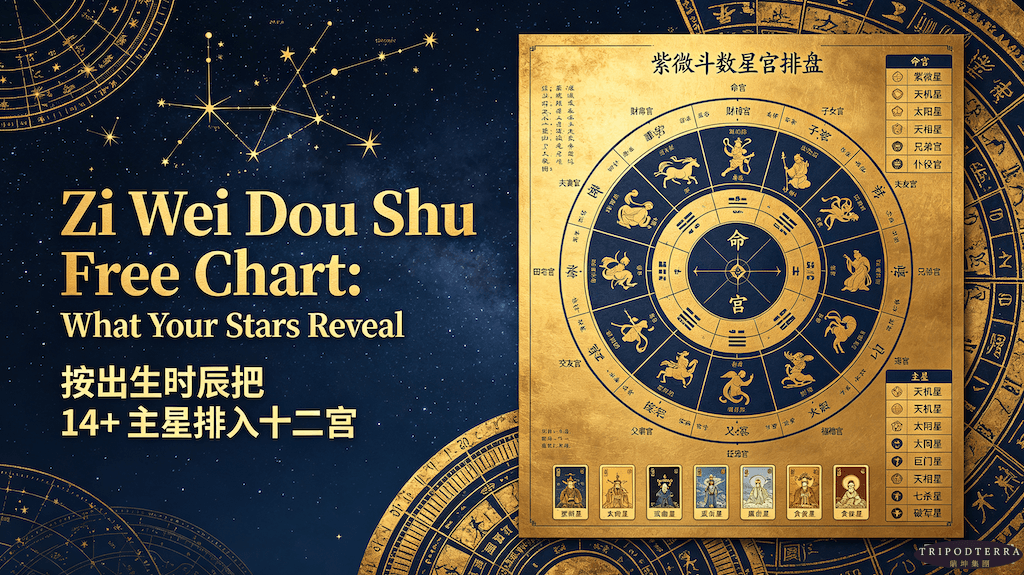
Zi Wei Dou Shu (紫微斗数, "Purple Star Astrology") is the other great Chinese charting system alongside BaZi — and for many readers, the one that feels most like Western astrology: a map of stars over your life.
1. The 12 palaces
A Zi Wei chart places stars onto a wheel of 12 palaces (宫), each governing a life domain:
- 命宫 Life — self, temperament, direction
- 兄弟 Siblings — siblings and peers
- 夫妻 Spouse — marriage and partnership
- 子女 Children — children and creative output
- 财帛 Wealth — money and income patterns
- 疾厄 Health — body and constitution
- 迁移 Travel — movement, abroad, public life
- 交友 Friends — allies, subordinates, social circle
- 官禄 Career — work and office
- 田宅 Property — home, real estate, roots
- 福德 Fortune — inner state, blessings, enjoyment
- 父母 Parents — parents and elders
2. The stars
The chart's 14 major stars (主星) include the emperor star 紫微 (Zi Wei itself), 天府 (Treasury), 天相, 太阳, 武曲, 天同, 廉贞, 太阴, 贪狼, 巨门, 天梁, 七杀, 破军, 天机. Each star has a temperament — Zi Wei is command, 天府 is vault-like stability, 贪狼 is appetite and charm, 七杀 is decisive force. Where each star falls in your 12 palaces shapes that life area's flavor; the palace of 命宫 with its resident star is read first, as your baseline self.
Combinations matter more than single stars: 紫微 + 天府 in Life is classically a "steady sovereign" pattern; 太阳 + 太阴 in Career can mean public-facing work.