Chinese Zodiac Reading: How to Read Your Sign, Element and Year
A Chinese zodiac reading is more than your animal, and most guides stop one twelfth of the way in. This one covers the full 12-sign year table from 1924 through 2031, the five elements that turn twelve animals into sixty genuinely distinct combinations, and why a Wood Dragon and a Metal Dragon are not the same reading. It explains the birth-year boundary properly — Lunar New Year versus the Start of Spring, the two rules that can assign you a different animal, and what to do if you were born in late January — plus the animal year and what the red-underwear custom is actually about, the classical six-harmony and three-harmony pairing systems, and how a real annual zodiac reading is assembled from four layers rather than a single paragraph. Ends with where the zodiac sits inside a full BaZi chart, and what free zodiac content can and cannot tell you.
4 readsOctober 11, 2026
Contents
🧑
Free BaZi Chart
Enter birth info, get your BaZi chart + Five Elements analysis
Ask someone in Shanghai what their sign is and they will not tell you a date range. They will tell you an animal — 我属龙, "I am a dragon" — and that answer will be doing a surprising amount of work in the conversation. It will shape how people guess at your temperament, who they think you should marry, which years they think will be good for you, and which ones they think you should lie low through.
That is what a Chinese zodiac reading is: a twelve-part personality and timing system that half the world has heard of and almost nobody outside East Asia has learned to read properly. This guide covers the whole thing — the year table you actually need, where the birth-year boundary falls (a question with a genuinely surprising answer), the five elements that turn twelve signs into sixty, 本命年, and how an annual zodiac reading is put together. It is a cultural framework, not a forecast, and we will come back to what that means in practice.
1. What a Chinese zodiac reading actually is
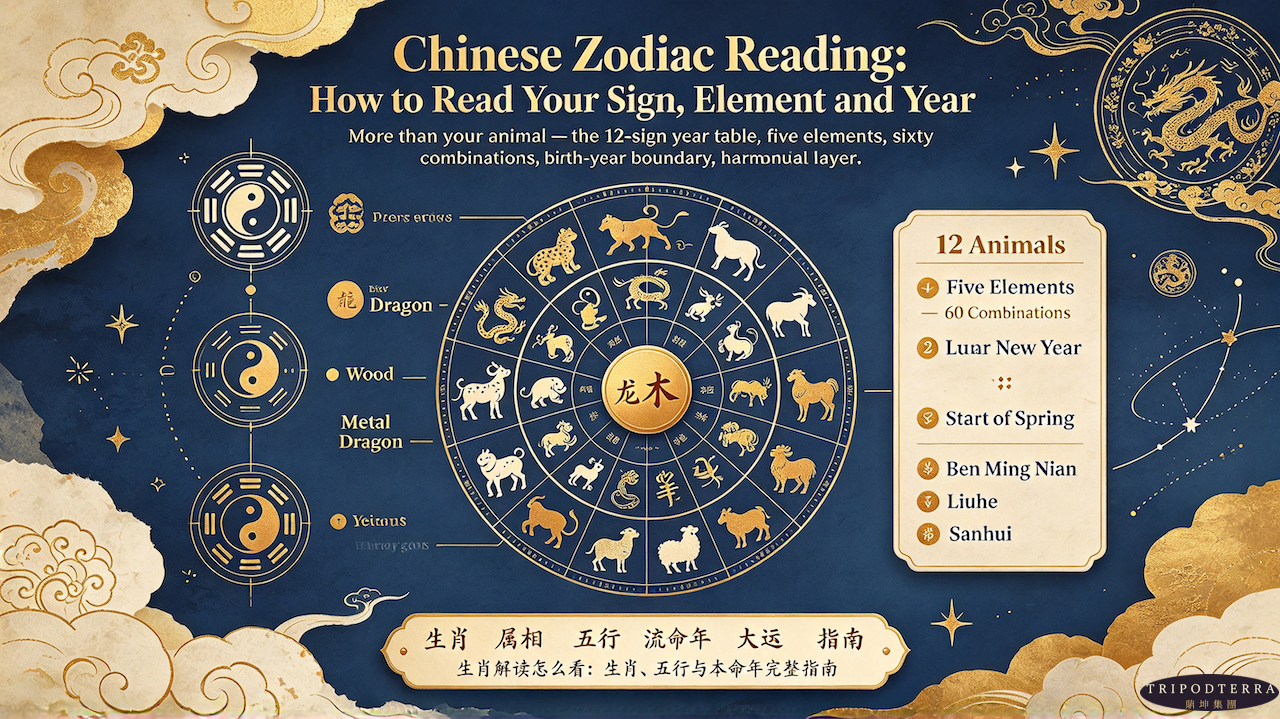
The Chinese zodiac is called 生肖 (shēng xiào) — literally "birth likeness." It assigns each birth year one of twelve animals, cycling in fixed order:
Two things about that list are worth noticing immediately.
First, the order is not random and it is not decorative — it maps to the twelve earthly branches (地支, dì zhī): 子 Rat, 丑 Ox, 寅 Tiger, 卯 Rabbit, 辰 Dragon, 巳 Snake, 午 Horse, 未 Goat, 申 Monkey, 酉 Rooster, 戌 Dog, 亥 Pig. Those branches are the same ones used in a full BaZi chart, where they combine with ten heavenly stems to produce the sixty-year cycle. The zodiac animal you know is the surface of a much deeper system.
Second, the animal is only one twelfth of the picture. Most popular "Chinese zodiac readings" stop there. A reading that stops there is about as informative as knowing someone's Western sun sign and nothing else — real, but thin.
2. The year table: which animal are you?
Here is the reference table people actually need. Find your birth year, read across.
The pattern is a clean twelve-year cycle, so you can extend the table in either direction by adding or subtracting twelve.
One caveat before you trust your row: the years above assume you were born after Chinese New Year. If your birthday falls in January or the first half of February, you may belong to the previous year's animal. That is not a small footnote — it is the single most common error in self-administered zodiac readings. The next section deals with it properly.
3. The birth-year boundary: 立春 vs Lunar New Year
This is the part where most online zodiac content quietly fudges the answer, so let us be precise, because the precise answer is genuinely interesting.
There are two different boundary rules in use:
1. The popular rule — Lunar New Year (春節). The zodiac animal changes on the first day of the first lunar month, which falls somewhere between late January and mid-February. Almost every consumer zodiac chart uses this rule, and it is what most Chinese families mean when they say which animal a person is. In 2027, for example, Chinese New Year lands on 6 February, and that is the date most sources will give for the start of the Goat year.
2. The classical rule — 立春 (Start of Spring). In the traditional 干支 calendrical system that underlies BaZi, the year changes at the solar term 立春, which falls around 4 February. Traditional almanacs and professional BaZi practice use this boundary, because the year pillar is defined by the solar year, not the lunar one.
In most years those two dates are only a few days apart — and most years they do not matter. But for a smaller number of years they are more than two weeks apart, and if you were born in that gap, the two rules give you different animals.
The honest framing, and the one we use on this site: if you are asking casually, use Lunar New Year — that is the cultural convention. If you are having a proper chart read, 立春 is the boundary that matters, because your BaZi chart's year pillar is what the reading is actually built on. They can disagree, and when they disagree, the chart is the authority for the reading.
If you were born in that January–early February window, do not guess. Enter your birth date with the exact time into a chart tool and let it resolve the boundary — it takes thirty seconds and it settles a question that a table never will.
4. The five elements: how 12 animals become 60
Here is what most zodiac articles leave out, and it is the single biggest upgrade you can make to your own reading.
Every zodiac year is not just an animal — it is an animal plus an element. The animal cycles every 12 years; the element cycles every 10 years. Because 12 and 10 share a common factor, the pairing does not repeat until 60 years have passed. That is the 六十甲子, the sixty-year cycle.
The ten-year element cycle runs through each element twice, once in its yang form and once in its yin form:
Yang Wood → Yin Wood → Yang Fire → Yin Fire → Yang Earth → Yin Earth → Yang Metal → Yin Metal → Yang Water → Yin Water
So there is no such thing as "a Dragon." There are five different Dragons: Wood Dragon, Fire Dragon, Earth Dragon, Metal Dragon, Water Dragon — and they arrive roughly sixty years apart. A 1988 Dragon and a 2000 Dragon are both Dragons, but the first is an Earth Dragon and the second a Metal Dragon, and a reading that treats them as identical has thrown away half its information.
Here is the current run, so you can place yourself:
Year
Animal
Element + polarity
Full designation
2020
Rat
Yang Metal
庚子 Metal Rat
2021
Ox
Yin Metal
辛丑 Metal Ox
2022
Tiger
Yang Water
壬寅 Water Tiger
2023
Rabbit
Yin Water
癸卯 Water Rabbit
2024
Dragon
Yang Wood
甲辰 Wood Dragon
2025
Snake
Yin Wood
乙巳 Wood Snake
2026
Horse
Yang Fire
丙午 Fire Horse
2027
Goat
Yin Fire
丁未 Fire Goat
2028
Monkey
Yang Earth
戊申 Earth Monkey
2029
Rooster
Yin Earth
己酉 Earth Rooster
2030
Dog
Yang Metal
庚戌 Metal Dog
2031
Pig
Yin Metal
辛亥 Metal Pig
This is why two people born twelve years apart can feel so different despite sharing an animal, and why "what is my Chinese zodiac element?" is a genuinely better question than "what is my animal?" The element changes the entire flavour of the sign. A Fire Horse (2026) is read as more volatile and more visible than a Water Horse; a Metal Rooster carries a sharper, more critical edge than an Earth Rooster.
The five elements are not decorative labels — they describe relationships. Each element generates one and controls another (Wood generates Fire, Fire generates Earth, Earth generates Metal, Metal generates Water, Water generates Wood; Wood controls Earth, Earth controls Water, Water controls Fire, Fire controls Metal, Metal controls Wood). When a reading says your year is "strong" or "clashing with this year," that is what is being measured. Our full guide to the five elements walks through the generating and controlling cycles in detail.
5. What each animal is traditionally read as
With the caveat that this is a twelve-part sketch and not a personality test, here is the traditional characterisation of each sign — the version you would hear from a grandmother or find in an almanac.
Animal
Archetype
Traditionally read as
Pairs well with
Tension with
Rat 鼠
The strategist
Resourceful, adaptable, quick to spot an opening; can be guarded about money and about trust
Ox, Dragon, Monkey
Horse
Ox 牛
The builder
Steady, patient, unshakeable once committed; slow to change course, sometimes inflexible
Rat, Snake, Rooster
Goat
Tiger 虎
The challenger
Bold, decisive, drawn to risk and to leadership; impatient with restraint
Horse, Dog, Pig
Monkey
Rabbit 兔
The diplomat
Gentle, tactful, conflict-averse, aesthetically minded; can avoid necessary confrontation
Goat, Pig, Dog
Rooster
Dragon 龍
The visionary
Ambitious, charismatic, self-believing; the most auspicious sign in the tradition, and the most demanding
Rat, Monkey, Rooster
Dog
Snake 蛇
The strategist's strategist
Insightful, private, deliberate; thinks several moves ahead and reveals little
Ox, Rooster, Monkey
Pig
Horse 馬
The free spirit
Energetic, independent, restless, drawn to movement and travel; dislikes being managed
Tiger, Goat, Dog
Rat
Goat 羊
The aesthete
Sensitive, creative, gentle, needs security and calm; read as the most artistic sign
Rabbit, Horse, Pig
Ox
Monkey 猴
The improviser
Clever, inventive, playful, quick with solutions; can be seen as scattered or slippery
Rat, Dragon, Snake
Tiger
Rooster 雞
The perfectionist
Meticulous, candid, hard-working, observant of detail; frankness can read as bluntness
Ox, Snake, Dragon
Rabbit
Dog 狗
The loyalist
Honest, principled, protective, dependable; can be anxious and slow to forgive betrayal
Tiger, Rabbit, Horse
Dragon
Pig 豬
The enjoyer
Generous, sincere, easygoing, fond of comfort and good company; can be too trusting
Rabbit, Goat, Tiger
Snake
The "pairs well with" column above is a compression of two classical relationship systems: the 六合 (six harmonising pairs) and the 三合 (four triangles of three signs). Our full Chinese zodiac compatibility chart sets out both systems properly, including the 六沖 clash pairs and the less-discussed 相害 and 相刑 relationships. If your interest is a specific pairing, we have a deep dive on Rooster and Dragon compatibility as a worked example of how a full comparison is actually assembled.
6. 本命年: what your animal year really means
本命年 (běn mìng nián) is the year that returns you to your own animal — every twelfth year of your life. For someone born in 1990 (Horse), that is 2026; for someone born in 1991 (Goat), it is 2027.
The tradition treats it as a year of heightened vulnerability. The mechanism is 太歲 (Tài Suì), the presiding deity of the year, and 本命年 is described as 值太歲 — "facing the year god directly." Practically, it is read as a year when things move, when plans get disrupted, and when caution is advised around major irreversible decisions.
The custom attached to it is famous: wearing red. Red underwear, a red cord, a red bracelet, given by an elder rather than bought for yourself. It is one of the most recognisable folk customs in the Chinese-speaking world and one of the most modern — the red-for-本命年 practice as it is performed today is largely a 20th-century popularisation, which is worth knowing before you treat it as ancient doctrine.
Two honest notes. First, 本命年 is not read uniformly as bad — traditional sources are clear that it can bring a significant change without that change being a loss, and many practitioners describe it as a year of movement rather than a year of misfortune. Second, the other 太歲 relationships (沖 clash, 害 harm, 刑 punishment, 破 disruption) apply to other signs in any given year, not only to your own animal — which is why a proper annual reading looks at the year's branch against your whole chart, not just your animal.
If you want to know whether a given year counts as 本命年 for you, the arithmetic is simple: subtract your birth year from the current year and check whether the result is a multiple of twelve. But remember the boundary caveat — if you were born in late January, the year your animal is assigned to may not be the year on your birth certificate.
7. How an annual zodiac reading is put together
The "chinese zodiac reading 2026" style searches are the biggest cluster in this space, so it is worth explaining what a good annual reading actually contains — because most of what ranks for those terms is a single paragraph per animal.
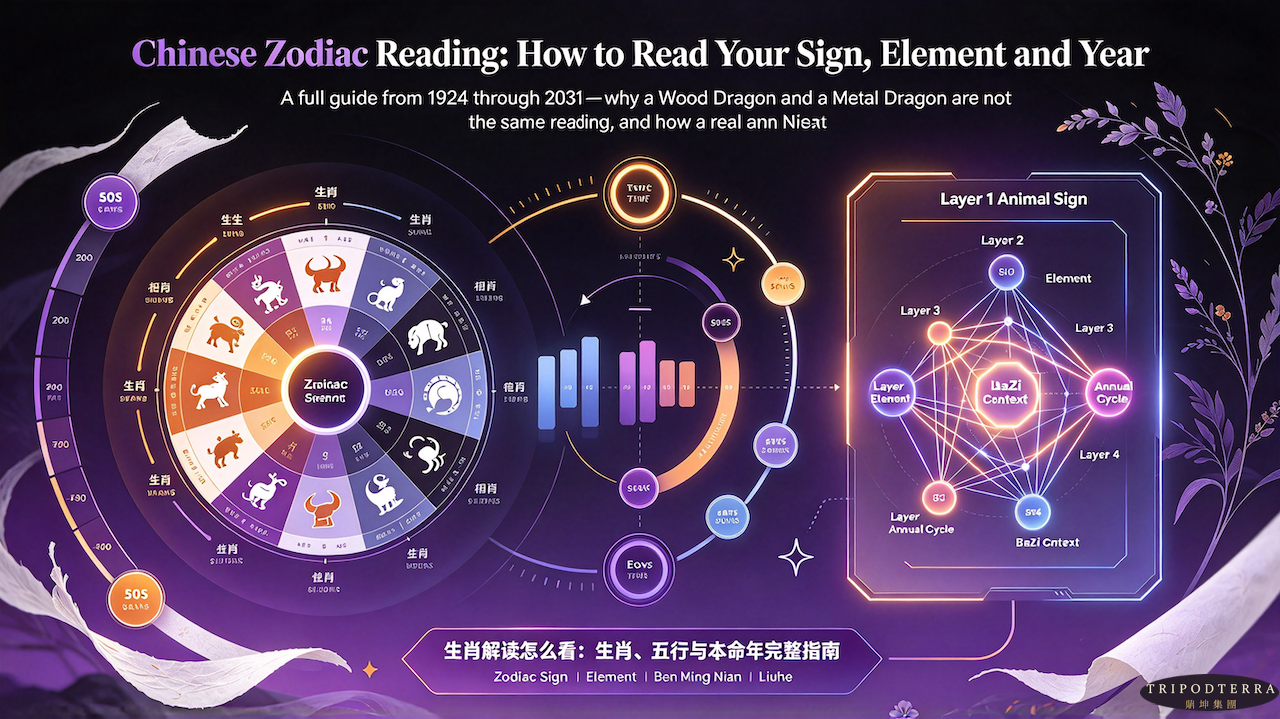
A properly assembled year reading combines four things:
1. The year's own character. 2026 is 丙午, a Yang Fire Horse year — Fire at its most expansive and least restrained. 2027 is 丁未, a Yin Fire Goat year — Fire that is warmer, softer and more domestic. The character of the year is the backdrop everything else is read against.
2. Your sign's relationship to the year's branch. Is your animal in 六合 with the year (generally harmonious), in 三合 (supportive), in 沖 (directly opposing — the strongest tension), or in 害 or 刑 (friction of a subtler kind)? For 2027, the Goat year, the Rat is in direct 沖 — traditionally read as the most turbulent placement — while the Horse, Rabbit and Pig sit in harmonising relationships.
3. The element interaction. Is the year's element feeding your chart's element, draining it, or controlling it? A Fire year reads very differently for someone whose chart is Fire-dominant than for someone whose chart is Water-dominant. This is the layer a sign-only reading cannot reach, because it requires your full chart — not just your animal — to assess.
4. Your luck cycle (大运). In BaZi, each person moves through ten-year luck cycles that modify everything above. Two people with the same animal can have completely different years because they are in different cycles. This is the layer that makes a genuine reading individual rather than generic.
Here is the part worth saying plainly: layers 1 and 2 you can read from a table. Layers 3 and 4 you cannot, because they depend on your full four pillars. That is exactly the line between a free zodiac paragraph and a real reading.
8. How far a zodiac reading can actually go
Most people who search for a zodiac reading are not really asking "what is my animal." They already know their animal. What they want is to know what it means for them — and that is where the zodiac runs out of road on its own.
The reason is structural. Your zodiac sign comes from the year pillar alone — the first of the four pillars in BaZi. There are three more:
The month pillar carries the season you were born into, and in BaZi the month is the strongest single influence on how a chart is weighted. Someone born in the first month of spring and someone born in deep winter share nothing in common, even with the same animal.
The day pillar carries the Day Master — the stem of your birth day, and in most schools the single most important element of the whole chart. This is the closest thing BaZi has to "who you are," and the zodiac cannot see it at all. Two people born in the same year, one on a 甲 day and one on a 癸 day, are being described by two fundamentally different archetypes. The zodiac tells them they are the same animal.
The hour pillar carries the branch of your birth hour, and it shapes how the rest of the chart expresses itself. It is also the pillar most likely to be wrong if true solar time was not applied.
So a zodiac reading is real information, but it is one data point out of four. It is the difference between knowing someone's nationality and knowing their name. Both are facts about them. Only one is a description.
There is a reasonable middle path, and it costs nothing. Have a proper chart drawn, then use your animal for what it is genuinely good for: the annual layer — which is exactly what the year tables and the compatibility pairings in this article describe. The zodiac reads well in the context of a year. It reads poorly in the context of a person.
If you want to test that claim, the fastest way is to see it fail. Get your free BaZi chart and compare two people born the same year but in different months. The charts will not look alike, and neither will the readings.
9. Free vs paid zodiac readings
The market splits cleanly, and knowing which side you are on saves both time and money.
Free zodiac content — the year tables, the animal descriptions, the compatibility chart, the once-a-year "your 2026 forecast" article — is genuinely useful and genuinely free. It is twelve paragraphs applied to millions of people. Take it as inspiration and as cultural grounding. Do not take it as personal.
A real reading — whether from a practitioner or a well-built AI tool — is generated from your full birth data: year, month, day and hour, with true solar time considered. It can tell you your Day Master, your element balance, which elements are favourable for you, and where you sit in your current luck cycle. It is not twelve paragraphs. It is one paragraph about you.
The price of a professional in-person BaZi consultation runs into the hundreds of dollars per session in most Western cities, which is exactly the gap that modern chart tools fill. A free BaZi chart will give you the four pillars, the Day Master and the current luck cycle at no cost; from there you can decide whether you want an interpretation. If you are new to the vocabulary, start with what your BaZi element means before going deeper.
10. Common misunderstandings
"My animal is my whole reading." It is roughly one twelfth of the branch layer, which is itself one of several layers. Real readings are built from four pillars, not one animal.
"Every Dragon is the same." There are five Dragons, sixty years apart, and they are read differently. The element matters as much as the animal.
"The zodiac year starts on 1 January." It never has. It starts at Lunar New Year or at 立春, depending on which convention you are using, and both fall in late January or February.
"I know my animal, so I know which year I was born in." The reverse is the trap, not the rule — see the boundary section above.
"本命年 is a cursed year." Tradition reads it as a year of movement and heightened caution, not a year of guaranteed misfortune. The red-underwear custom is a folk practice, not a prediction.
"Goat and Sheep are different signs." They are the same sign. 羊 covers goat, sheep and ram, and different translations simply chose differently. The same is true of Pig/Boar.
"The zodiac can tell me who to marry." It can describe a traditional framework for compatibility. It cannot tell you whether a specific person will treat you well, and it should never be used that way.
11. Where the zodiac sits inside BaZi
The cleanest way to hold all of this: the zodiac is the visible surface of the BaZi system, not a separate tradition.
Your zodiac animal is your birth year's earthly branch. Your BaZi chart takes that branch and sets it beside three more — the month, day and hour — along with four heavenly stems, producing eight characters that interact in ways a single animal never can. The zodiac gives you one word. BaZi gives you the grammar.
That is why the animal is a good entry point and a poor destination. Start with it, because everyone does and because it is genuinely charming. Then let the chart tell you what the animal could not.
12. Read your own sign properly
Here is the short version. Find your animal in the year table — but if you were born in January or early February, resolve the boundary before you trust it. Then find your element, because a Wood Dragon and a Metal Dragon are not the same reading. Check whether the coming year is your 本命年, and understand it as a year of movement rather than doom. And treat the whole thing as what it is: a twelve-part cultural lens with a sixty-part grammar underneath it, and a genuinely enjoyable way to think about temperament and timing.
Generate your free BaZi chart to see your animal alongside your element balance, your Day Master and your current ten-year luck cycle — the layers a sign alone can never reach. And if you want to talk through what any of it means for a specific question, ask the AI reading, which works from your full chart rather than a single animal.
Chinese Zodiac Reading: Sign, Element & Year — TripodTerra