
1. What Is My Chinese Zodiac Sign? A Simple Way to Find Out
If you have ever typed "what is my chinese zodiac sign" into a search bar, you are not alone. The Chinese zodiac, known as Shengxiao (生肖), is one of the most recognizable parts of Chinese metaphysics — twelve animals arranged in a repeating twelve-year cycle, each carrying its own personality, reputation, and folk wisdom.
Finding your sign is usually quick, but there is one detail that trips up a surprising number of people: the year does not start on January 1. In this guide you will learn how the cycle works, how to calculate your animal correctly, and what your sign traditionally represents.
2. The Twelve Animals and Their Order
The Chinese zodiac follows a fixed sequence, and the animal assigned to a year repeats every twelve years:
- Rat (鼠)
- Ox (牛)
- Tiger (虎)
- Rabbit (兔)
- Dragon (龙)
- Snake (蛇)
- Horse (马)
- Goat (羊)
- Monkey (猴)
- Rooster (鸡)
- Dog (狗)
- Pig (猪)
Each animal is also linked to one of the five elements — Wood, Fire, Earth, Metal, Water — which rotates on its own cycle. That combination is why you will hear people described not just as a "Dragon" but as a "Wood Dragon" or "Fire Horse." If the element layer interests you, our introduction to the five elements explains how they interact.
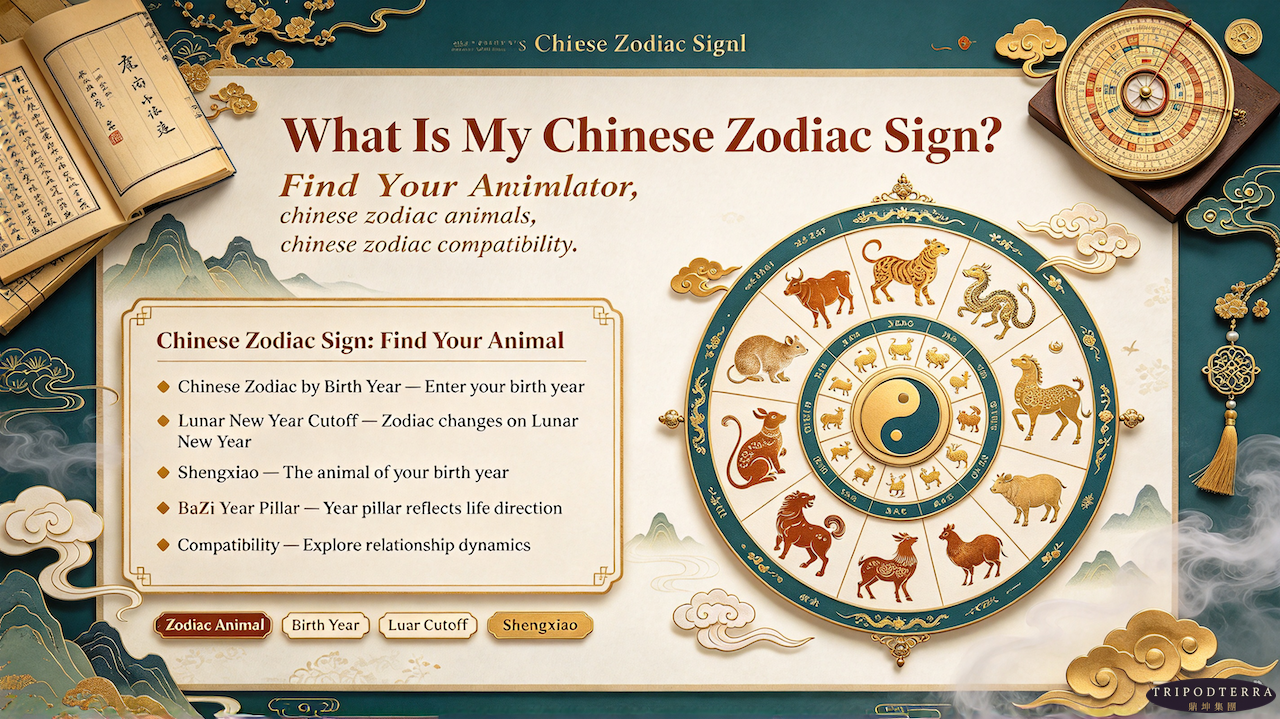
3. The Most Common Mistake: The Lunar New Year Cutoff
Here is the rule that matters most. Your Chinese zodiac sign is determined by the Chinese lunar year in which you were born, and that year typically begins somewhere between late January and mid-February — the date of Chinese New Year.
So if you were born in January or early February, you may belong to the animal of the previous year, not the one printed on a quick-lookup chart.
3.1. A worked example
Suppose you were born on January 20, 2000. Many online charts would label you a Dragon, because 2000 is a Dragon year. But Chinese New Year in 2000 fell on February 5. Born on January 20, you were still inside the previous lunar year — the Year of the Rabbit. Your sign is Rabbit.
3.2. A second layer of precision
Traditional practitioners go one step further. BaZi (Four Pillars) astrology does not use the lunar calendar at all for the year pillar — it uses the solar terms, with the year beginning at Lichun (立春), usually around February 4. The difference between the lunar new year and Lichun is only a matter of days, but for anyone born in that narrow window it can change the reading. Our guide to true solar time covers the related question of adjusting birth time to local sun position.
3.3. Quick self-check
- Born well after mid-February? Use your birth year directly.
- Born in January or the first week of February? Check the exact Chinese New Year date for that year before deciding.
- Born within a few days of the new year? Verify against Lichun as well, or consult a practitioner.
4. How to Calculate Your Sign Without a Chart
The arithmetic is simple once you know the anchor. The Year of the Rat recurs in years such as 1984, 1996, 2008, and 2020. From any of those, count forward through the twelve animals.
Alternatively, use the remainder method:
- Take your birth year (adjusting for the new year cutoff first).
- Subtract 4, then divide by 12.
- The remainder maps to an animal: 0 = Rat, 1 = Ox, 2 = Tiger, 3 = Rabbit, 4 = Dragon, 5 = Snake, 6 = Horse, 7 = Goat, 8 = Monkey, 9 = Rooster, 10 = Dog, 11 = Pig.
For a worked example: 1990 − 4 = 1986; 1986 ÷ 12 = 165 remainder 6; remainder 6 = Horse. And indeed 1990 was a Horse year.
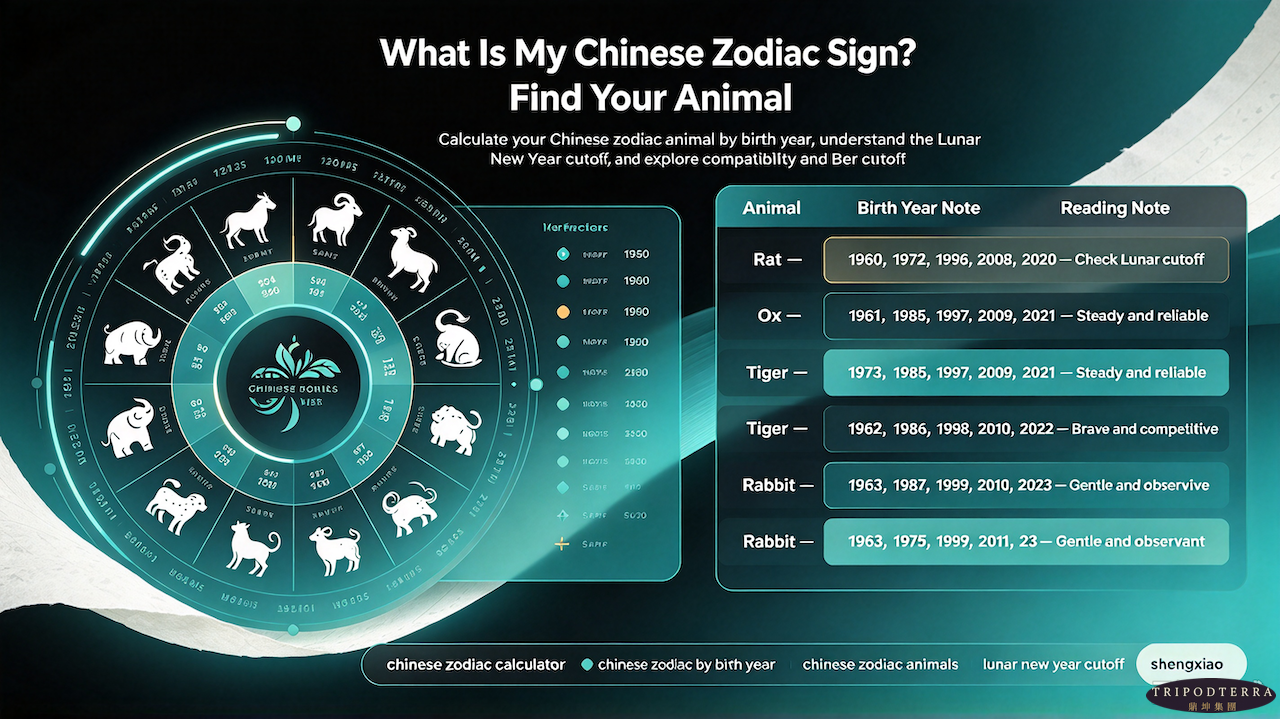
5. What Your Animal Traditionally Represents
Chinese zodiac profiles are folk characterizations, not verdicts. Read them as cultural shorthand — a starting point for reflection rather than a fixed label.
5.1. The quick-reference table
- Rat — resourceful, observant, quick to spot opportunity
- Ox — steady, patient, dependable under pressure
- Tiger — bold, competitive, drawn to challenge
- Rabbit — gentle, diplomatic, values harmony
- Dragon — confident, ambitious, charismatic
- Snake — intuitive, private, strategic
- Horse — energetic, independent, restless
- Goat — artistic, empathetic, sensitive
- Monkey — clever, adaptable, playful
- Rooster — precise, hardworking, outspoken
- Dog — loyal, principled, protective
- Pig — generous, sincere, easygoing
5.2. Compatibility and the "inner animal"
The zodiac is also used to discuss compatibility. Traditional pairings favor certain combinations — Rat with Ox, Tiger with Pig, Rabbit with Goat, and so on — while marking others as more friction-prone. Treat these as conversation starters about temperament differences, not as relationship rules.
Some traditions also assign an "inner animal" based on your birth hour, giving you a second sign that adds nuance. That is essentially a simplified doorway into BaZi, where the hour pillar carries real weight. If you want the fuller picture, our BaZi introduction walks through all four pillars, and a professional BaZi reading can map your chart properly.
6. Zodiac Sign vs. Western Sun Sign
The two systems answer different questions. Your Western sun sign comes from the position of the sun against the constellations in a given month. Your Chinese zodiac animal comes from the year of birth in a lunisolar calendar. They are not translations of each other, and one is not more "accurate" — they are simply different lenses.
Many people find it useful to hold both: the Western sign for broad seasonal archetypes, the Chinese animal for year-based temperament and the wider framework of elements and cycles.
7. Where the Zodiac Fits in a Bigger Reading
A single animal sign is the entry level of Chinese metaphysics. Behind it sit the five elements, the ten heavenly stems and twelve earthly branches, and the full BaZi chart. Zi Wei Dou Shu, a separate system, maps a different set of "palaces" entirely. If you are curious how these frameworks differ, our overview of Zi Wei Dou Shu is a good next step.
For year-specific material — festival dates, annual forecasts, and animal-of-the-year notes — see our pages on Chinese New Year 2027 and the 2027 zodiac year.
8. Frequently Asked Questions
8.1. Does my Chinese zodiac sign change every year?
No. Your sign is fixed at birth and stays with you for life. What changes each year is the animal governing the year itself, which is what annual forecasts discuss.
8.2. I was born in January — which sign am I?
Most likely the animal of the previous year. Confirm the Chinese New Year date for your birth year before deciding.
8.3. Can two people born in the same year have different signs?
Only in the narrow window around the new year, where one birth falls before the cutoff and one after.
8.4. Is the Chinese zodiac the same as Feng Shui?
They overlap in shared vocabulary — elements, directions, cycles — but they are distinct practices. Feng Shui concerns the arrangement of space; the zodiac concerns time cycles and personal charts.
9. A Final Note
Chinese zodiac profiles are cultural and educational material. They are a lens for self-reflection and conversation, not a prediction of your future, your health, or your finances. Content is for reference only.
If you want to go beyond the animal and see how year, month, day, and hour interact in your own chart, start with the BaZi basics and build from there.