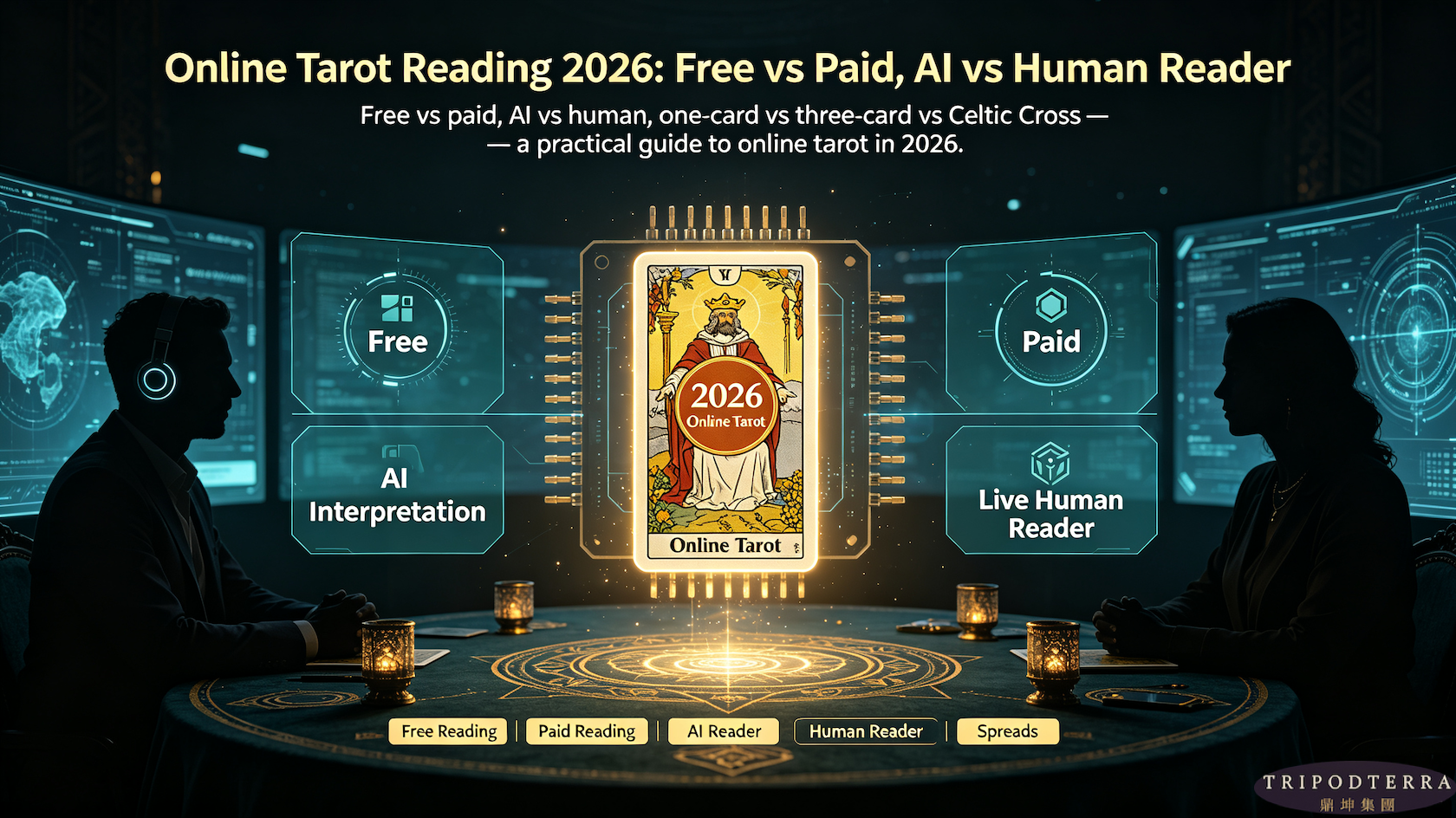
Online Tarot Reading 2026: Free vs Paid, AI vs Human Reader
An online tarot reading is a structured way to think about one question, not a verdict about your life. This guide compares free and paid readings, AI interpretation and live human readers, and the five business models hiding behind the word "free," so you know ten seconds in whether a site is genuinely free or a paywall in disguise. It walks through the one-card, three-card, and Celtic Cross spreads and when each one fits, shows how to phrase a question so the answer carries real information, and covers the honest limits — what tarot does well, what neither an AI nor a human reader can promise, how the one-card yes or no method differs from the two-option three-card layout, and how to pick a format by what you actually want out of the session rather than by which one claims to be most accurate.
14 readsSeptember 19, 2026
🧑
Free BaZi Chart
Enter birth info, get your BaZi chart + Five Elements analysis
There are thousands of pages offering an online tarot reading, and almost none of them answer the question you actually have, which is not "what does the Ten of Cups mean" but "which of these is worth my time, and what should I expect from it."
That question has a real answer. Online tarot divides into a small number of categories, each with genuinely different strengths and honest limitations. A free AI reading and a ninety-dollar session with a live reader are not the same product at different prices; they do different jobs. This guide walks through every format, the spreads that matter, how to phrase a question so that the answer carries information, and how to spot the paywall hiding behind the word "free."
Share
Daily Fortune Newsletter
One daily BaZi reading, straight to your inbox. Free, unsubscribe anytime.
One framing note before anything else, because it governs how to read every section below. Tarot is a mirror for reflection and a structured prompt for thinking. It is not a verdict, it is not a forecast of fixed events, and it is not a substitute for a doctor, a lawyer, or a financial adviser. Readers on this site write about tarot in the same register we use for BaZi and the I Ching: traditional tendency, read as a tool for self-reflection, never as a promise about what will happen.
What an online tarot reading actually is
Strip away the artwork and a tarot reading is a short, bounded exercise in structured thinking. You take one question you have been circling, you draw a small number of cards, and you read their traditional meanings against the specific situation you described.
An online reading is that same exercise, delivered one of four ways:
A free web tool that deals a random card or spread and shows you a prewritten interpretation. Instant, private, costs nothing, and gives the same text to everyone who draws that card.
An AI reading that draws cards and then generates an interpretation of that specific combination, in context, with your question in front of it. The reinterpretation is the entire product — the cards are the same 78 either way.
An app that combines a deck, a journal, and a daily pull, usually with a limited free tier and a subscription behind it.
A live human reader on a per-minute or per-session basis, who can adjust the spread mid-reading, notice what you hesitate over, and ask a follow-up question.
The one thing all four share: the deck does not change, the traditional meanings do not change, and the value of the reading comes from how well the interpretation is applied to your actual situation.
Free versus paid: what you are actually buying
The single most useful thing to understand about free online tarot readings is that "free" describes five completely different business models, and the experience differs enormously between them.
Free model
What it looks like
What you get
The catch
No-signup trial
Full spread and full interpretation, no account
A complete one-off reading
One reading only; the second requires payment
Signup credits
A few free credits when you register
Several readings
Credits run out; then it is packs or a subscription
Ad-supported
Unlimited generic card meanings
Volume, not depth
You pay in ads and in the data you hand over
Per-minute live
First few minutes free with a new reader
A real conversation
Free minutes are short, then the meter runs
First reading free, then subscription
One spread, sometimes abbreviated
A taste
Automatic renewal — this is the one to watch
The practical test is simple, and it takes about ten seconds. Before you start, find the answer to two questions: where does the free part end, and does the site ask for a card number before showing me anything. A blurred or truncated interpretation is a preview, not a free reading. A card number requested before the reading begins usually means an auto-renewing subscription, and the cancellation terms are usually on a page you have not opened yet.
None of that makes paid readings bad. It makes them paid. The failure mode is not paying; it is not knowing which model you walked into.
What free genuinely does well. For learning, a free reading is unmatched. Daily pulls teach you the deck faster than any course, because you meet the same card in different weeks and notice it reads differently depending on what you brought to it. Free is also the right answer for low-stakes questions, for practice spreads, and for the ninety percent of readings that are really just you thinking out loud with structure.
What payment genuinely buys. Three things, in order of importance. First, depth of synthesis — not a card-by-card dictionary entry but a reading of how the cards argue with each other, which is where most of the information in a spread lives. Second, context retention — a reader, human or AI, that remembers what you asked last month can say something no one-shot reading can. Third, interaction — the ability to say "that does not feel right, look at it again," which is a real and useful part of a live session.
What payment does not buy is accuracy in any measurable sense. A forty-dollar reading is not more likely to be correct than a free one. It is more likely to be specific, personalised, and better at holding several threads at once. That is a real difference and it is worth money to some people. It is not a difference in predictive power, and any reader who claims otherwise is selling something other than tarot.
AI versus human: the honest comparison
This is the question the industry argues about, and most of the arguing is not useful because it is framed as a competition. It is not one. The two do different things.
AI tarot reading
Live human reader
Availability
Instant, 24/7, no queue
Booking, queue, or per-minute wait
Cost
Free tier or a few dollars a month
Per minute on live platforms; independent readers set their own rates, and published figures span from around $30 to well over $250 a session
Consistency
Identical quality at 3am and 3pm
Varies enormously by reader
Memory
Remembers your history if the product is built for it
Remembers if you are a returning client
Synthesis across a spread
Strong — can hold all ten Celtic Cross positions at once
Strong, and can weigh tone and hesitation too
Tone and pacing
Even, sometimes generic
Can be extraordinary, can be terrible
Adapts mid-reading
Only if you tell it to
Yes — can change spread, ask follow-ups
Judgment calls
No interpersonal read of you
Notices what you avoid saying
Privacy
Depends entirely on the operator
Depends entirely on the reader
Where AI is genuinely better. Consistency and patience. An AI will read your tenth spread with the same care as your first, will not get bored, will not push you toward an upsell, and will not read your mood in a way that colours the answer. It is also better at the unglamorous mechanical work: holding all ten positions of a large spread in view simultaneously, tracking which cards repeat, and noticing when the same card has shown up in three consecutive readings. For a daily practice, and for anyone who wants to think a question through at length without a meter running, that is a real advantage.
Where a human is genuinely better. A good reader hears what you did not say. They notice that you asked about your career and then spent two minutes on your relationship. They can tell that a card you brushed past is the one that matters, and they can ask about it. That is an interpersonal skill and no model has it. If what you want is to be seen and questioned by another person, a human reader is the answer and no amount of AI quality substitutes for it.
The thing neither does. Neither predicts the future in any testable way, and neither should be treated as a decision-making authority. The useful frame is that both are conversation partners for thinking, with different conversational strengths.
The spreads, and when to use each
Spreads are not interchangeable. The size of the spread should match the size of the question; asking a ninety-card question about whether to text someone back is how people end up confused by tarot.
One card — the daily pull
The most underrated reading in tarot. One card, one question, no spread to interpret. It is excellent for a daily practice, where its value is cumulative rather than individual: thirty cards in a month teach you the deck in a way thirty readings never do.
Do not read a single card as a verdict. Read it as a question. Pull Death on a Tuesday and the useful move is not "something ends" but "what in my day does this point at?" Most single cards become far more intelligent when treated as prompts.
Three cards — the workhorse
Three-card spreads account for roughly a third of all readings in published platform data, and the number stays that high because three is the smallest number that gives you a shape. The classic layouts:
Past — Present — Future. The most common and the most misused. The future position is not a prediction; it is where the current trajectory points if nothing changes, which is a different and more useful claim.
Situation — Action — Outlook. Preferred by most experienced readers for decision questions, because the middle position gives you something to do instead of something to wait for.
You — Them — The Between. For relationship questions, and notably better than the past-present-future layout for that purpose, because it forces the reading to account for two separate people rather than one timeline.
Option A — Option B — What tips the balance. For binary choices. This is the spread that answers most "yes or no" questions properly, and it is a far better tool than a single card for that purpose — see our full guide to the yes or no tarot method for how the one-card and three-card versions differ.
Celtic Cross — ten cards
The famous one, and the spread most likely to be attempted too early. Ten cards, each with a defined position: the present situation, the crossing influence, the goal or crowning outcome, the foundation beneath the matter, the recent past, the near future, your own attitude, the surrounding environment, your hopes and fears, and the final outcome.
Two honest notes. First, the position names vary between traditions — different sources swap the order of the past and foundation positions, and some modern versions relabel several of them. That is fine; what matters is that the spread consistently covers present situation, past, future, self, environment, hopes and fears, and outcome. Second, the Celtic Cross produces the most interpretation-heavy output of any standard spread, which makes it the best possible use case for AI reading and a genuinely difficult spread to self-read cold. Ten positions held at once is exactly the task a language model is good at and a tired human on a Tuesday night is not. If you want a worked example of how a large spread gets synthesised rather than enumerated, that is what our AI tarot reading is built to do.
Covers self, environment, timing, and outcome together
Something you have asked ten times
Stop, or ask a different question
Repetition produces noise, not clarity
How to ask a question that gives you an answer
Most disappointing readings are disappointing because of the question, not the cards. Five rules do most of the work.
1. Ask about one thing. "Will my relationship improve and should I take the job and what about my health" is three readings wearing one coat. Split it.
2. Ask an open question, not a yes/no, unless you want a yes/no. "Should I stay in this job" forces the deck into a binary it is not built for. "What do I need to see about this job" opens it up. If you do want a binary, use a spread designed for it rather than fighting the format.
3. Ask about what you control. "Will they come back" hands the reading to someone else's agency and produces a reading about which you can do nothing. "What is my part in this, and what should I do next" puts the agency back where you can use it.
4. Give the reading enough context to be specific. A one-line question gets a one-line answer, which is the single biggest reason free readings feel generic. Say what the actual situation is — the cards do not need protecting from detail.
5. Do not re-ask the same question when you do not like the answer. This is the most common self-sabotage in tarot. The deck is not a slot machine; drawing until you get the Sun produces a reading of your anxiety, not of your situation. If you get an answer you dislike, the useful follow-up is "what am I not seeing," which is a genuinely different question.
Which format is right for you
A short decision guide, by what you are actually trying to do.
You are learning the cards. Free. Daily one-card pulls, and read about the card afterwards. Cross-reference against the full tarot card meanings list rather than relying on the site's own short blurb, because learning from one source's paraphrase teaches you that source, not the deck.
You want a daily practice. An app or a daily-pull tool with a journal. The habit matters far more than the interpretation on any given day, and the journal is what converts thirty pulls into actual fluency.
You have a real decision to think through. A structured reading with a three-card spread, and then — this is the part people skip — write down your own answer before you read the cards. The gap between what you wrote and what you read is the entire value of the exercise.
You want depth on something complicated. Either a large spread with an AI interpretation that can hold all the positions, or a trained human reader. Both are legitimate; pick based on whether you want synthesis or conversation.
You want to be seen and questioned. A live reader. Nothing else does this, and no amount of AI capability replaces it.
You want a fast yes or no. A one-card reading with a tightly framed question. Ninety seconds, and genuinely useful if you use it as a decision prompt rather than a command.
How to spot a bad online reading site
Five checks, all of them quick.
A "100 percent accurate" claim. No honest reader or platform says this. It is the single clearest signal that the site is selling certainty it cannot deliver.
A card number requested before the reading. Usually an auto-renewing subscription. Read the cancellation terms before you enter anything.
The interpretation is identical whoever asks. Draw the same card twice with two very different questions. If the text does not change, the site is a card dictionary with a shuffle animation, which is fine — as long as it is priced as one.
Fear-based upsells. "This reading shows danger — unlock the full result." A reading that manufactures alarm in order to sell the remedy is not a reading service.
No named operator and no stated data policy. You are typing personal questions into a website. The check is the same one you would apply to any service handling sensitive text — and it is worth doing, because the wider wellness-app category has a documented record here. Mozilla's Privacy Not Included review of 32 mental health and prayer apps found that 25 of them failed its minimum security standards and that the majority shared or sold users' most personal disclosures to third parties. That study did not cover tarot apps specifically, and tarot sites are not named in it. The pattern it describes is nonetheless the reason to read the privacy policy of any tool you are about to hand your relationship problems to.
Where TripodTerra sits in this — full disclosure
This is our platform, so read the following with that in mind, and weigh it accordingly.
TripodTerra's AI tarot reading is an AI reading in the category described above, and it is honest about what that means. You bring a question; it draws a three-card spread, reads it in context against what you have told it, and can hold the conversation across sessions rather than resetting each time. Where it differs from a generic AI tarot tool is that it is part of a wider metaphysics platform: the same chat also runs BaZi, Zi Wei, I Ching, palmistry, and thirteen other services, and the tarot reading is informed by your birth chart rather than standing alone. That cross-system grounding is the actual product argument, and it is also the thing to be sceptical about until you have tried it.
What it is not: a human reader, and it does not claim the abilities a human reader brings. It will not notice that you changed the subject. It has a free tier and a paid subscription, like most of the tools on this page, and the free tier is genuinely usable rather than a preview.
If what you want is a person, hire a person — a live reader on a per-minute platform is the right answer, and the earlier comparison section is written to help you pick one rather than to steer you away from them.
Common mistakes people make with online readings
Treating the reading as the decision. The reading is an input. You are still the one deciding, and the whole point of the exercise is that it makes you articulate what you already think.
Asking the same question repeatedly. Covered above, and worth repeating because it is the single most common pattern. Re-asking is not checking; it is anxiety with a card deck.
Reading the cards instead of the spread. A card in isolation is a dictionary entry. The information is in the relationship between the cards and the position each sits in. This is exactly why a full meanings list is a starting point and not a method.
Ignoring the boring cards. People post the Tower and the Death card to forums. The Three of Pentacles is where most actual answers live — incremental work, collaboration, getting on with it — and it is the card most often skimmed past.
Reading for other people without their involvement. "What does he think of me" is a question tarot handles badly, because the spread describes the person drawing it. Reading someone else's mind is not what the tool does.
Paying for something you did not want to pay for. Re-read the free model table above before you click. Ten seconds of checking prevents most of the bad experiences people report with online readings.
Expecting the reading to be right rather than useful. The right frame is not "is this true" but "does this give me a clearer way to think about the situation." On that test, a free daily pull often outperforms an expensive session, because you did the thinking yourself.
Frequently asked questions
Are free online tarot readings worth anything?
Yes, for learning and for daily practice, and for any question where you mostly need to think it through. They are worth less for anything requiring synthesis across a large spread or sustained context, which is where paid tools and live readers earn their price.
Is an AI tarot reading as good as a human reader?
It is better at some things and worse at others. AI is more consistent, available instantly, cheaper, and better at holding a large spread in view. A human notices what you avoid saying and can adapt the reading as it goes. Choose by what you want out of the session, not by which one is "more accurate" — neither is measurably accurate in a predictive sense.
What is the best spread for a yes or no question?
A single card with a tightly framed question, or the two-option three-card layout. The full method, including which cards traditionally lean yes and no, is in our yes or no tarot guide. What matters more than the spread is the phrasing: a binary question gets the most out of a binary format.
How many cards should I draw?
As few as will answer the question. One for a daily pull, three for most decisions, ten only when the situation genuinely has many moving parts. Drawing more cards does not produce more information; it produces more interpretation, which is a different thing and usually a worse one.
Can an online reading tell me the future?
No, and any site that says it can is telling you what it is. Online readings are structured reflection. The "future" position in a spread reads as where the current trajectory points, which is useful and is not a prediction of events.
Do I need a course to learn tarot?
No. A deck, a meanings reference, and a daily pull will teach you the structure within a few months. Courses are useful for people who want a guided curriculum and a community, and they are usually priced accordingly. Start with the free practice and buy the course only if you hit a wall.
Is online tarot private?
It depends entirely on the operator. A reading you type into a website is data held by that website. Check the privacy policy, and treat anything you would not want indexed as something not to type.
What should I do if a reading upsets me?
Close it and do something physical. A reading that produces fear rather than reflection has not told you anything about your future; it has told you something about your current state. If a site is manufacturing that fear in order to sell you an unlock, leave and do not pay.
Where to start tonight
The short version: pick the spread before you pick the platform. One card for a daily pull, three for a real decision, ten only for something genuinely complicated. Ask about one thing you control, and phrase it as an open question unless you specifically want a binary. Then decide what you actually want — free practice, depth of synthesis, or a conversation with a person — because those are three different products and the market prices them very differently.
If you want to start with a structured reading and see how a three-card spread reads when the cards are actually interpreted against your situation rather than matched to a dictionary, try the AI tarot reading free. If you have a specific decision and want the yes/no method properly explained first, read the yes or no tarot guide and then bring the question across. And if you would rather compare tools before choosing one, the best tarot apps of 2026 comparison covers learning apps, daily-pull apps, AI readers, and live-reader platforms side by side.
Online Tarot Reading: Free vs Paid & AI vs Human — TripodTerra
 TRIPODTERRA